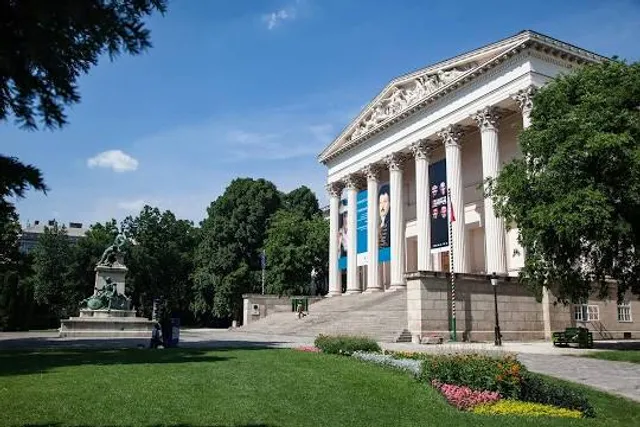
I went to this museum with my mom while visiting Budapest, hoping to learn more about Hungarian history. What we found at this museum was something that deeply impacted both of us in a very negative way. I can sum it up with the two points: major user unfriendliness and vagueness of museum information, and near complete erasure of major historical facts about Hungary. I will tell you more about each part below.
Firstly, this museum’s lack of user friendliness is kind of wild. The English placards for the ENTIRE MUSEUM are mounted about 2 feet off the ground (0.6 meters). If you are a dog, this placement would be perfect, but as a human, it forces you to either bend way over or crouch on the ground to read anything. There were folded chairs provided at the entrance and at first I didn’t take one, but I ended up doing so to make it easier on me physically. There was no reason they needed to be posted this low- it kinda felt like they just wanted to make you suffer. Additionally, a lot of the English placards were missing for certain artifacts, or were just extremely vague and didn’t say anything about the piece. What year was it made? What is it made of? Why is it important?
Secondly, it should be known that this museum is more of a collection of objects than it is actually a full history of the nation of Hungary. I say this because nearly every single section was dominated by dry information about the ruling class/nobles and then whoever was invading at the time, with a side of commerce/industry. Having gone through the entire second floor, which covers 900 AD to the present, I don’t recall seeing anything about how Hungarian people actually lived. A nation’s history isn’t just about who was in power, what the rich people were doing, and what tribe took over. It’s also about the culture, the human experience, the way the peasants and city dwellers lived. The lack of humanness was noted even before we got to the WWII section, which was the most difficult part of our experience.
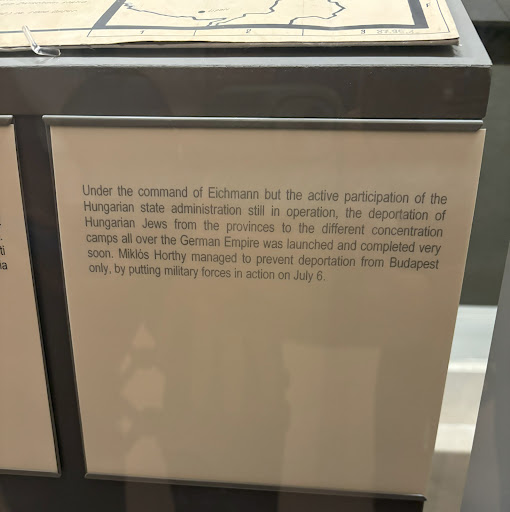
This museum has a million square meters devoted to objects related to nobility and dry facts about dates and kings, but the section that should have covered the fact that roughly 600,000 Hungarian Jews were sent to their deaths in Auschwitz? That got maybe 1 meter of space and two extremely vague placards, which I am including photos of below. Numerous historical sources and our walking tour in Budapest confirmed that the Hungarian militia collaborated with the Nazis to round up roughly 600,000 Hungarian Jews and send them to their deaths in concentration camps. These Hungarian citizens made up roughly 4% of the entire population at the time, and yet this fact is never mentioned in this museum. If 4% of your own citizens can be abducted and sent to their deaths with the help of your military and you won’t even say it in your national museum, then what other facts about your history are you leaving out? Is this fact also left out of textbooks in Hungarian schools, leaving a ripe environment for Holocaust denial? I am not Jewish and these were not my family members who died, but I was both dismayed and infuriated by the outright erasure in this section of the museum.
I don’t think I will ever forget how this made us feel. The fact that the current government put up a “Memorial for the Victims of German Occupation” in 2014, which represents Hungary as a victim as opposed to a willing participant in the Nazi cause, adds to the feeling that there is a coordinated effort by the state to deny its role in the holocaust. There is an entire counter-memorial around this structure, where people have hung photos, stories, articles, etc, trying to tell the TRUTH about what the Hungarian military did to their family members. It appears that Hungary is still unwilling to discuss or own up to their part in it, which is very scary in our current political climate. Coming from the US, which has its own issues with truth-telling about the things it has done in the past, I will never forget this. It will shade how I interpret every museum I see...
Read moreWe visited the National Hungarian Museum a Saturday morning in January. We purchased the ticket there, which costs 3,500 ft (almost 9 euros) for each person. The museum was pretty big, and it was very well organized. In the last floor (from where we started), each space had an information sign about the period that you are going to observe in the room that follows, which was very helpful. There were also many replicas of real items that were available for you to touch, so that you could feel how coins or crowns felt. The upper floor referred to the most recent period and as we were going down, we were seeing exhibits from earlier periods of time, leading to the “minus” floor. The entrance for that will be found if you follow the signs towards the Roman Lapidary, where you can see extremely old exhibits. We really liked the way you could start from the top and travel to the oldest periods, or vice versa, it gave us a sense of great coherence. The only thing that we didn’t like at all was this. Next to the cloakroom there was another door. When we entered and showed our tickets, the woman was talking to us in Hungarian and not letting us in. We were saying that we do not speak Hungarian and if she could please speak in English and tell us why we can’t go inside (one other employee had just ripped our tickets so we thought that maybe she couldn’t see that it was a today’s ticket), but she kept on talking in Hungarian. We left and asked another employee who informed us that this is a temporary exhibition which was not included in our ticket. This experience would have been way better if we had been asked by the cashier if we wanted to see the whole museum, as we asked for “full adult tickets” and though they would include everything. So, if you want to see the whole museum, you need to tell the cashier yourself. Also, the experience would be way better if the employee could speak in English, as it is a position that requires some communication with people who do not know Hungarian, so speaking a common language in a National Museum entrance could facilitate their explaining about the exhibitions and not make her seem “not friendly” and rude. The museum was very nice, yet I cannot evaluate it with 5/5, because I think the absence of English is...
Read moreHuge place, if you are interested in history and not just prancing around it will take you a minimum of four hours to explore it all (took me six and towards the end I was trying to move as fast as I could).
The museum is laid out on three floors, the lower floor hosting a lapidarium with tombstones dating from the centuries of Roman occupation of Pannonia as well as a treasure trove of coins and jewelry from all over Hungary.
The ground floor hosts an archaeology museum presenting the history of Hungary since the paleolithic to the establishment of Hungary as a polity of Europe in the 10th century. Also on this floor there is an exhibition of a treasure trove (Seuso) which was the absolute highlight of the whole museum for me. There is also a library and a ceramics museum that could easily fill three medium museums if properly curated.
The upper floor presents the history of Hungary from its' establishment as a state to the end of communism, the highlight here was the room on the 18th century.
Overall, it's a big place with a tonne of artifacts, the price for all was 6000 HUF because I paid extra 1000 to be able to take photos. This extra charge is well worth it, I took about 700 pictures although more than half are bad because of poor lighting.
Which leads me to the negatives: as others have stated the museum is a bit chaotic... It really could improve by giving you at least a map if proper signs would seem as too burdening
the invigilators will not be able to help you, they don't speak anytime but Magyar, good people even though a bit eager to "impose the rules", you are very much on your own here, not even at the reception desk did I find much support, all the staff are despondent
the lighting is very poor in two thirds of the exhibition, in many places it's impossible to take pictures and even to read the text and get a good look at the exhibits, some of the text is white on glass, no clue why anyone thought that a good idea
there is a lot of bias and factual inaccuracies in some of the modern history rooms BUT less than I had expected
Overall, I spent here six hours and soaked up a lot of history but this museum can find vast room...
Read more