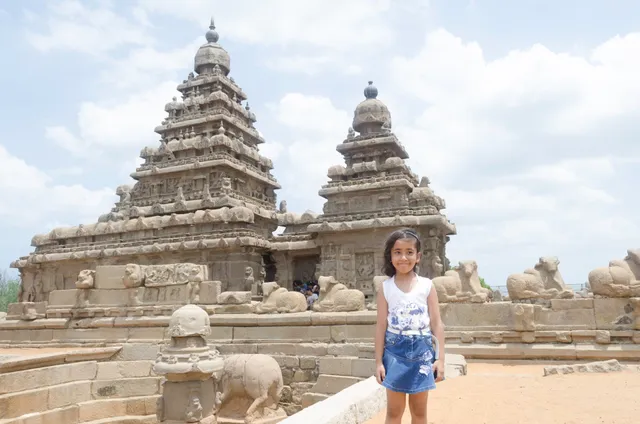
The Shore Temple in Mahabalipuram (also known as Mamallapuram), Tamil Nadu, is one of the most iconic and ancient temples in India. It is situated along the Coromandel Coast of the Bay of Bengal and is famous for its stunning architectural style and historical significance. The temple is a UNESCO World Heritage Site and forms part of the Group of Monuments at Mahabalipuram, which is known for its rock-cut temples, sculptures, and monuments dating back to the Pallava dynasty.
Key Features of the Shore Temple:
Historical Significance: The Shore Temple was built during the Pallava dynasty under the reign of King Rajasimha (Raja Raja Chola I) in the 7th or 8th century CE. It is often regarded as one of the earliest examples of Dravidian-style temple architecture and a testament to the Pallavas' architectural innovation.
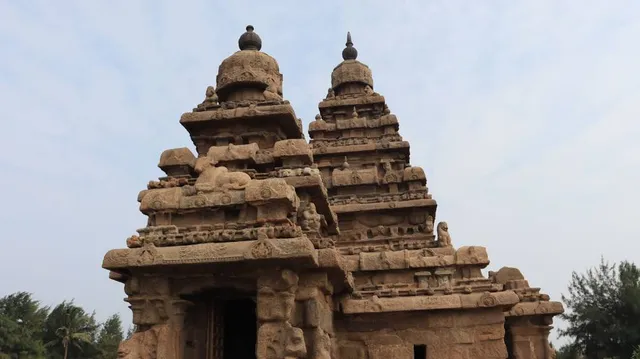
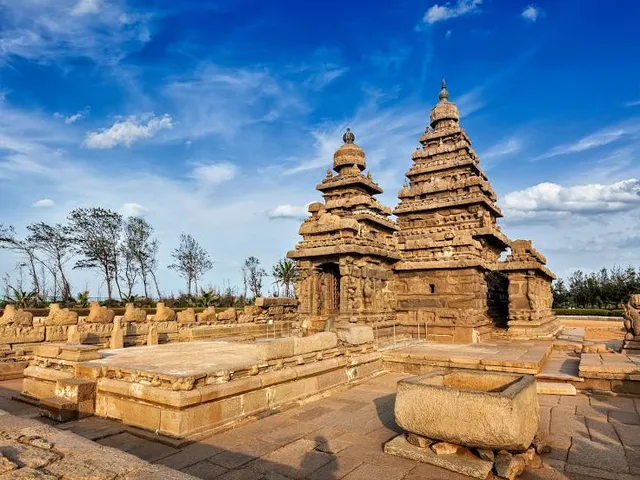
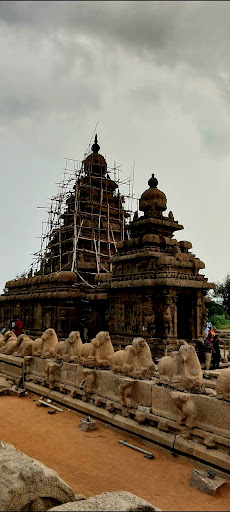
Architecture: The Shore Temple is an example of structural architecture, built using large blocks of granite. Unlike many other temples in the region, which are rock-cut, this temple is constructed on the shore, giving it its name. The temple is a sandstone structure that consists of two main shrines, one dedicated to Lord Shiva and the other to Vishnu.
Shiva Shrine: The main structure is a Shiva temple, with a large central shrine housing a deity of Lord Shiva. Vishnu Shrine: Adjacent to the Shiva shrine, there is also a smaller shrine dedicated to Lord Vishnu.
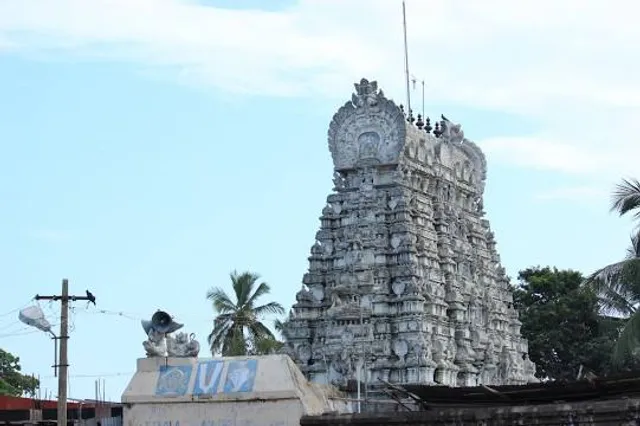
The temple is known for its striking pyramidal towers, or Shikhara, which are characteristic of Dravidian temple architecture.
Shore Location: The Shore Temple is situated right by the sea, making it visually striking as it overlooks the Bay of Bengal. This location gives the temple a unique and scenic beauty, with the waves of the sea crashing against the shore, especially during high tide. The temple was built in a way that it can be seen from afar, creating a majestic view against the backdrop of the ocean.
Religious Significance: The temple is a Shaiva temple (dedicated to Lord Shiva), and it is believed to have been an important religious site for pilgrims in ancient times. Its close proximity to the sea symbolizes the connection between the divine and the natural world, particularly the power of water in Hindu philosophy.
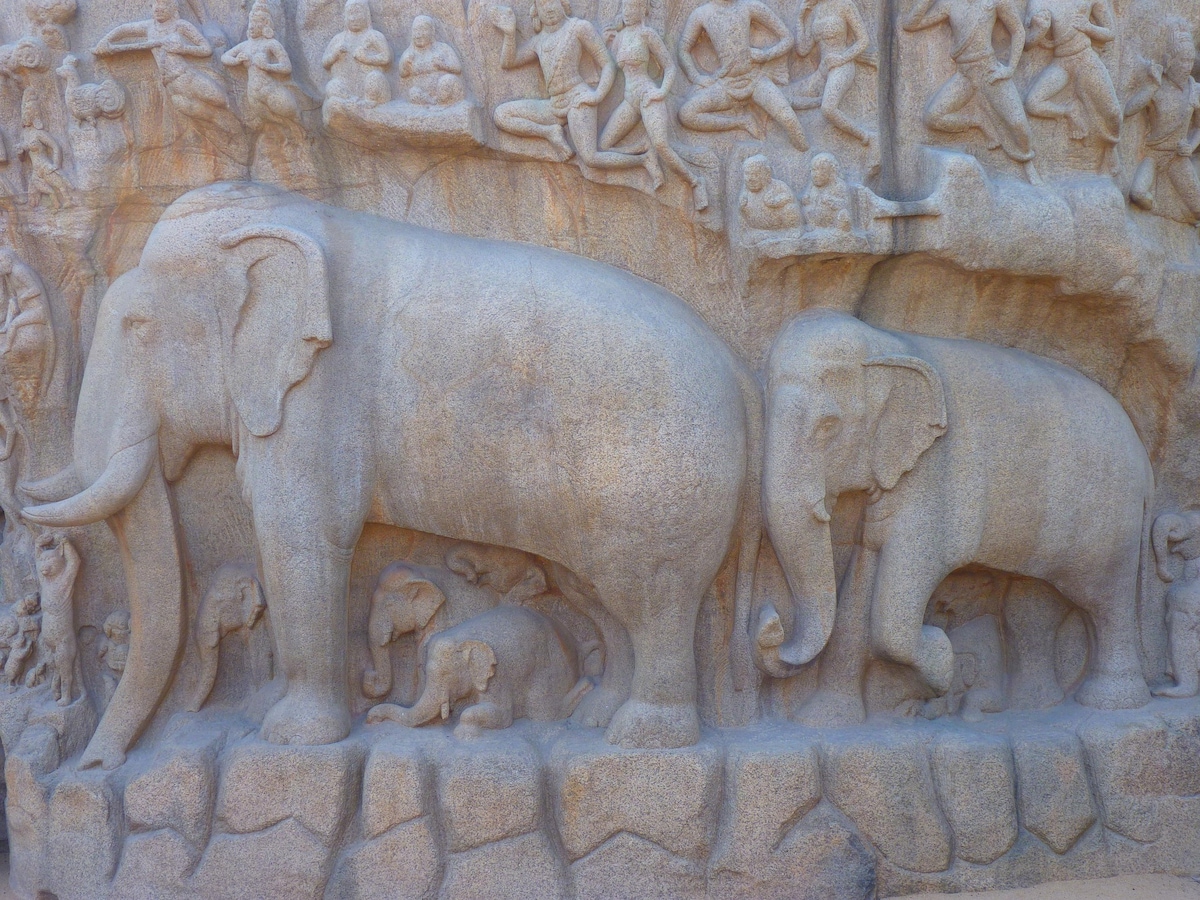
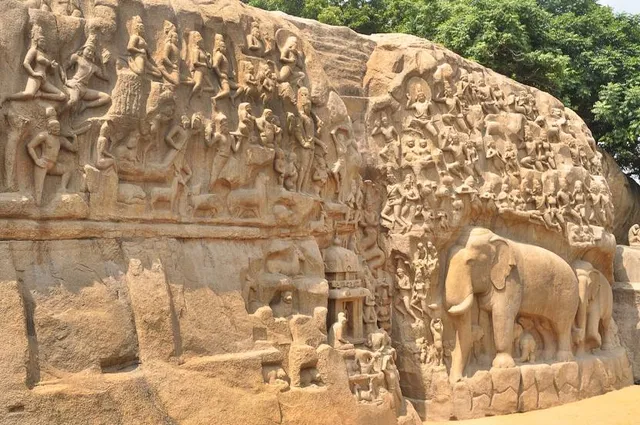
Artistic and Architectural Elements: The Shore Temple is a blend of structural and sculptural elements. It features intricate carvings and sculptures of gods, goddesses, and mythical figures. Notably, there are numerous stone carvings of Shiva, Nandi (the bull), and other deities. The temple also features lion figures and elephants, which are common motifs in Pallava architecture.
Preservation and Impact: The Shore Temple has withstood the ravages of time, including the effects of erosion from the sea. However, it remains remarkably well-preserved and continues to be an important cultural and religious site. Its proximity to the sea also presents challenges in terms of conservation, as saltwater and wind erosion have caused some wear to the structure over the centuries.
UNESCO World Heritage Status: The Shore Temple, along with other monuments in Mahabalipuram, is recognized as a UNESCO World Heritage Site due to its historical importance and architectural excellence.
Conclusion: The Shore Temple of Mahabalipuram is not only an architectural gem but also a cultural and spiritual icon. It stands as a remarkable testament to the engineering and artistic capabilities of the Pallava dynasty. The temple’s location, blending the serene beauty of the sea with ancient architecture, makes it one of India’s most photographed and visited...
Read moreShore temple is located in Mahabalipuram, about 60 kilometres (37 mi) south of Chennai in Tamil Nadu, India. The Shore Temple (c. 725 AD) is a complex of temples and shrines that overlooks the shore of the Bay of Bengal. It is located in Mahabalipuram, about 60 kilometres (37 mi) south of Chennai in Tamil Nadu, India It is a structural temple, built with blocks of granite, dating from the 8th century AD. At the time of its creation, the site was a busy port during the reign of Narasimhavarman II of the Indian Pallava dynasty.[3] As one of the Group of Monuments at Mahabalipuram, it has been classified as a UNESCO World Heritage Site since 1984.[4] It is one of the oldest structural (versus rock-cut) stone temples of Southern India.
Historical facts: Marco Polo and the European merchants who came to Asia after him called the site Seven Pagodas. One of these is believed to be the Shore Temple. The temple probably acted as a landmark for seafarers. As it appears like a Pagoda, the name became familiar to the seafarers.
This structural temple complex was the culmination of the architectural creations that were initiated by the King Narasimhavarman II in mid 7th century starting with the Cave temples and the monolithic Rathas. Even though the architectural creation of sculpturing cut-in and cut-out structures continued during subsequent periods, as seen in the Atiranachanda cave, the Pidari rathas and the Tiger cave, the main credit for the architectural elegance of the Shore Temple complex in the category of structural temples goes to the King Rajasimha (700–28 AD), also known as Narasimhavarman II, of the Pallava Dynasty. It is now inferred that this temple complex was the last in a series of temples that seemed to exist in the submerged coastline; this is supported by the appearance of an outline of its sister temples off the coast during the Tsunami of 2004 which struck this coastline. The architecture of the Shore Temple was continued by the Cholas (in the temples that they built) who ruled Tamil Nadu after defeating the Pallavas.
The tsunami of December 2004 that struck the coastline of Coromandel exposed an old collapsed temple built entirely of granite blocks. This has renewed speculation that Mahabalipuram shore temple was a part of the Seven Pagodas described in the diaries of Europeans, of which six temples remain submerged in the sea. The tsunami also exposed some ancient rock sculptures of lions, elephants, and peacocks that used to decorate walls and temples during the Pallava period during the 7th and 8th centuries
Though the tsunami of 26 December 2004 that occurred in the Indian Ocean struck the temple and the surrounding garden, the Shore Temple was not badly damaged, as the water level returned to its normal level within a few minutes. The damage was to the foundation of the bali pitham (sacrificial altar) in front of the temple, the steps leading to the boat jetty, and the small shrine with the Varaha (Boar) sculpture at the basement of the Shore temple. As the temple foundation is on hard granite rock, it could sustain the waves created by the tsunami; the groynes erected around the temple area on the coastline also aided its protection.
According to the two inscriptions found in the slab of smaller Shiva temple, the names of the three temples mentioned are as Kshatriyasimha Pallavesvara-gruham, Rajasimha Pallavesvara-gruham and Pllikondaruliya-devar. The entire temple complex is called as Jalashayana (lying in water). This confirms that the Vishnu shrine was the first shrine to be excavated here. The inscription on the lintel of the Vishnu shrine also mentions this as Narapatisimha Pallava Vishnu Griha where Narapatisimha is a title...
Read moreShore Temple, Mahabalipuram Located 60km (37mi) off Chennai, Mahabalipuram (or as commonly called Mamallapuram) is revered as the temple city of South India. It has seen the footfall of thousands of tourists every year and is well connected to the rest of the major cities of the country by road, rail and air.
The place has a historical significance making it one of the most enchanting travel sites of India.
Interesting Facts about Mahabalipuram
Shore Temple • Mahabalipuram is a UNESCO World Heritage Site • The place was revered as the melting point of art and literature between 3rd and 7th century CE. • Mahabalipuram was nicknamed as the “land of the Seven Pagodas” by the ancient mariners. • After excavation, several coins have been discovered which proves the trading relation with the Romans in ancient times.
Shore Temple, Mahabalipuram This temple is one of the most regal examples of Indian heritage and is a loved and revered place in India. Located on the shores of Bay of Bengal, the Shore Temple in Mahabalipuram was built in the 7th century and today is recognised as one of the UNESCO world heritage sites of India.
The temple is dedicated to Lord Vishnu and Lord Shiva and is divided into three shrines. The most significant of the three shrines is the one where Lord Vishnu and Lord Shiva are worshipped. In the Grabhagriha of the temple, you can find the Shivalingam which seems like embracing the temple. There are two shrines placed at the back of the temple faced opposite to each other. Of the, one is dedicated to Lord Vishnu and while the other highlights the grandeur of Ksatriyasimnesvara. The image of Lord Vishnu is shown as Seshanag who is considered as the symbol of realization as per the Hindu religion.
History of Shore Temple, Mahabalipuram In the early days, the seafarers mistook this temple as pagodas owing to its gigantic tall structure. Then sailors named it as seven pagodas and marked this colossal structure as a sight for navigating their ships.
Narasimha Varma I created this magnificent temple and this artistic work initiated in the 7th century. Narasimha Varma was also known as Mammalla and the place came to be known as Mamallapuram. King Rajasimha, who ruled the place during 700-28 AD contributed to the styling of the Shore Temple in Mahabalipuram which initially was carved as monolithic Rathas and the cave temples. King Rajasimha was also known as Narasimhavarman II.
In the last decade, when the Tsunami of 2004 hit the coastline of Coromandel, archaeologists found an ancient temple granite-built temple which had entirely collapsed earlier. Interestingly, one can find the special mention of Mahabalipuram in European diaries as one of the parts of the seven Pagodas. According to many experts, six of the seven Pagodas have gone under the sea. But, with the Tsunami, a few of the ancient sculptures of peacocks, elephants, and lions have come into light which were sculpted to adorn the walls of the structures built during the...
Read more