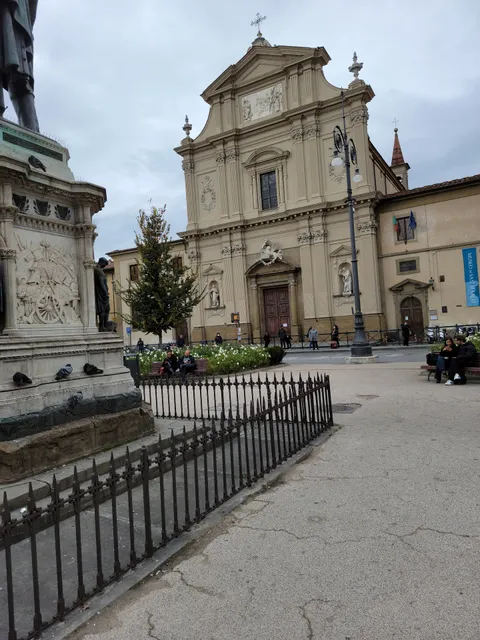
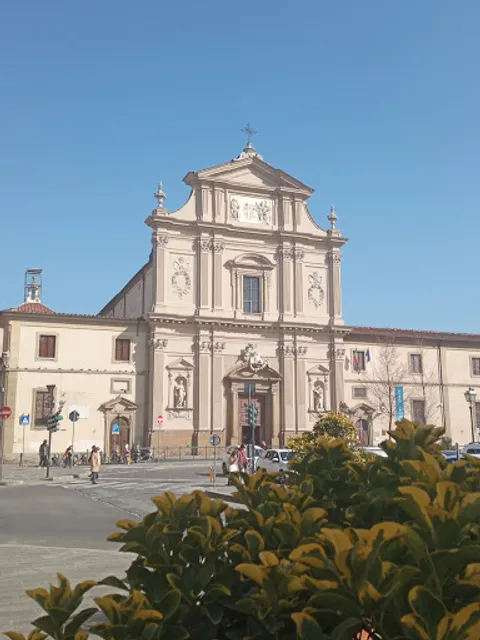
Museo Nazionale di San Marco is an art museum housed in the monumental section of the medieval Dominican friary dedicated to St Mark, situated on the present-day Piazza San Marco, in Florence, region of Tuscany, Italy.
The museum, a masterpiece in its own right by the fifteenth-century architect Michelozzo, is a building of first historical importance for the city and contains the most extensive collection in the world of the works of Fra Angelico, who spent several years of his life there as a member of the Dominican community. The works are both paintings on wood and frescoes. The museum also contains other works by artists such as Fra Bartolomeo, Domenico Ghirlandaio, Alesso Baldovinetti, Jacopo Vignali, Bernardino Poccetti and Giovanni Antonio Sogliani.
San Marco is known as the seat of Girolamo Savonarola's discourses during his short spiritual rule in Florence in the late 15th century.
The Museum is situated in the oldest part of the monastery occupying about half the total space. The building has expanded over time, now taking up a whole block, and part of it is still occupied by friars today. The oldest section of the building, built over the medieval Sylvestrian monastery, was constructed by the architect Michelozzo at the specific request of Cosimo il Vecchio de' Medici and his expense, to house the reformed Dominicans of Fiesole, an order at that time led by Antonino Pierozzi. Over about ten years (1436-1446) Michelozzo completed an extremely modern and functional monasterial building project which contributed to the glorification of Medicean patronage. Michelozzo made use of the pre-existent wall structures of the Sylvestrian monastery complex which date back to the end of 13th century. Michelozzo ably linked together the ground floor rooms around a harmoniously-proportionated cloister and raised the levels of these buildings to create the dormitories on the first floor with a large number of cells to suit an expanding monastery.
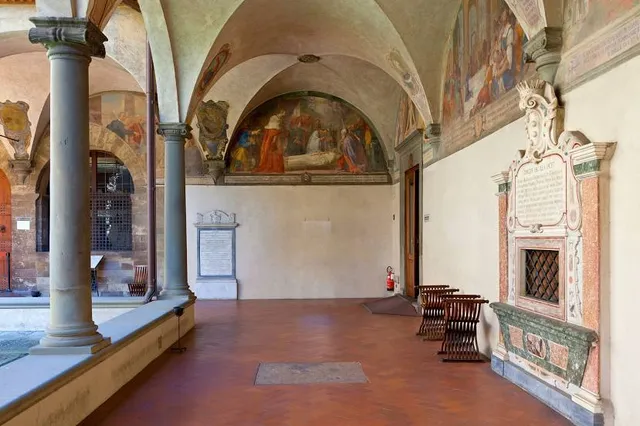
The cloister is behind the church and it introduces the visitor to the sight of the splendidly poised architecture of the monastery, a typical example of a measured and orderly Florentine Renaissance architecture. The sight of St. Dominic worship the Crucifix, painted by Fra Angelico opposite the entrance is uplifting. Originally this was the only painted image decorating the white cloister. The appearance of the cloister was changed during the 17th century, when the monks of San Marco decided to celebrate the figure of St. Antonino by commissioning the most famous Florentine painters of the time to paint a cycle of lunettes depicting Scenes from the life of St. Antonino.
The large room, which can be entered from the right side of the cloister, occupies all the part of the building onto Piazza San Marco and already existed in the Middle Ages when the monastery was inhabited by the Sylvestrian monks. When the monastery was rebuilt in the 15th century, Michelozzo covered the whole area with cross vaults and raised the building to construct the second friars' dormitory. Inside there was also a Pilgrims'Hospice, alluded to in the fresco painted by Fra Angelico on the second door, Christ the pilgrim welcomed by Dominicans. Today it is the home of almost all of Angelico's panel painting, coming from the churches and monasteries of Florence.
Like many establishments of its kind throughout Europe, the convent was seized by the civil authorities during the upheavals stemming from the French Revolution and the expansion of the Napoleonic Empire. San Marco met this fate in 1808, returned to Dominican hands after the fall of Napoleon, but then was confiscated in large part by a decree of the nascent Kingdom of Italy dated 7 July 1866 and became State property. This left to the Dominicans the church, the rooms opening on to the Saint Dominic cloister and the area that came much later to house the library containing over 10,000 books specializing in spirituality, founded in 1979 thanks to the bequest of the Catholic scholar Arrigo Levasti (1886-1973) and...
Read moreThe site has been occupied by a convent since the 12th century. In 1437 Cosimo the Elder de’ Medici decided to rebuild the entire complex. The work was carried out by Michelozzo. The decoration of the walls was done between 1439 and 1444 by Fra Angelico and assistants, who included Benozzo Gozzoli. Further alterations were made in the later 16th century by Giambologna, and also in the 17th.
It looked like it might be busy as we fought our way through a large tour group outside the entrance and then inside there was a school group of ankle-biters. After paying the incredibly cheap 4€ each we were in the cloister of St Antonino. The Sala dell’Ospizio (room of the pilgrims) houses a gallery where many of Fra Angelico’s most important panel paintings have been gathered together. They include his "Santa Trinita Altarpiece" (1432) and "Tabernacle of the Linen-Drapers (Linaiouli Madonna)" (1436). The light was difficult and many of the works very small. We stopped to look at a roomful of paintings by followers of Fra Bartolomeo, and then decided to head upstairs for the highlight, the cells, not knowing how busy it would be or how many works we could see.
Upstairs, above the cloisters, are the cells where the monks prayed. Many of the great figures of 15th century Florence lived and worked here. Fra Angelico (with help) decorated the 40+ cells, each with a single fresco concerning the life of Christ and containing deep spiritual and ascetical meaning . Having seen photos we were excited to have the opportunity to see them. They are each quite simple and made up of beautiful, subdued colours. They date from 1440-1441. They certainly did not disappoint and are one of the art treasures of Italy. Cosimo the Elder de’ Medici had a very nice cell himself for prayer and contemplation.
Fra Girolamo Savonarola also had a cell which now contains some of his personal items. He is best remembered as being responsible for the Bonfires of the Vanities in the Piazza della Signoria where many "decadent" works of art and books were burned. In his sermons Savonarola raged against the immorality of the age. He was finally put to death and burnt in the same piazza in 1498 after becoming too much for everyone.
Also on the upper floor is the library, designed by Michelozzo and completed in 1444. It housed a library of Latin and Greek texts built up by Cosimo the Elder, in consultation with the Pope, of titles considered to be the most important for inclusion in a library. On display now are a number of 15th century psalters including some decorated by Fra Angelico.
At this stage we had finished upstairs. We were virtually alone. It was great. As we descended to ground level we noticed a sign limiting the number of people upstairs to 120 at any one time. It must get busy.
We continued in the rooms off the cloister. The first was the Chapter House which contains the largest fresco by Fra Angelico at San Marco. It covers one entire wall and depicts the crucifixion together with all the patron saints of the Medici family plus many others from the Dominican Order. Similarly to the other frescoes by Fra Angelico it dates from 1441-1442.
There are also important works by Fra Bartolomeo and others from his school in another roon. So off we went. There are a number of his works on terracotta tiles. They are head and shoulder portraits. Very simple, very light and very clear. His works are from the first decade of the 16th century. Then we had time to look at the frescoes painted around the cloister. There are a few more of Fra Angelico's works amongst a number of other artists. We think that we shared the cloisters with 2 other people.
Time was getting on so the final stop was the bookshop. That is located in the old cenacolo (refectory). It has art too. Ghirlandaio's 1486 "Last Supper" covers an 8 metre section of wall. It is in very good condition. The bell was ringing informing visitors that it was time to go.
An...
Read moreThe San Marco Museum in Florence is a wonderful place to explore. Located in a former Dominican convent, it is full of beautiful art and history. One of the main highlights is the work of Fra Angelico. His impressive frescoes cover the walls, creating a peaceful and inspiring atmosphere.
The infamous Girolamo Savonarola had a cell there and used the monastery as his "headquarters". His raising to the power was quick, and for about 4 years he used to be the "influencer" and eventually the ruler of Florence, until he was burned at Piazza della Signoria 1498.
Each room in the museum offers something special. The cells where the monks lived are simple but hold amazing frescoes that tell religious stories. The library, with its elegant architecture, is another gem, emphasizing the importance of knowledge and learning during the Renaissance era. The manuscripts and the tools to create them in the 15th century bring to life the craftmanship of those days.
The museum also has a lovely courtyard, perfect for a quiet moment of reflection. The San Marco Museum is not as crowded as some other attractions in Florence, making it a more relaxed and enjoyable visit.
Overall, the San Marco Museum is a must-see for anyone interested in art, history, or simply looking for a serene and beautiful place to spend a couple of hours. Its rich collection and peaceful setting make it a true treasure in Florence.
High value for your...
Read more