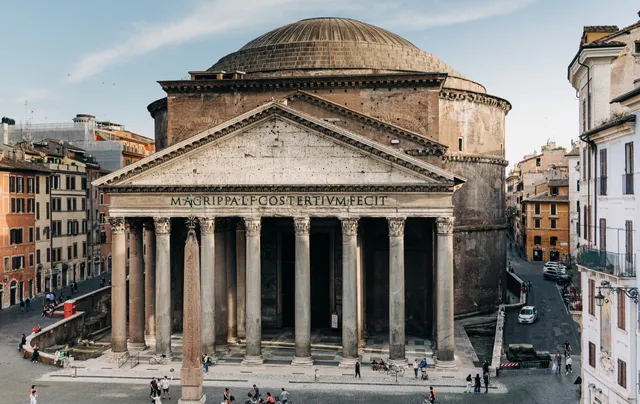
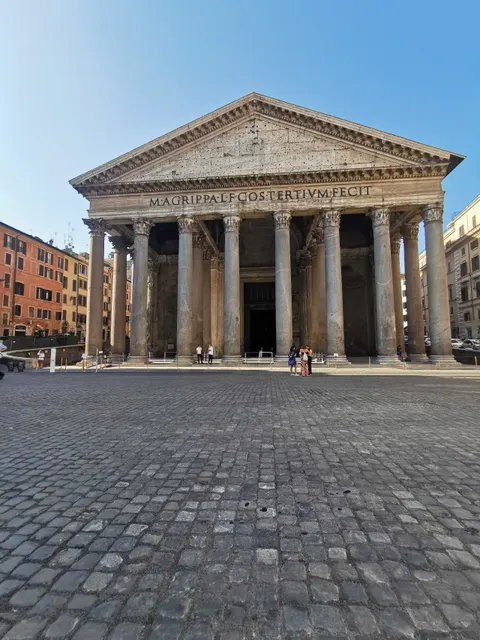
As an architect, this is the perfect building not only because it contains a sphere, one of the five platonic solids, but because it has survived the tests of time. Having been built as a place to honor many gods, (pan), important, abandoned, left to sit alone, restored to serve another religion, set back to its original form and all the while retaining its internal composure, stature and beauty. The Pantheon to me almost glows with a halo from its elite status among ancient buildings. The way they have lit it stages this emotive feeling, which when it was built would have been impossible to see. Modern lighting shows us it's form. Note the massive columns in depth, the inconsistent completeness of the capitals, and the missing frieze statuary all signs of politicized vandalism, much like what happened to the monuments in ancient Egypt. The exterior has weathered well all things considered, the interior, even more so. For a building with this much history and an open hole in the roof, what would expect from any modern building? This is one of the Gods of architecture to make the analogy. Right up there with the Parthenon that differs by only one letter. As you enter you are humbled by your size. Much like St Peters, this is about setting the mood and emotion to admit we are but mere mortals to all the gods or the one god, depending on who owned and manipulated the building's political aesthetic influence. Note also the coffers on the dome. They too use a bit of what Phideus did on the Parthenon. There are four squares in four planes inside of the main dome surface, or are there? No. They are trapezoids, with radial sides shrinking in width as they go up. If you are observant you will notice the inner most trapezoid is set highest, the next one a little lower and the third inside the fourth the lowest. You can see these by looking carefully at the shadows, which to me are amazing speakers of truth that give away a building true form. The greatest achievement in ancient art forms is understanding light and it's shadows. This is basic geometry. By constructing the coffers this way the dome seems larger and deeper. Because the eye perceives the deepest most plane to be further away. This was the genius of their creations Phideus did this on the Parthenon too. Exaggerate the size by manipulating the purity of the basic forms. The dome is simple enough, but the later addition of polychromic marble adds an even more spectacular effect to the grandeur of the space. This is one of my favorite spaces from antiquity, seconded only by the pyramids and the Partheon. The grandeur of St Peters has the same effect, but the single barrel vaults elegance simplifies the more intriguing groin vaults to its side aisles. The Pantheon has none of those, it simply rotates away all of the edges inherent in the square. That is the reason the circle and sphere, with its infinite angles are made aesthetically analogous to the divine. A must see in Rome. Get tickets before...
Read moreThe Pantheon in Rome is one of the most astonishing feats of ancient architecture, a testament to the ingenuity and grandeur of Roman engineering. Walking up to its massive bronze doors, you immediately feel the weight of history, knowing this structure has stood for nearly 2,000 years. The exterior, with its imposing columns and pediment, is impressive, but it doesn’t quite prepare you for the awe you feel upon stepping inside.
The interior of the Pantheon is simply breathtaking. The vast, open space crowned by the iconic oculus creates an atmosphere that is both majestic and serene. The light pouring in from the oculus, shifting throughout the day, transforms the space in a way that feels almost otherworldly. The perfect symmetry, the geometric precision, and the harmonious proportions of the dome all contribute to an experience that is as intellectually stimulating as it is visually stunning.
However, it’s essential to acknowledge that the Pantheon is now a highly trafficked tourist site, and this popularity does come at a cost. The continuous flow of visitors can make the experience feel rushed and somewhat crowded, detracting from the building’s intended sense of tranquility and reverence. The noise level inside can be surprisingly high, with chatter and camera clicks disrupting what could otherwise be a moment of quiet reflection. The Pantheon was originally a temple and later converted into a Christian church, and yet it’s often difficult to find a moment of peace within its walls due to the throngs of people.
Another aspect worth mentioning is that while the Pantheon’s grandeur is undeniable, the interior decoration is relatively sparse compared to other Roman churches. This simplicity is part of its charm, emphasizing the architectural achievement, but it might leave some visitors expecting more ornate details slightly underwhelmed. The religious significance is also somewhat subdued, with the space feeling more like a monument than a living place of worship, despite its ongoing use as a church.
Despite these points, the Pantheon remains an absolute must-see. Its historical importance, architectural brilliance, and sheer endurance through the ages make it a site of profound significance. But it’s best appreciated with managed expectations: prepare for the crowds, accept the noise, and focus on the incredible engineering and history that the Pantheon embodies. It’s a place where the past feels incredibly present, a reminder of the power and permanence of Roman civilization. Even with its modern-day challenges, the Pantheon continues to inspire awe and respect, a true marvel that stands as a bridge between ancient Rome and the...
Read moreVisiting the Pantheon in Rome was an experience that far exceeded my expectations, deserving nothing less than a five-star rating. This architectural masterpiece, once a Roman temple and now a church, is a testament to the ingenuity and grandeur of ancient Rome.
The Majestic Dome: The moment you step inside, the Pantheon’s vast dome captivates you. Its oculus, the only source of natural light, casts a heavenly beam across the interior, creating a serene and almost mystical atmosphere. The engineering marvel of the dome, still the world’s largest unreinforced concrete dome, left me in awe of ancient Roman architectural prowess.
Historical Significance: The Pantheon holds centuries of history within its walls, serving various roles throughout its existence. Its endurance through time, virtually intact, offers a rare and direct connection to the ancient world. Walking through the same space where emperors and artists once tread was a profoundly moving experience.
Artistic Beauty: Beyond its architectural significance, the Pantheon also houses important works of art, including the tombs of renowned artist Raphael and several Italian kings. The beauty of the art and inscriptions adorning its interior adds layers of depth to an already fascinating visit.
Accessibility and Preservation: Despite its popularity, access to the Pantheon is remarkably efficient, with free entry that allows everyone to appreciate this historical gem. The care taken to preserve this ancient structure while keeping it open to the public is commendable.
A Place of Reflection: What sets the Pantheon apart for me is its atmosphere of tranquility and reflection. Amid the bustling streets of Rome, it stands as a sanctuary of peace, inviting visitors to ponder the passage of time and the legacy of human achievement.
Conclusion: The Pantheon is not just an essential visit for those interested in history or architecture; it is a profound experience that resonates on a deeper level. Its architectural brilliance, historical depth, and enduring beauty make it a highlight of Rome that should not be missed. My visit to the Pantheon was an unforgettable journey back in time, leaving me with lasting memories and a deep appreciation for this...
Read more