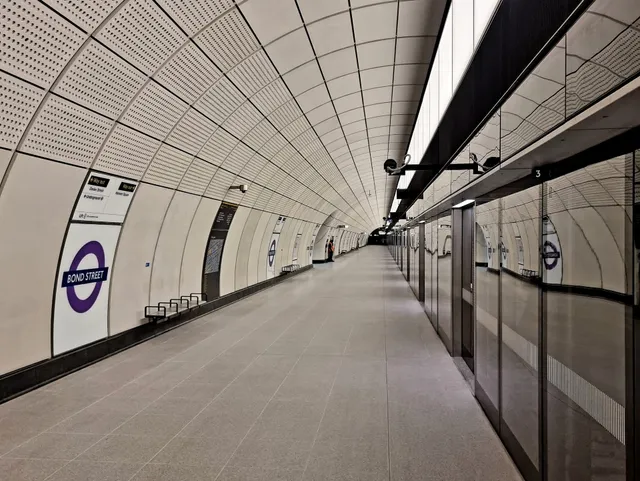
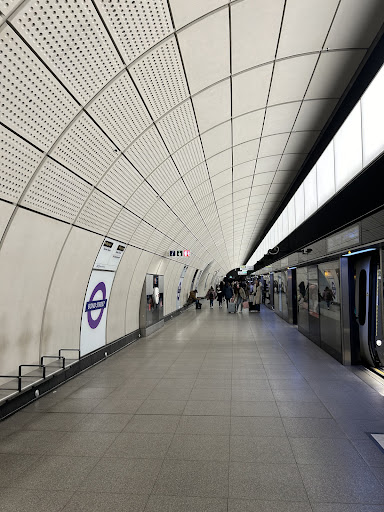
A nice London station with good new facilities and connections.
Bond Street in the West End of London links Piccadilly in the south to Oxford Street in the north. Since the 18th century the street has housed many prestigious and upmarket fashion retailers. The southern section is Old Bond Street and the longer northern section New Bond Street—a distinction not generally made in everyday usage.
The street was built on fields surrounding Clarendon House on Piccadilly, which were developed by Sir Thomas Bond. It was built up in the 1720s, and by the end of the 18th century was a popular place for the upper-class residents of Mayfair to socialise. Prestigious or expensive shops were established along the street, but it declined as a centre of social activity in the 19th century, although it held its reputation as a fashionable place for retail, and is home to the auction houses Sotheby's and Bonhams (formerly Phillips) and the department store Fenwick and jeweller Tiffany's. It is one of the most expensive and sought after strips of real estate in Europe.
There is evidence of Roman settlement around what is now Bond Street. In 1894, a culvert made from brick and stone was discovered in the area.7] The street was named after Sir Thomas Bond, the head of a syndicate of developers who purchased a Piccadilly mansion called Clarendon House from Christopher Monck, 2nd Duke of Albemarle in 1686, and proceeded to demolish the house and develop the area.[8] At that time, the house backed onto open fields, known as Albemarle Ground, and the development of estates in Mayfair had just begun.[1]
New Bond Street was laid out during the second phase of construction 14 years after Bond's syndicate began developing the area.[8] Most of the building along the street occurred in the 1720s, on what was the Conduit Mead Estate.[1 John Rocque's map of London, published in 1746, shows properties along the entire length of Bond Street, including the fully constructed side streets. The two parts of the street have always had separate names, and a plan by the council to merge the two into a singular "Bond Street" in the 1920s was rejected by locals.[9]
During the 18th century, the street began to be popular with the bourgeoisie living around Mayfair. Shop owners let out their upper storeys for residential purposes, attracting lodgers such as Jonathan Swift, George Selwyn, William Pitt the Elder and Laurence Sterne.[1] In 1784, Georgiana Cavendish, Duchess of Devonshire, an active socialite, demanded that people boycott Covent Garden as its residents had voted against Whig member of parliament Charles James Fox. This had caused him to lose his seat in Parliament, leading to the dissolution of the Fox–North Coalition. She insisted people should look for nearer shopping streets, and encouraged people to go to Bond Street. Consequently, the street became a retail area for people living in Mayfair. By the end of the century, an upper-class social group known as the Bond Street Loungers had appeared, wearing expensive wigs and parading up and down the street in a pretentious manner
Lord Nelson stayed at temporary lodgings in New Bond Street between 1797 and 1798, as did his mistress Emma, Lady Hamilton between 1811 and 1813.[10] Thomas Pitt, 2nd Baron Camelford lived in Bond Street and was unhappy about the presence of the Bond Street Loungers.[8] Already notorious for a violent and abusive temper, on 7 October 1801 he refused invitations to join in celebrations of peace between Britain and France (which led to the Treaty of Amiens), resulting in an altercation with several Loungers at his doorstep. Camelford retreated upstairs and fired upon the crowd with a pistol.[11]
During the 19th century, Bond Street became less known for its social atmosphere but increased its reputation as a street for luxury shopping. The auctioneer Phillips was established...
Read moreToday's gate failure at Bond Street main station. In the morning I couldn't get my oyster card out. In the evening after work I went to the station and wanted to ask what should I do with the oyster. I asked 2 female employees in uniform undergraund standing.Wrong information as a result, I touched the oyster from the inside of the gate. When I wanted to enter normally, the gate did not want to open. A small African woman with dreadlocks told me that it was not her problem and did not want to help me at all! It is amazing that someone like that works at a subway station.All what shi can do is stand there for nothing even if he can't smile to people on station past her! It's good that there was a supervisor there who knew what was going on and helped me get home. These types of anti-social people with zero customer service should not work at underground stations. It's nice to take money for nothing to do and mislead traveling people. And then take no responsibility for anything and be useless at work. What do underground clients spend their money on?! The kind of people who make their lives difficult and are rude. I think someone should be interested in this matter, because this cannot be.Tuesday 6th jun time 19:25-19:45. No sorry no nothig extreme unpleasant...
Read moreBond Street! Dieser Name allein klingt schon nach Eleganz, nach Luxus und nach diskretem Glanz. Und genau das ist sie auch! Eine der berühmtesten Einkaufsstraßen Londons, gelegen im Herzen von Mayfair, zwischen Oxford Street im Norden und Piccadilly im Süden.
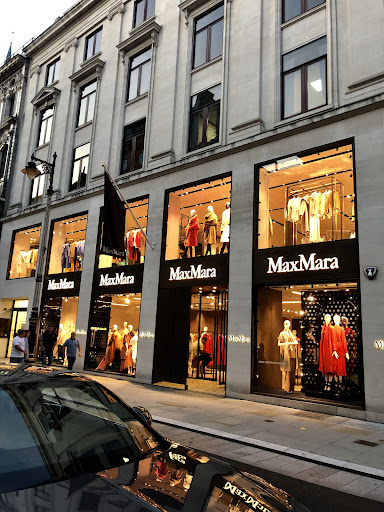
Wenn man die die blitzblanke Metro verlässt und Straße betritt, spürt man sofort, dass hier etwas anders ist als an anderen Einkaufsstraßen der Stadt. Es ist ruhiger, gediegener und kein hektisches Treiben, sondern flanierende Menschen, oft in maßgeschneiderter Kleidung, mit Einkaufstaschen, die Namen tragen wie Chanel, Hermès, Gucci, Cartier oder Dior. Bond Street steht nicht für Shopping, sondern für Erlebnis und Exklusivität.
Eigentlich besteht Bond Street aus zwei Teilen: Die Old Bond Street im südlichen Abschnitt, näher bei Piccadilly und die New Bond Street im nördlichen Teil, Richtung Oxford Street Beide zusammen bilden eine einzige, durchgehende Straße, aber historisch und architektonisch unterscheiden sie sich leicht. Old Bond Street ist etwas schmaler und von georgianischer Architektur geprägt, während New Bond Street großzügiger wirkt und modernere Fassaden mit klassischen Stilmitteln kombiniert.
Die Pflasterung ist gepflegt, der Straßenraum wirkt fast wie eine Flaniermeile. Zwischen eleganten Laternen, Blumenampeln und diskreter Überwachung ist Bond Street so gestaltet, dass sie ihre Besucher einlädt aber mit einem feinen Augenzwinkern auch auswählt. Die Bond Street ist die Heimat fast aller großen internationalen Luxusmarken von Rolex bis Louis Vuitton, von Burberry bis Prada. Viele Geschäfte hier sind Flagship Stores, also die wichtigsten ihrer Art weltweit oder zumindest im Vereinigten Königreich. Neben Modehäusern gibt es auch traditionsreiche Kunstgalerien und Auktionshäuser wie Sotheby’s, die hier seit Jahrhunderten ansässig sind. Ja genau, dieses Sotheby`s wo Leonardo Da Vincis "Salvator Mundi" im Jahr 1958 hier in London für gerade mal 45 Britische Pfund an einen privaten Bieter versteigert wird. Sechzig Jahre später geht er für 450 Millionen US Dollar über den Tisch. Kunst hat in der Bond Street eine ebenso große Tradition wie Mode.
Viele Gebäude an Bond Street sind denkmalgeschützt. Man erkennt georgianische, viktorianische und edwardianische Fassaden, die mit viel Sorgfalt renoviert wurden. Besonders auffällig sind die aufwendig gestalteten Eingänge der Läden, oft mit Portiers, polierten Messinggriffen und Schaufenstern, die mehr wie Ausstellungsräume wirken. In der Mitte der Straße befindet sich die Statue von Churchill und Roosevelt, die Seite an Seite auf einer Bank sitzen. Ein Symbol für die britisch-amerikanische Freundschaft. Ein beliebter Ort für Fotos, mitten im Herzen des Luxus.
Rund um Bond Street liegt Mayfair, eines der wohlhabendsten Viertel Londons, voller Fünf-Sterne-Hotels, Privatclubs, Galerien und edler Restaurants. In Laufweite sind auch der Hyde Park, die Royal Academy of Arts, der Green Park und die Flaniermeilen Regent Street und Savile Row. Es ist ein London der alten Schule, wo Stil wichtiger ist als Show.
Stand: 19.04.2025
„Luxus ist, wenn der Tag beginnt wie ein Gemälde von Monet. Weich, verschwenderisch und vollkommen sinnlos schön. Wenn das Frühstück auf Porzellan serviert wird, das man eigentlich ausstellen sollte, und der der Löffel beim Rühren in der Teetasse nach Jazz klingt. Reichtum ist nicht, was sich anhäuft, sondern was sich entfaltet - ein Moment echter Muße, ein Spaziergang durch eine Galerie, in der man das eigene Leben plötzlich in Öl auf Leinwand erkennt. Genuss? Das ist die Kunst, das alles jetzt zu rahmen, mit Goldkante und einem Augenzwinkern und dabei zu wissen, dass der teuerste Besitz die Fähigkeit ist, sich selbst ein kleines...
Read more