This place is a HUGE SCAM. I have visited almost a hundred of UNESCO sites and there was not a single one like this.
The palace itself is far from original, instead it is a later reconstruction filled by similar furnitures used by contemporaries. The outlook and the inner decoration are far from aesthetically exceptional, especially the latter one is just average Rococo furnishment not even comparable to Chateau de Fontainebleau or Schloss Brühl. Almost all except a handful of the rooms are completely without text introduction, and the audioguide is no more informative than Wikipedia. (For example, briefly introducing Franz Joseph I and Sisi's life or gossips while completely ignore how the interior designs were crafted) Furthermore, when another poor guy accidentally triggered the proximity alarm in room 4, the loud bell whistled for nearly 3 MINUTES and made everyone unable to immerse to the surrounding or focus on the audioguide. Come on, do you have to be so aggressive to protect your treasures that it was even worsening the already crowdy atmosphere?
I tried to asked a staff for a (maybe) more detailed printed guide, but was answered the texts are the same and I need to buy an art book at souvenir store to get to know more details... Oh, I have not mentioned that photography is forbidden all over the palaces. Excuse me? You sold a €24 euro ticket to a UNESCO World Cultural Heritage site that should belong to all humans, provided only a scratchy intro, and BAN THE PHOTOGRAPHY, just to force the visitors to buy your art book? Not to mention that if you did not book a more expensive ticket as I did (Sisi ticket in my case), there would be almost half a palace (Maria Theresa Apartment) you are not allowed to visit and there is a security guy checking the ticket. Well, just as classist as old Habsburg aristocrats isn't it? What an authentic experience!
Besides the already annoying management, the most intolerable part is the horrible staff. Firstly, all the staff I met are cold & apathetic at best, (for example, I tried to purchase a souvenir medal but the machines were out of order, I tried to ask one staff in souvenir store whether I could got one on-site, he firstly asked me to go to the machines, and when I showed him the photo of broken machines, he bluntly told me that they were broken for 2 weeks as it was not his business,) if not being directly rude or unfriendly. A Korean guide I encountered is definitely one of the latter. He used his finger pointed at me and ordered me like he is my father when trying to stop me taking some photos (yes, pure rudeness without any reservation, I can tell), when I argued back he threatened to call the security, but finally backed down as he still have a bunch of Korean tourists to fool, and I have lost all my patience to keep enjoying these artificial spectacle. When I encountered him again outdoor I told him I am filling a complaint and ask him to go ** himself, and guess what? He just swore back! What a professional staff he is for such a noble cultural heritage!
At last, the only suggestion for improvement I could give to this completely joke is: Why not just putting a sign at the front door saying, "Dear tourists, today we are gonna rip you off because our bosses spent a lot securing the patent of this who-know-what heritage and they want it worths. Enjoy or go screw yourself. " The Austrian government should take back this property from the unscrupulous SCHÖNBRUNN GROUP and run it as a national museum to educate and to entertain all, or it would keep being a scandal to such a beautiful and historically brilliant city.
If you want to have a good time in Vienna, go to other brilliant museums such as the newly opened Museum Wien Karlsplatz, House of Music, Military History Museum, or Belvedere, as you would know more about the beauty and glory of this capital of the old Europe with a much cheaper price. Even Zentralfriedhof is more fascinating than this rottening scam.
Oh, the Christmas Market is good BTW, but it's vendors'...
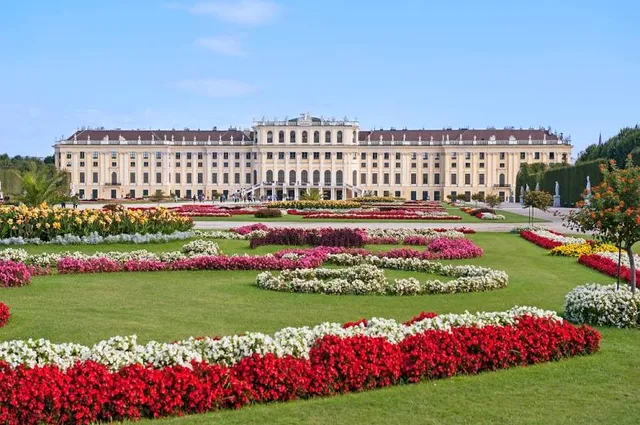
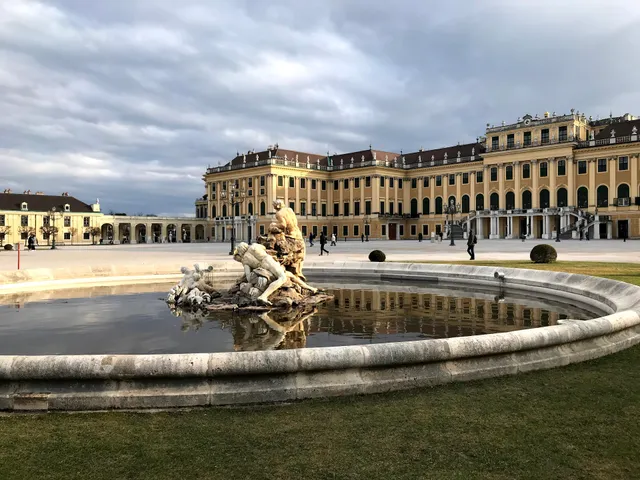
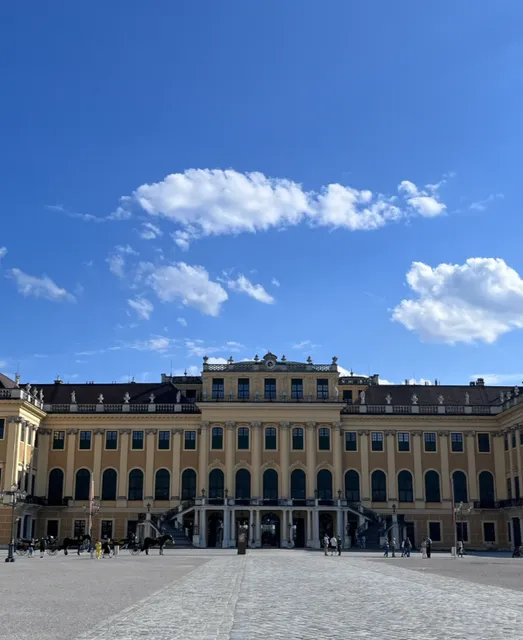
Read moreSchönbrunn Palace (German: Schloss Schönbrunn [ʃøːnˈbʁʊn]; Central Bavarian: Schloss Scheenbrunn) is the main summer residence of the Habsburg rulers, located in Hietzing, Vienna. The name Schönbrunn (meaning “beautiful spring”) derives from the artesian well from which the palace drew its water.
With 1,441 rooms, the palace is one of the most important architectural, cultural, and historical monuments in the country. The history of the palace and its extensive gardens spans over 300 years, reflecting the changing tastes, interests, and aspirations of successive Habsburg monarchs. It has been a major tourist attraction since the mid-1950s.
In 1569, Holy Roman Emperor Maximilian II purchased a large floodplain along the Wien River below the hill, located between Meidling and Hietzing. The previous owner had built a large house named Katterburg there in 1548. The emperor ordered the area to be fenced off and stocked with game animals such as pheasants, ducks, deer, and wild boars, to serve as a recreational hunting ground for the palace. In a small, separate section of the area, “exotic” birds such as turkeys and peacocks were kept. Ponds were also constructed.
Over the next century, the area was used as a hunting and recreational site. Eleonora Gonzaga, who enjoyed hunting, spent much of her time there and bequeathed the area as a residence for her widow after the death of her husband, Ferdinand II. From 1638 to 1643, she added a palace to the Katterburg mansion, while the first mention of the name “Schönbrunn” appeared on an invoice in 1642. The origin of the Schönbrunn orange trees also seems to trace back to Eleonora Gonzaga. The Schönbrunn Palace in its current form was built and renovated during the 1740s–50s under the reign of Empress Maria Theresa, who received the land as a wedding gift. Franz I commissioned the exterior of the palace to be redecorated in the neoclassical style as seen today.
Franz Joseph, the longest-reigning emperor of Austria, was born at Schönbrunn and spent most of his life there. He died there at the age of 86 on November 21, 1916. Following the fall of the Habsburg monarchy in November 1918, the palace became the property of the newly established Republic of Austria and was preserved as a museum.
Since 1992, the palace and gardens have been owned and managed by Schloss Schönbrunn Kultur-und Betriebsges.m.b.H., a limited liability company wholly owned by the Republic of Austria. The company carries out the preservation and restoration of all palace properties without state subsidies. UNESCO included Schönbrunn Palace in the World Heritage List in 1996, along with its gardens, as an extraordinary Baroque ensemble and an example of a synthesis of the arts (Gesamtkunstwerk).
Schönbrunn is the most popular tourist destination in Vienna, having welcomed 3.8 million visitors in 2017. The entire Schönbrunn complex, including the Schönbrunn Zoo, Palm House, Desert House, Carriage Museum, and Schönbrunn Palace Concerts, attracted over five million visitors in 2009. Tickets can be purchased in advance on the official website for tours. In addition to tours and tour packages, many classical concerts featuring the music of Mozart and his contemporaries can be enjoyed with the added benefit of more time in the spectacular halls, the Orangerie, or the...
Read moreWe were very excited to visit and decided to go for the Palace tickets. At €60 or so for two of us, we were expecting exciting things! Unfortunately, the Palace didn't deliver.
We arrived by U-bahn, which was efficient and very nearby. It was easy from there to find our way to the main entrance thanks to some helpful signage.
We'd bought tickets online so we skipped the ticket office and went straight to the entrance area. But that's when things started to go down hill.
The entrance area was crowded and poorly designed, with a massive queue for the cloakroom taking up most of the space. Signage was a little sparse, but we soon found the correct point and joined the queue.
It wasn't clear at which point we collected our audioguides, until we'd already gone through. For the 10:30 slot it was already getting busy.
We collected our audioguides, which promised us detail and the chance to learn more in some sections, and set off.
To summarise, the rooms could be interesting, but there were no information boards and our audioguides said very little. For each room the audioguide essentially said: "This is the X room, which was used for X by X person." For some rooms, a little more detail was provided but with no context. The audioguide didn't even say which decades it was discussing or give any context for who was who.
On our tour, rooms were very bare. We would have expected info boards, historical items or something to engage with, but in some rooms we were just shuttled through. Some rooms were set up and interesting to look at, but with little context to what we were seeing, they felt rather empty.
The rooms were also very constrained, with narrow walkways through them. Whilst this isn't unusual, they were poorly managed. Large school groups and tour groups would frequently stop and take up the whole space. Not only is this annoying, but it very much emphasised a lack of attention to detail for visitor experience.
As we made our way round, we were left feeling disappointed and a little ripped off. The audioguide was next to useless and the rooms themselves held no info or context in any language. The narrow walkways and overcrowding caused by tour groups, made us feel like it really is a tourist grab. The reason my photos show so few people is because almost all the room was out of reach behind the walkways.
Once we'd completed our ticket area, we didn't know where to go next. We hadn't been given leaflets or maps, and there were none to hand either. We ultimately decided to leave, as the whole experience was expensive without the wow factor.
Ultimately, if you'd like to visit, book in advance, but be prepared to be left with questions - we had a good read of Wikipedia at some points during the tour for context - but don't expect to leave having learnt much about the Palace, its occupants or its history. If friends asked whether they should add it to their itinerary for some culture or history, I would say...
Read more