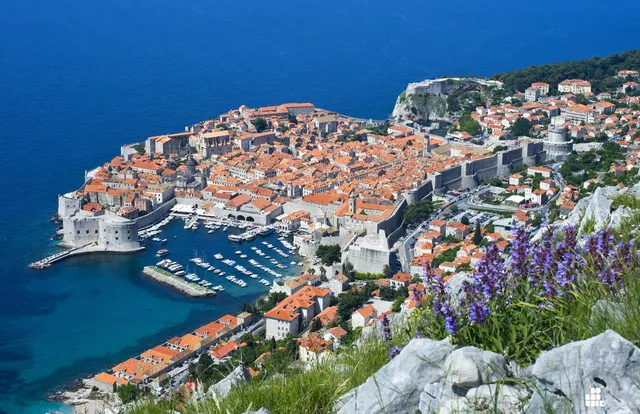
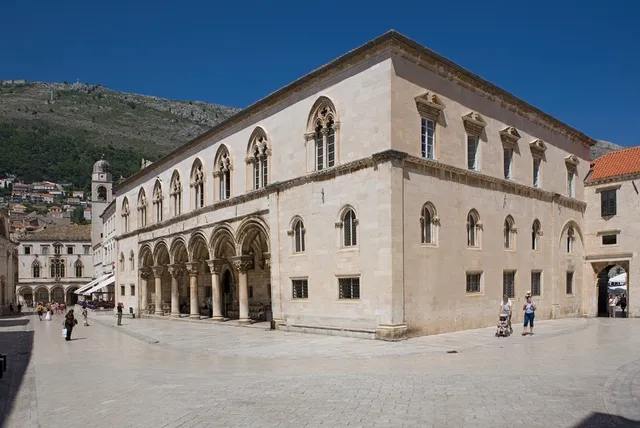
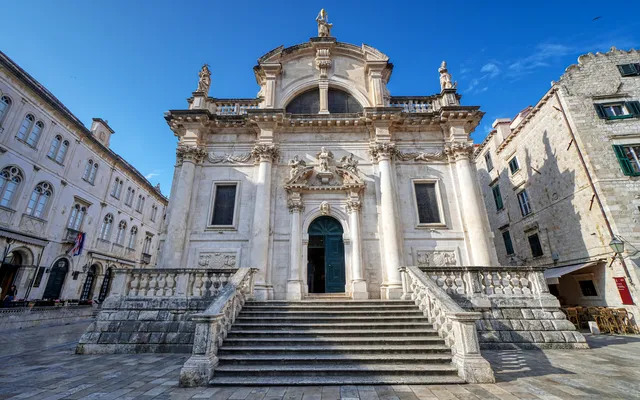
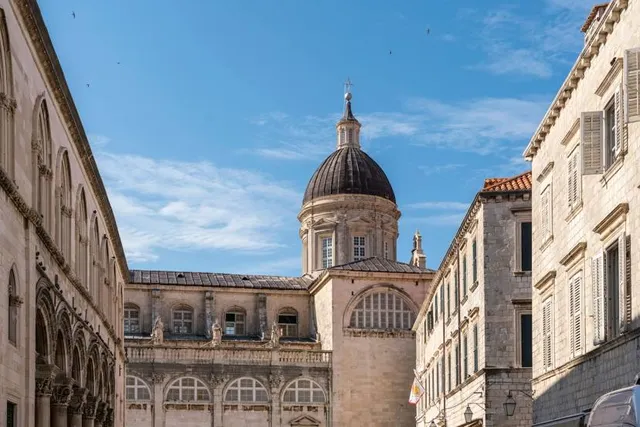
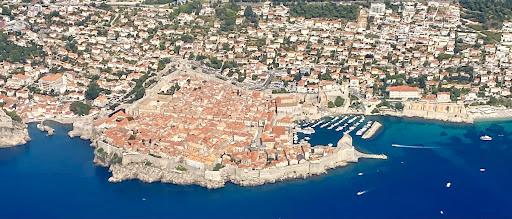
City plan of Dubrovnik in 1930s

Port of Dubrovnik in 1965.
With the fall of Austria-Hungary in 1918, the city was incorporated into the new Kingdom of Serbs, Croats, and Slovenes (later renamed to Kingdom of Yugoslavia). Dubrovnik became one of the 33 oblasts of the Kingdom. When Yugoslavia was divided among nine banovinas in 1929, the city became part of the Zeta Banovina. In 1939, Dubrovnik became part of the newly created Banovina of Croatia.
During the World War II in Yugoslavia, Dubrovnik became part of the Axis puppet state, Independent State of Croatia (NDH), occupied by the Italian Army first, and by the German Army after 8 September 1943. There were clashes between Italian and German troops in Dubrovnik when the Germans took over.[53] In October 1944, Yugoslav Partisans liberated Dubrovnik, arresting more than 300 citizens and executing 53 without trial; this event came to be known, after the small island on which it occurred, as the Daksa executions.[citation needed] Communist leadership during the next several years continued political prosecutions, which culminated on 12 April 1947 with the capture and imprisonment of more than 90 citizens of Dubrovnik.[54] After the war the remaining members of Dalmatian Italians of Dubrovnik left Yugoslavia towards Italy (Istrian-Dalmatian exodus).[55]
Under communism Dubrovnik became part of SR Croatia within SFR Yugoslavia. After the World War II, the city started to attract crowds of tourists–even more after 1979, when the city joined the UNESCO list of World Heritage Sites. The growth of tourism also led to the decision to demilitarise the Dubrovnik Old Town. The income from tourism was pivotal in the post-war development of the city, including its airport.[56] The Dubrovnik Summer Festival was founded in 1950.[57] The Adriatic Highway (Magistrala) was opened in 1965 after a decade of works, connecting Dubrovnik with Rijeka along the whole coastline, and giving a boost to the tourist development of the Croatian Riviera.[58]
Siege of Dubrovnik and its consequencesedit
Main article: Siege of Dubrovnik
Stradun shelled during the Siege of Dubrovnik (1991)
In 1991, Croatia and Slovenia, which at that time were republics within SFR Yugoslavia, declared their independence. At that event, Socialist Republic of Croatia was renamed to Republic of Croatia.
Despite the demilitarisation of the Old Town in early 1970s in an attempt to prevent it from ever becoming a casualty of war, following Croatia's independence in 1991, Yugoslav People's Army (JNA)–by then composed primarily of Serbs–attacked the city. The new Croatian government set up a military outpost in the city itself. Montenegro–led by President Momir Bulatović and Prime Minister Milo Đukanović, who came to power in the Anti-bureaucratic Revolution and were allied to Slobodan Milošević in Serbia–declared that Dubrovnik should not remain in Croatia because they claimed it historically had never been part of an independent Croatia, but rather more historically aligned with the coastal history of Montenegro.[citation needed] Despite these unfounded claims, at the time most residents of Dubrovnik had come to identify as Croatian, with Serbs accounting for 6.8 percent of the population.[59]
On 1 October 1991, Dubrovnik was attacked by the JNA resulting in a siege that lasted for seven months. The heaviest artillery attack was on 6 December with 19 people killed and 60 wounded. The number of casualties in the conflict, according to Croatian Red Cross, was 114 killed civilians, among them poet Milan Milišić. Foreign newspapers were criticised for placing heavier attention on the damage suffered by the Old Town than on human casualties.[60] Nonetheless, the artillery attacks on Dubrovnik damaged 56% of its buildings to some degree, as the historic walled city, a UNESCO World Heritage Site, sustained 650 hits by artillery rounds.[61] The Croatian Army lifted the siege in May 1992, and liberated Dubrovnik's surroundings by the end of October, but the danger of sudden attacks by the JNA lasted for...
Read moreThis place is simply fantastic.
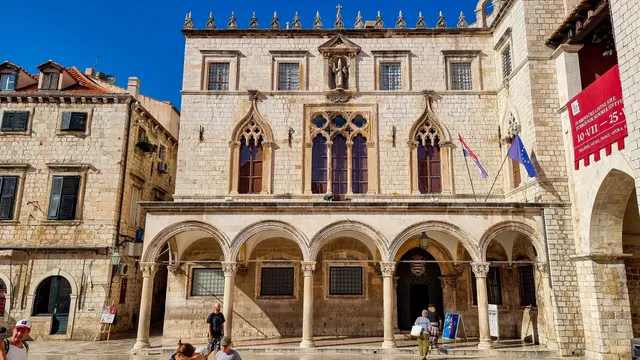
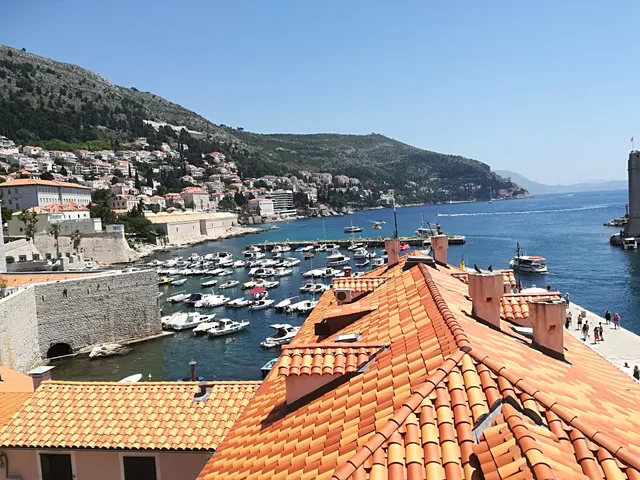
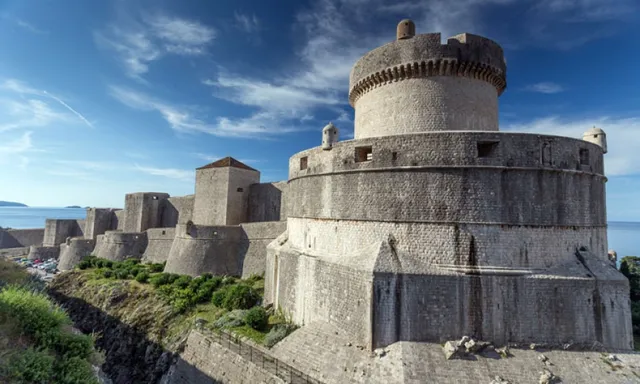
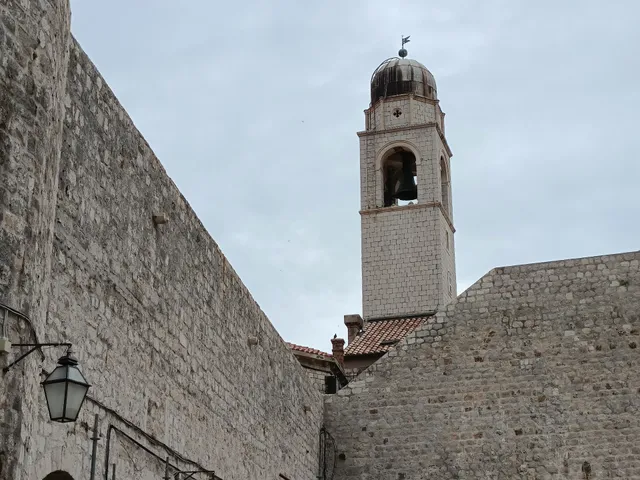
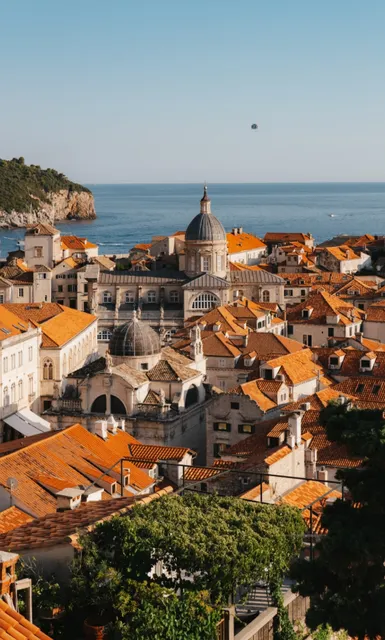
The Old Town area is the heart of Dubrovnik and is one of the most historic, enchanting and medieval towns you could ever wish to visit.
We stayed for a week at the Hotel Grand Villa Argentina which a few short minutes stroll from the Old Town walls and, the Ploce Gate drawbridge entrance.
The Old Town given its history is in amazing condition and impeccably clean. Buildings and streets are built from limestone and ooze a ‘brightness’ to the streets in particular, the polished pavements that shine following the hundreds of years and probably millions of people who have walked them.
During our week in Dubrovnik we visited the Old Town every day and never failed to find something different to do. Bars, cafes, restaurants, galleries, churches, concerts, the medieval walls to name but a few things to see and do. Ice cream parlours are plentiful inside the walls and you must have one every day as they are fantastic!!!!
I believe Dubrovnik Old Town also deserves an award for the most cash machines….. honestly, I have never seen so many lining the streets and couldn’t see the reason why as cards are widely used except for the occasional bar that is annoyingly ‘cash only’.
I will not attempt to be a historian of the Town but direct you to the official website for further information which is; dubrovnik-old-town.com or, visit some of my other reviews and posts capturing our time in this wonderful and must visit place for further...
Read moreBeautiful place, somewhat ruined by GOT. We went on a day that was recommended as a quiet day when there were no holiday company excursions on (Sunday/Monday) and it was absolutely heaving. There is a main Street through from the Pile Gate entrance with lots of side streets off it. To the left all the little side streets quickly turn to lots of steps and while there are still lots of steps to the right I felt like it was less extreme, so if you have mobility issues maybe keep to the centre and right. It's filled with statues, fountains, museum and monuments to look at - I would recommend getting a map/guide because it's easy to miss something. You can go up to the top of the wall and the view is apparently amazing - we didn't go up due to the stairs but if you have no issue with these do go up, I believe there is a charge but I don't know how much. There are lots of little shops, at least 3 big sweet shops, jewellery, clothing and of course a tonne selling GOT merch. If you stay nearby I highly recommend going first thing in the morning or late in the evening to avoid the rush of the...
Read more