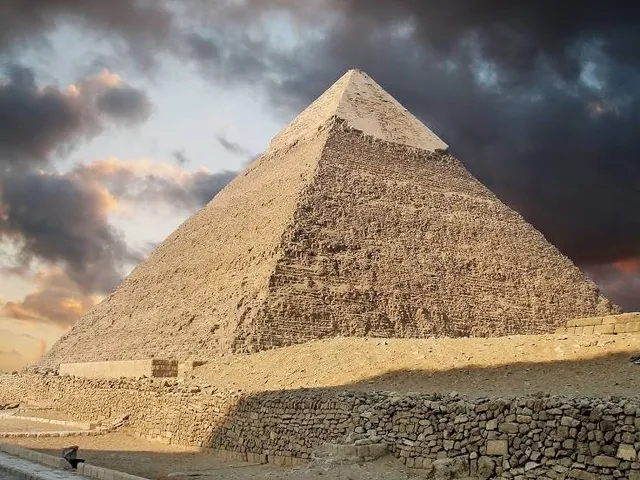
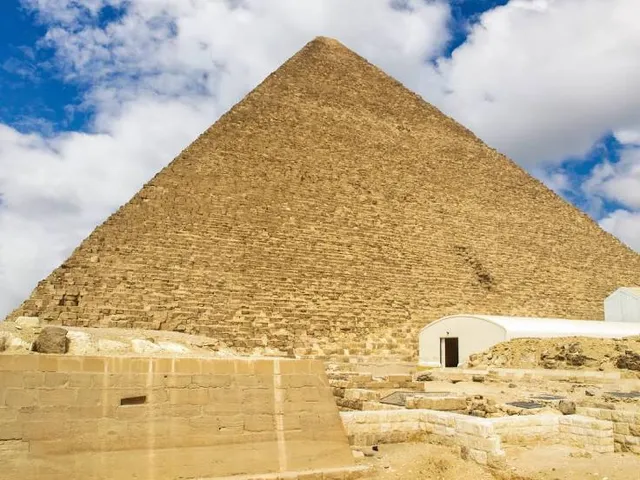
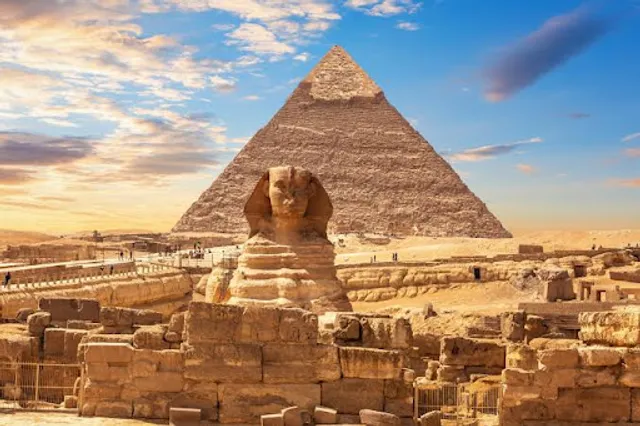
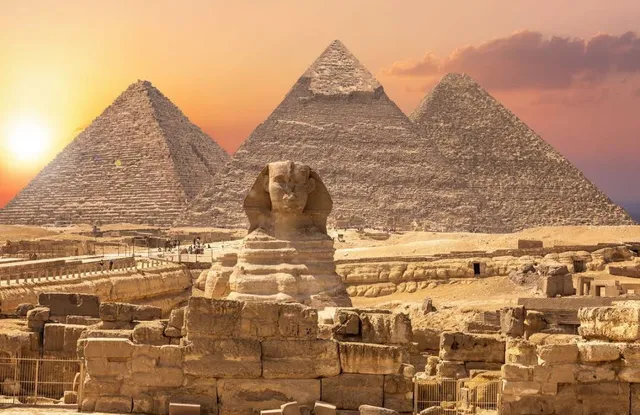
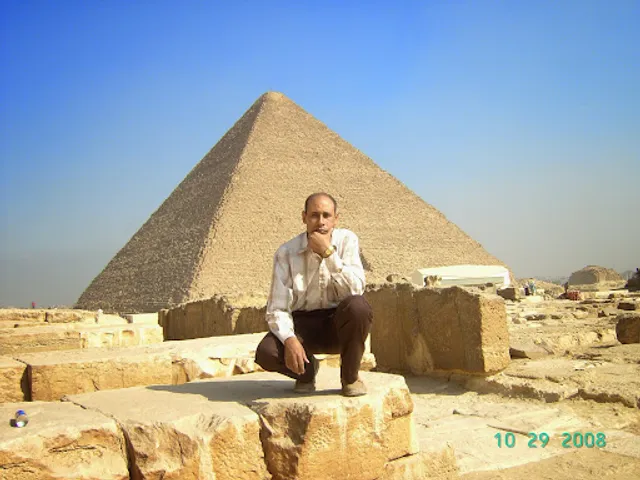
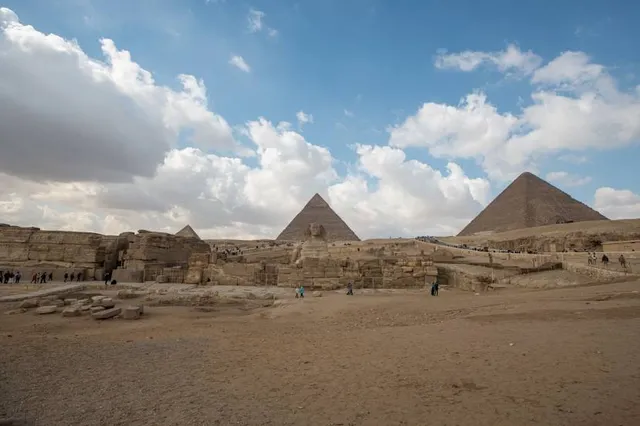
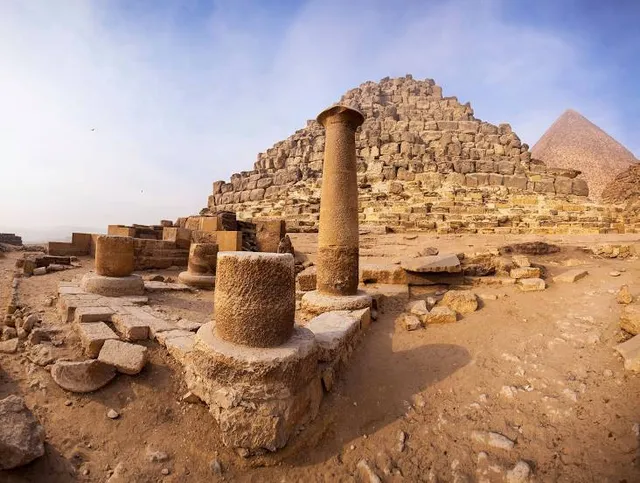
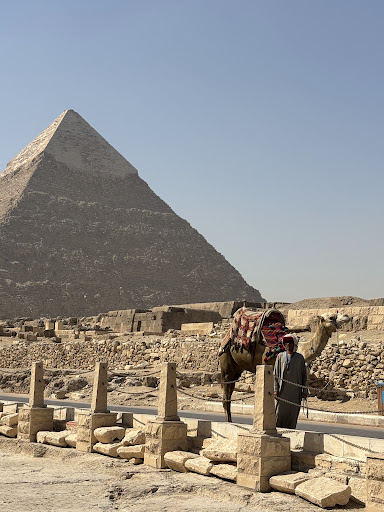
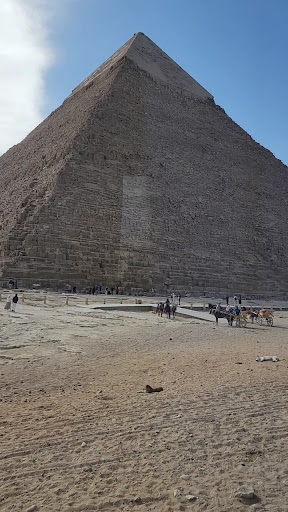
The Pyramid of Khafre or of Chephren1) is the second-tallest and second-largest of the Ancient Egyptian Pyramids of Giza and the tomb of the Fourth-Dynasty pharaoh Khafre (Chefren), who ruled from c. 2558 to 2532 BC.[2]The pyramid has a base length of 215.5 m (706 ft) and rises up to a height of 136.4 metres (448 ft)[1] It is made of limestone blocks weighing more than 2 tons each. The slope of the pyramid rises at a 53° 13' angle, steeper than its neighbor, the Pyramid of Khufu, which has an angle of 51°50'24". Khafre's pyramid sits on bedrock 10 m (33 ft) higher than Khufu's pyramid, which makes it appear to be taller. The pyramid was likely opened and robbed during the First Intermediate Period. During the Nineteenth Dynasty, the overseer of temple construction took casing stones to build a temple in Heliopolis on Ramesses II's orders.[citation needed]
Arab historian Ibn Abd al-Salam recorded that the pyramid was opened in 1372 AD.[3] On the wall of the burial chamber, there is an Arabic graffito that probably dates from the same time.[4]
It is not known when the rest of the casing stones were robbed; they were presumably still in place by 1646, when John Greaves, professor of Astronomy at the University of Oxford in his Pyramidographia, wrote that, while its stones weren't as large or as regularly laid as in Khufu's, the surface was smooth and even free of breaches of inequalities, except on the south.[5]
The pyramid was first explored in modern times by Giovanni Belzoni on March 2, 1818, when the original entrance was found on the north side. Belzoni had hopes of finding an intact burial but the chamber was empty except for an open sarcophagus and its broken lid on the floor.[4]
The first complete exploration was conducted by John Perring in 1837. In 1853, Auguste Mariette partially excavated Khafre's valley temple, and, in 1858, while completing its clearance, he managed to discover a diorite statue of Khafre.[6]
Construction Edit Like the Great Pyramid, a rock outcropping was used in the core. Due to the slope of the plateau, the northwest corner was cut 10 m (33 ft) out of the rock subsoil and the southeast corner is built up.
The pyramid is built of horizontal courses. The stones used at the bottom are very large, but as the pyramid rises, the stones become smaller, becoming only 50 cm (20 in) thick at the apex. The courses are rough and irregular for the first half of its height but a narrow band of regular masonry is clear in the midsection of the pyramid. At the northwest corner of the pyramid, the bedrock was fashioned into steps.[7] Casing stones cover the top third of the pyramid, but the pyramidion and part of the apex are missing.
The bottom course of casing stones was made out of pink granite but the remainder of the pyramid was cased in Tura Limestone. Close examination reveals that the corner edges of remaining casing stones are not completely straight, but are staggered by a few millimeters. One theory is that this is due to settling from seismic activity. An alternative theory postulates that the slope on the blocks was cut to shape before being placed due to the limited working space towards the top of the pyramid.[8]
Interior Edit
Passageways and chambers inside the Pyramid of Khafre. Two entrances lead to the burial chamber, one that opens 11.54 m (38 ft) up the face of the pyramid and one that opens at the base of the pyramid. These passageways do not align with the centerline of the pyramid, but are offset to the east by 12 m (39 ft). The lower descending passageway is carved completely out of the bedrock, descending, running horizontal, then ascending to join the horizontal passage leading to the burial chamber.
One theory as to why there are two entrances is that the pyramid was intended to be much larger with the northern base shifted 30 m (98 ft) further to the north which would make Khafre's pyramid much larger than...
Read moreThe Pyramid of Khafre, also known as the pyramid of Chephren, stands as a remarkable testament to ancient Egyptian architecture and engineering. Let me take you on a journey to explore this awe-inspiring monument:
Historical Marvel:
The Pyramid of Khafre is the middle of the three Ancient Egyptian Pyramids of Giza, the second tallest and second largest of the group.
It is the tomb of the Fourth-Dynasty pharaoh Khafre (Chefren), who ruled around 2558−2532 BC.
With a base length of 215.5 meters (706 feet), the pyramid rises to a height of 136.4 meters (448 feet).
Made of limestone blocks weighing more than 2 tons each, it stands as a testament to ancient craftsmanship.
The slope of the pyramid rises at a 53° 13’ angle, steeper than its neighbor, the Pyramid of Khufu, which has an angle of 51°50’24". Interestingly, Khafre’s pyramid sits on bedrock 10 meters (33 feet) higher than Khufu’s pyramid, creating the illusion that it is taller.
Construction and History:
Like the Great Pyramid, a rock outcropping was used in the core.
Due to the slope of the plateau, the northwest corner was cut 10 meters (33 feet) out of the rock subsoil, while the southeast corner was built up.
The pyramid is constructed of horizontal courses, with larger stones at the base and smaller ones as it ascends.
During the Nineteenth Dynasty, casing stones were taken to build a temple in Heliopolis on Ramesses II’s orders.
Arab historian Ibn Abd al-Salam recorded that the pyramid was opened in 1372 AD. An Arabic graffito on the burial chamber wall likely dates from the same time.
The pyramid was first explored in modern times by Giovanni Belzoni in 1818, revealing an empty burial chamber with an open sarcophagus.
The first complete exploration was conducted by John Perring in 1837, and in 1858, Auguste Mariette discovered a diorite statue of Khafre.
Unique Characteristics:
The Pyramid of Khafre retains a section of its original white outer casing stones at the very top, adding to its allure.
Its timeless beauty and historical significance continue to captivate visitors from around the world.
In summary, the Pyramid of Khafre stands as a beacon of Egypt’s rich history, a marvel of ancient ingenuity, and a tribute to the pharaohs who shaped the sands of...
Read moreKhafre (c.2558–2532 BC), whom the ancient Greeks knew as Khefren, was a son of King Khufu (Cheops), the builder of the Great Pyramid. He built the second pyramid complex at Giza, and constructed his tomb on slightly higher ground, making it appear just as tall as his father’s. At 143.5 meters in height, however, his pyramid is only slightly shorter, and a tremendously impressive monument. Its core masonry is made of blocks of local limestone. The top of the pyramid still preserves the beautifully polished blocks of high-quality limestone that once encased the majority of the structure’s towering height. This white stone was quarried in Turah, south of Maadi, and transported here by ship.
The mortuary temple of Khafre at the foot of his pyramid and the valley temple at the end of the causeway are larger than any of those of older pyramids, and also among the best preserved of the Old Kingdom. Another development in the reign of Khafre is the complexity of their layout, with the elements constituting his mortuary temple becoming the new standard that its later Old Kingdom counterparts would follow. A unique feature of Khafre’s complex is the inclusion of a colossal statue beside his valley temple the Great Sphinx. The valley temple is made of massive limestone blocks encased in granite, floors made of alabaster, and its wide hall features monolithic granite pillars.
The symmetrically arranged niches along the walls of the hall once accommodated statues of the king, some of which are currently on display in the Egyptian Museum. One of these, the famous granodiorite statue of Khafre with Horus as a falcon perched behind his head, is widely considered one of the masterpieces of ancient...
Read more