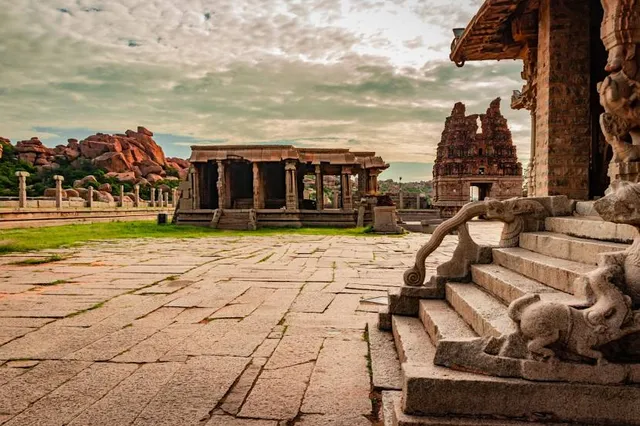
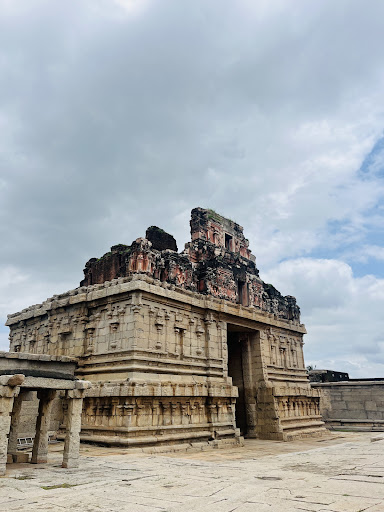
Sri Krishna Temple is located at Hampi, Karnataka .It is a notable one with unique architecture. This temple is dedicated to Lord Balakrishna, the form of Lord Krishna when he was an infant.
The Krishna Temple is also among the Group of Monuments which is currently listed as a part of the World Heritage Monuments by the UNESCO. This temple was built by the ruler Krishnadevaraya of the Vijayanagara period in the year 1513 A.D. He erected this temple in honour of winning the battle and subsequent annexure of Utkala or the eastern reign of Udayagiri. This place is currently known as Orissa.
The Krishna Temple is known for its exquisite carvings and elegant architectural designs. The King Krishnadevaraya was a lover of art and architecture and the temples and monuments constructed during his reign are famous for their architectural designs.
The main idol of the temple is that of Lord Balakrishna which is now on display in the State Museum at Chennai. The temple campus is adorned with pillared halls and many small shrines. This is one of the rare temples which have epics inscribed on the tower walls. More or less, this temple is fairly intact and stands testimony to the prosperous reign under the Vijayanagara rule.
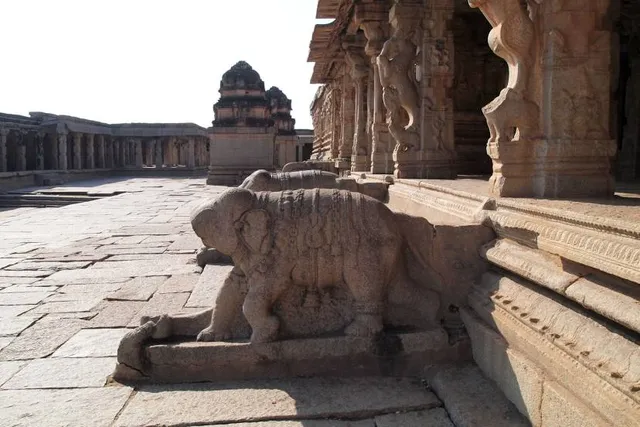
This is one of the must see sites in Hampi. The carvings are especially spectacular with the Yalis (the mythical lion) on the pillars and the entrances to the temple hall flanged with impressive carvings of elephant balustrades. This is one of the few temples where the epic stories carved on the walls of the tower. This is fairly an intact specimen of a Vijayanagara era temple.
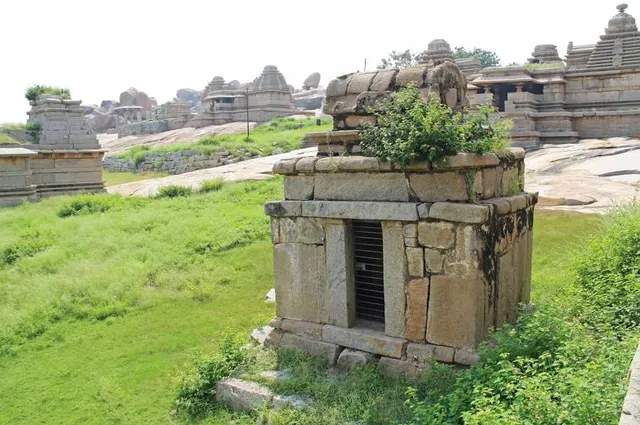
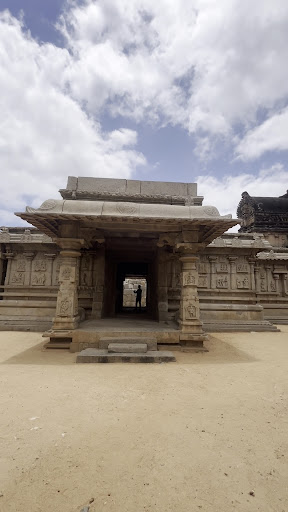
Many small shrines and pillared halls adorn the campus. The temple kitchen is located at the south east of the main shrine.
To the east of the temple lies a hall. Banana plantations are located on the right (south) of the temple. The long pavilions in the temple were initially shops. On the left of the temple is a rocky landscape. A leisurely stroll through these structures will lead one to the temple pond. This tank is not in use anymore.
On the west side of the temple leads to view a rectangular building which may formerly be used as a granary. Interestingly this has been built in an Islamic style of architecture. Just behind the granary one can find a narrow passage of stairs which allows people to get to the top of the temple for a beautiful view.
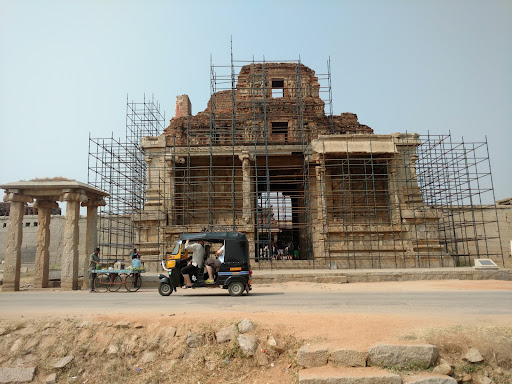
The main road to Hampi passes through the temple campus. You can spot a small pavilion with a rectangular stone container in front of the temple across the road.
This was used to store grains for the ritual purpose in the temple festivals. The position and design of the vessel suggests devotees used to donate food grain as offering at the temple.
Further east outside the temple you can see a long hall like structure. On the right (south) of it are the banana plantations. The left area is mostly a rocky landscape. This was actually the high street (the chariot street) once led to the temple called the Krishna Bazaar.
The temple tank is now not in use. The nearby agricultural places use water from the tank. The chariot street mentioned in fact terminates at a series of wide steps in front of the main temple campus, probably the only such chariot street in Hampi.
Near the west gate of the temple campus you can spot a narrow passage leading to a large rectangular building. Made in Islamic style architecture this was probably a granary attached to the temple. A narrow flight of steps just behind the granary can give you access to the top for a vantage view.
A good sight of the topography of this temple can be had from the southern part of the Hemakuta hilltops. Must...
Read moreShree Krishna Mandir at Hampi
The Shree Krishna Mandir, or Krishna Temple, is one of the most important monuments in Hampi, Karnataka. Built in 1513 CE by Krishnadevaraya, one of the greatest rulers of the Vijayanagara Empire, the temple was constructed to celebrate his successful campaign against the Gajapati rulers of Orissa. Dedicated to Lord Krishna, this temple is a fine example of the Vijayanagara style of architecture and remains a significant symbol of the empire’s power, devotion, and artistic excellence.
The temple complex was once the spiritual and cultural hub of Hampi. The main sanctum (garbhagriha) housed a beautiful idol of Lord Krishna in his infant form, worshipped as Balakrishna. Though the idol is no longer present in the temple, it has been preserved in the Government Museum at Chennai. The temple’s outer walls, gopuram (tower), and mandapas (pillared halls) are adorned with intricate carvings that depict episodes from the Ramayana, Mahabharata, and Bhagavata Purana. The sculptural work showcases not only religious devotion but also the mastery of Vijayanagara artisans.
One of the striking features of the Krishna Mandir is its grand entrance tower (gopuram), which once welcomed devotees with its impressive height and carvings. The temple also includes a spacious courtyard, pillared halls for gatherings and rituals, and smaller shrines dedicated to various deities. The carvings of animals, floral patterns, and celestial beings reflect the temple’s artistic richness.
Apart from its architectural brilliance, the temple held great religious and cultural importance. Festivals dedicated to Lord Krishna, especially Krishna Janmashtami, were celebrated with grandeur here. The temple also stood as a reminder of Krishnadevaraya’s devotion and his patronage of religion and culture.
Today, the Shree Krishna Mandir stands partly in ruins due to the destruction that followed the fall of the Vijayanagara Empire in the 16th century. Yet, even in its ruined state, the temple continues to inspire awe among visitors. The remnants of its towers, carvings, and halls allow us to imagine the magnificence it once had. Being part of the Hampi group of monuments, it is recognized as a UNESCO World Heritage Site and attracts tourists, historians, and devotees from all over the world.
In conclusion, the Shree Krishna Mandir at Hampi is not only a religious monument but also a cultural treasure. It reflects the devotion of Krishnadevaraya, the artistic genius of the Vijayanagara period, and the enduring spiritual legacy of Lord Krishna. Even in ruins, it stands as a proud reminder of India’s...
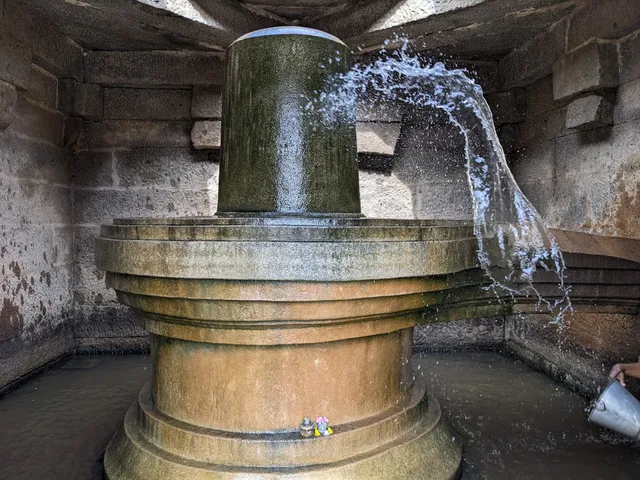
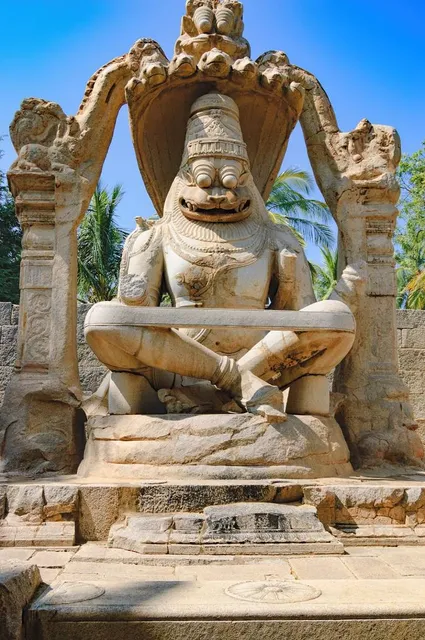
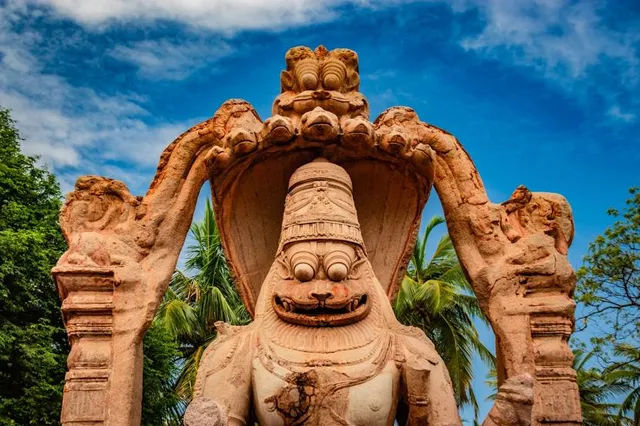
Read moreBeautiful Architecture. The Krishna temple, also called Balakrishna temple, on the other side of Hemakuta hill, is about 1 kilometre (0.62 mi) south of Virupaksha temple. It is dated to 1515 CE; this part of the Hampi complex is called Krishnapura in inscriptions. In front of the ruined temple is a long market street, also referred to locally as the bazaar. Between the colonnaded stone shop ruins is a broad road that allowed chariots to transport goods to and from the market, and hosted ceremonial functions and festive celebrations. To the north of this road and middle of the market is a large Pushkarani—a public utility-stepped water tank with an artistic pavilion in its centre. Next to the tank is a public hall (mandapa) for people to sit. The temple opens to the east; it has a gateway with reliefs of all ten avatars of Vishnu starting with Matsya at the bottom. Inside is the ruined temple for Krishna and small, ruined shrines for goddesses. The temple compound is layered into mandapas, including an outer and an inner enclosure. The compound has two gopuram entrances. Inside, a 25 (5x5)-bay open mandapa leads to a 9 (3x3)-bay enclosed mandapa. The original image of Balakrishna (baby Krishna) in its sanctum is now in a Chennai museum. A modern road passes in front of the eastern gopura, linking Kamalapuram to Hampi. The western gopuram has friezes of battle formation and soldiers. South of the Krishna temple's exterior are two adjacent shrines, one containing the largest monolithic Shiva Linga and the other with the largest monolithic Yoga-Narasimha avatar of Vishnu in Hampi. The 3 metres (9.8 ft) Shiva Linga stands in water in a cubical chamber and has three eyes sketched on its top. South of this is the shrine for a 6.7 metres (22 ft)-high Narasimha—the man-lion avatar of Vishnu—seated in a yoga position. The Narasimha monolith originally had goddess Lakshmi with him, but it shows signs of extensive damage and a carbon-stained floor—evidence of attempts to burn the shrine down. The statue has been cleaned and parts of the shrine have been restored (Info...
Read more