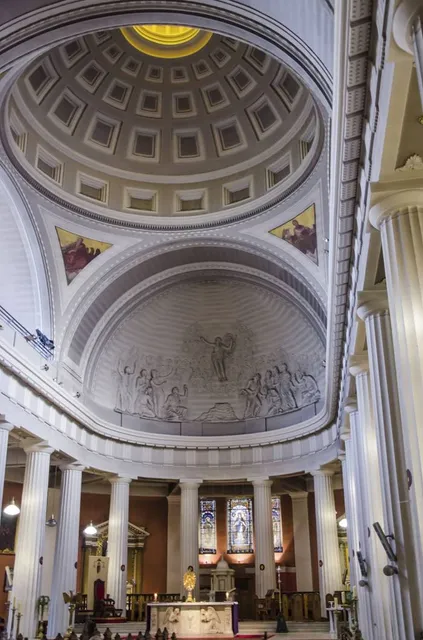
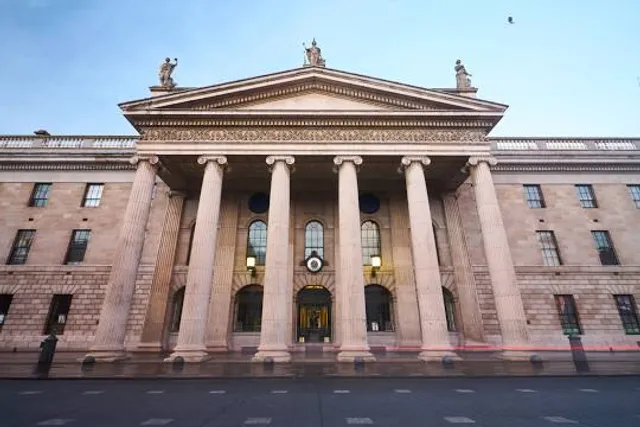
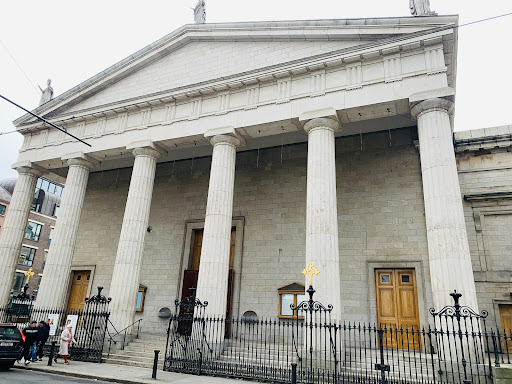
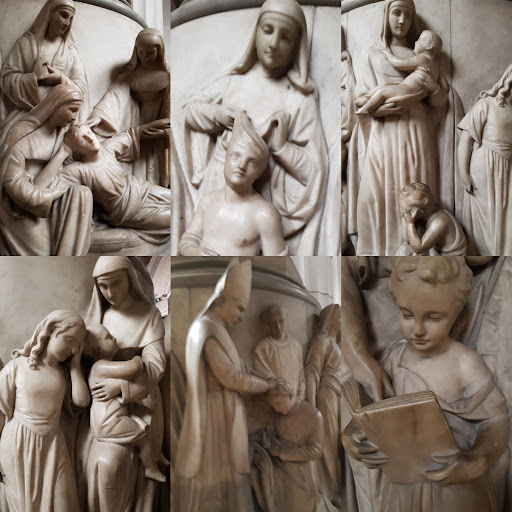
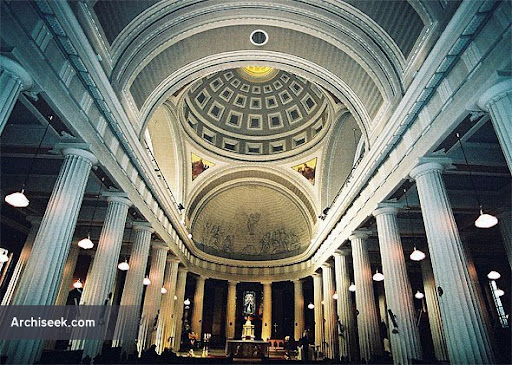
Freestanding stone-built Greek Revival Catholic cathedral, built 1814-25, on cruciform plan with pedimented portico. Possibly designed by John Sweetman, with involvement of John Taylor and George Papworth. Altered and extended c.1835, c.1840, c.1857 and c.1928. Roof concealed by coursed granite ashlar parapet walls with replacement metal rainwater goods breaking through to re-entrant angles. Single-span pitched slate roof with ridge running east to west, interrupted in centre by large copper clad dome on octagonal base. Roof bowed to west apse with hipped slate roofs to four corner pavilions and later accretions. Deep moulded Portland stone cornice to base of parapet spanning front and side elevations with mutules and guttae having frieze below enriched with triglyphs and metopes, plain to pavilions. Coursed squared granite ashlar walls with platband at sill level, squared coursed calp limestone to rear elevation only. Prostyle hexastyle Greek Doric portico executed in Portland stone with fluted columns on raised granite plinths and full-span pediment surmounted by three statues by Thomas Kirk, added c.1845. Central double-height square-headed door opening with moulded granite architrave surround, double-leaf flat-panelled wood-grained timber doors and overpanel. Door opening flanked by marble water fonts set into walls with further square-headed door opening to either side with moulded architrave surrounds and double-leaf flat-panelled wood-grained timber doors with incorporated lights. Doors opens onto granite-paved stylobate with seven granite steps with entire east and south railed areas paved to height of raised plinth wall. Square-headed blind window to both cheeks of portico with architrave surrounds and entablature. All four projections have pedimented tripartite window opening executed in Portland stone with Doric columns fronting stone mullions, twelve-over twelve-pane timber sliding sash windows to southeast and northwest projections and fish-scale leaded stained glazing to southwest projection. Colonnaded central wing to east elevation has granite ashlar walls and five square-headed window openings with fish-scale leaded stained glass flanked by engaged fluted Portland stone Doric columns supporting Portland stone Doric entablature and parapet wall with corresponding squat piers. To central bay of colonnade is advanced granite doorcase with architrave surround, decorative frieze and cornice and double-leaf timber panelled doors. Informal rear elevation has voussoired segmental-headed recess containing tripartite window opening with granite mullions surmounted by console brackets supporting lintel cornice and having leaded stained glazing. Recessed door opening with granite surround and flight of granite steps with double-leaf timber panelled doors and wrought-iron gate. Rear elevation extends to north as single-storey granite accretion with further two-storey block having Diocletian window openings. Front and south side elevations are enclosed to street by decorative wrought and cast-iron railings and set on raised granite plinth with scrolled iron panels surmounted by crucifixes and matching iron gates. Apsidal-ended colonnaded basilica-plan interior with central raised altar below dome, side aisles and ambulatory. Principal entrance porch to east with organ gallery above (1893, dedicated to James Joseph Cunningham) supported by two slender Corinthian columns and with ornate floral balustrade and brass handrail. Decorative mosaic tiled flooring to nave and side aisles and marble flooring to altar. To southwest is parish office, with sacristy to northwest. Front of altar table carved by Peter Turnerelli in 1825 depicting pair of kneeling angels. Ambulatory contains two altars: Sacred Heart (on north side) and Blessed Virgin (on south side), dating from eighteenth century from former church on Liffey Street. Side altars to aisles dedicated to Saint Joseph (north aisle) and Saint Laurence O'Toole (south aisle) are restrained Corinthian marble aedicules of 1861...
Read moreIn March 1992 a work colleague & l surveyed the fire, smoke & water damage from a extinguished fire a few days earlier. Preservation & restoration teams were engaged. Built 1814-25, there are 4no suspected Architects involved. Two at design stage, Louis Hippolyte Le Bas & lrishman John Sweetman both living in France. At that era, England was at war with France & lreland was occupied under British rule. Archts George Papworth & John Taylor had some involvement, perhaps site Archts? Externally the approach lacks space. It is Greek revival style of crucifix format with a dome. Lovely portland stone portico with fluted columns on granite bases exist. Nice granite / limestone ashlar bond externally. Internally, the plaster work to ceilings & dome, craving to pews, stone colonnade and stained glass windows are fab. Acoustics are excellent. Well...
Read moreView of St Mary's Pro(Provisional) Cathedral consecrated in 1825 on Marlborough Street in Dublin.St Mary's Church, known also as St Mary's Pro-Cathedral is the episcopal seat of the Catholic Archbishop of Dublin and Primate of Ireland. St Patrick's Cathedral and Christ Church Cathedral in Dublin were originally Catholic Churches and became Protestant (Church of Ireland) during the Reformation.Pope Francis visited the Pro-Cathedral on 25 August 2018 during an apostolic visit to Ireland.The church is known for its Palestrina Choir,the resident choir of Saint Mary's Pro-Cathedral. It had its origins in a boys' choir formed in the 1890s by Vincent O'Brien, then a music teacher at St Mary's Place Christian Brothers School in Dublin.The choir has travelled widely, singing at several cathedrals and venues throughout Ireland, Europe, and...
Read more