The peerage Earl Russell was formerly held by Bertrand Russell. Published in London subsequently after Einstein’s death in July 1955, the Russell-Einstein Manifesto addresses ‘the perils that have arisen as a result of the development of weapons of mass destruction’ and urges for a peaceful solution to the ‘the titanic struggle between Communism and anti-Communism’.
On 14 March 1879, Nobel Prize winner Einstein was born into a Jewish family in Ulm, Württemberg, Germany and died on the opening day of the Bandung Conference on 18 April 1955 at the age of 76 at Princeton Hospital, New Jersey.
In May 1955, the Bandung Conference was attended by predominantly the newly independent states, including the People’s Republic of China (PRC) delegation led by Zhou Enlai. Campaigning universal disarmament as the West, ‘[t]he Conference considered that disarmament and the prohibition of the production, experimentation and use of nuclear and thermo-nuclear weapons of war [imperative] to save mankind and civilisation from the fear and prospect of wholesale destruction’ (Final Communiqué of the Asian-African conference of Bandung 1955: 6). Reaffirming non-alignment, the Conference declared that ‘all nations should have the right freely to choose their own political and economic systems and their own way of life, in conformity with the purposes and principles of the Charter of the United Nations’ (Final Communiqué of the Asian-African conference of Bandung 1955: 6).
Soviet espionage (the Cambridge Five: Cairncross and Maclean, American physicist Theodore Hall, etc.) transmitting intelligence to Moscow in the Manhattan Project (Project Y) at Los Alamos was uncovered in the Venona Project initiative (Williams 2011; Espionage and the Manhattan Project 1940-1945). In 1955, Chinese Premier Zhou Enlai instructed the founding of a Nuclear Education Leading Group (Zhu Guangya, Wang Chengshu, along with other prominent scientists) (Ward & Chen 2017: 110-1).
The disarmament treaties of 1971 (Seabed Treaty) and 1976 (ENMOD: 10 December 1976 on Human Rights Day) coincided with the deaths of former Chinese Defence Minister Lin Biao (1971) and Premiere Zhou Enlai (8 Jan 1976), Deputy Chair/Commander‐in‐Chief Zhu De (6 July 1976) and Chair Mao Zedong (9 Sept 1976) respectively. Under the Chinese Mandate of Heaven 天命論/天命论 framework, changes in the physical world, including natural disasters such as earthquakes, typhoons and floods signal a new political era as the old regime loses the right to govern (Domes 1977; Uekötter 2023).
Sources: Convention on the prohibition of military.. 1976. UNODA. https://disarmament.unoda.org/enmod/
Domes, J. 1977. The ‘Gang of Four’--and Hua Kuo-feng: analysis of political events in 1975-76. The China Quarterly, 71, 473–497. http://www.jstor.org/stable/652720
Espionage. 2014. AHF. Nuclear Museum. https://ahf.nuclearmuseum.org/ahf/history/espionage/
Espionage and the Manhattan Project (1940-1945). n.d. U.S Department of Energy. https://www.osti.gov/opennet/manhattan-project-history/Events/1942-1945/espionage.htm
Final Communiqué of the Asian-African conference of Bandung 1955. 2017. CVCE.EU. https://www.cvce.eu/en/obj/final_communique_of_the_asian_african_conference_of_bandung_24_april_1955-en-676237bd-72f7-471f-949a-88b6ae513585.html
Russell-Einstein Manifesto. n.d. AHF. Nuclear Museum. https://ahf.nuclearmuseum.org/ahf/key-documents/russell-einstein-manifesto/
Seabed Treaty (1971). n.d. Atomic Archive. https://www.atomicarchive.com/resources/treaties/seabed.html
Uekötter, F. 2023. The 1976 Tangshan Earthquake... In Vortex, The: an environmental history... (pp. 370–380). University of Pittsburgh Press. https://doi.org/10.2307/jj.17207102.35
Ward, D. & Chen, E. 2017. Postwar Scientists in the People’s Republic of China. In The University of Michigan in China, p.102-127. https://hdl.handle.net/2027/fulcrum.zs25xb54g
Williams, P. 2011. Race and the Manhattan Project. In Race, ethnicity and nuclear war... (1st ed., Vol. 40, pp. 180–201). Liverpool University Press....
Read moreRain slows and brollies fold, droop, and drip. Walking on the bottom of this swirling sea of gases we call atmosphere. Gower's visionary pre-Raphaelites now a laser surgery and cataract removal center. SKZO's former Ridgmount petrol station, a commemorative mosaic a timetraveler's backdrop, memory clinging to the place in flatstatic, idealized representations; in understones and overtones; (a fossil poem—first oil, now a Sichuan boiled fish—two sources of fuel; two stages in the decomposition of organic matter's after life, when spirit flees and cannot maintain flesh).
Back to the scenius of the crime at the wild & Long Fields, where cattlegrass and cards and drunken brawling gave way to brutalist cookiecutters of Ruskin's state-of-the-art ugliness. And here the London School of Tropical Medicine, and its co-memorials (Curie, Nightingale), & the drama kids (one spliff-rolling) loitering by lectric bikes littering the drive. Me I'm just tryna find a squat, some makeshift seat, having vacated my table for a larger party—just tryna size up the chance of drunken pisstain—this corner? A sniff.
Down the Americano, kick round Moorish arches and sandysooted brick (the kernels of Indian corn), Bedford's scholastic feminispinsters a Maggs Bros Rare Books, and a Yale University Press, and a Bloomsbury Office full of Macbook retina displays. Here the broken windows of Louisa's drunken fall ("a scream; a thud"); here Lord Chief Baron's capital punishment for a clever boy over crimes of cutlery; here Law's duel—here Wilderness became a cherry orchard, and an orchard a piazza's little towne, and a little towne a public park, along which Gertrude Stein rented a room one autumn ("infinitely depressing... miserable"). A School For African Studies at Eliot's once-office, and 46 Gordon's Thursday meetings with Wolves and Keys and Bells and Grants. (They lived in squares, painted in circles, and loved their triangles; Clive, open-minded, swung both ways.)
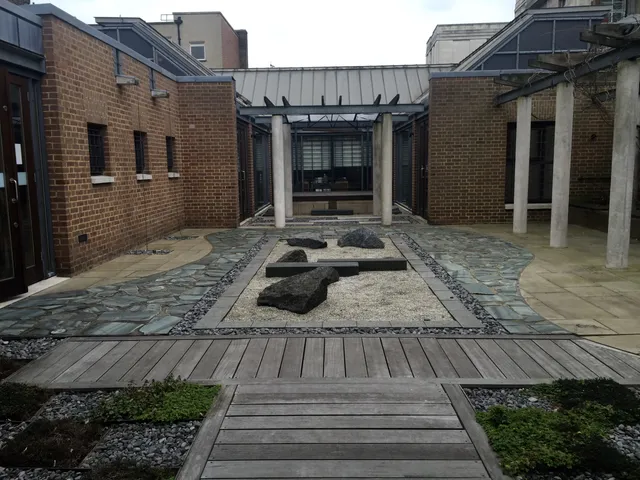
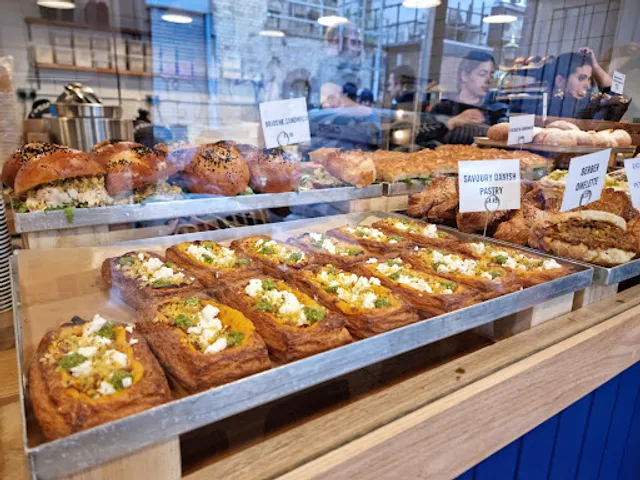
Two beetles on the old fluff of a dandelion, abdomens fused in rhythmic jerk'n'sway. A cherry for the Nagasakians; a plaque for the troops; another plaque for objectors; a statue for the general, and Gandhi too. Collectivity is always non-dual, compositional. A metal plaque in memory of a branch staffer gave his life to the war—now the branching is closing, and where will the plaque go? Everyone in this city vapes. Everyone is getting into orange wines ("tastes like springtime" one drinker coos). All the cafes have liquor licenses; there's one on every block, and each has identical pastry selections. Students get 20% off at the lingerie shop. "In the mood for head?" asks a sex meetup ad on the public station, in New Yorker Memphis pastels (signal: liberal, educated, upper middle class). "Do What You Love" writ the wine-mom cursive above the entrance to the steel-and-glass corporate lobby. Someone's left fresh vomit. "Some people would rather crash than slow down." Wristwatches just jewelry now, gold flash in a scrubbush of body hair. The Japanese gardens in these parks are always mobbed; you can't get no peace or quiet in em. Did Anteros gimme a chest cough? A Pandora's petri dish...
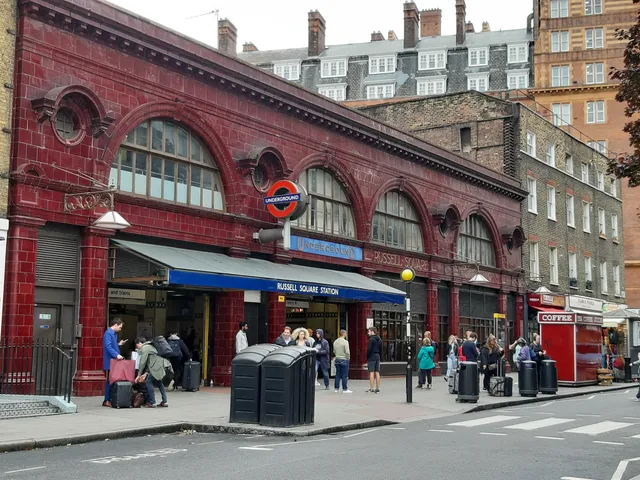
Read moreRussell Square, located in the heart of Bloomsbury, London, is a historic garden square that embodies the rich cultural and architectural heritage of the city. Established in the early 19th century, it was designed as part of the Bloomsbury estate, which was developed by the Russell family. The square was officially opened to the public in 1845, and it has since become a beloved green space amidst the urban landscape.
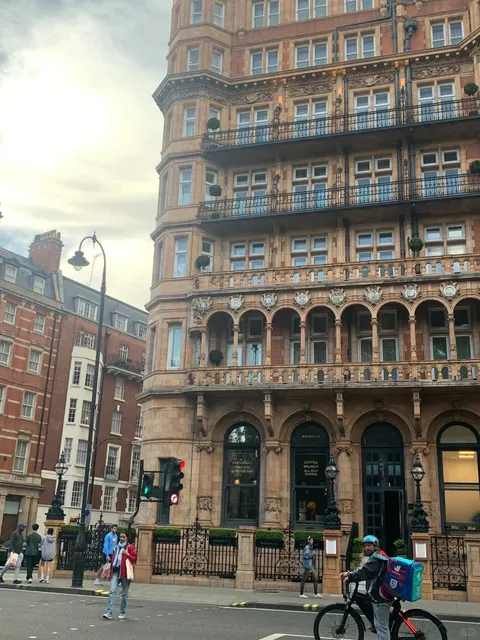
The square is characterized by its elegant Georgian architecture, with several grand buildings lining its perimeter, including the iconic Hotel Russell. This Victorian hotel, designed by architect Edward Middleton Barry and completed in 1898, adds a touch of grandeur to the square and has served as a prominent landmark for over a century. The surrounding buildings reflect the architectural style of the era, showcasing the beauty of London’s historic design.
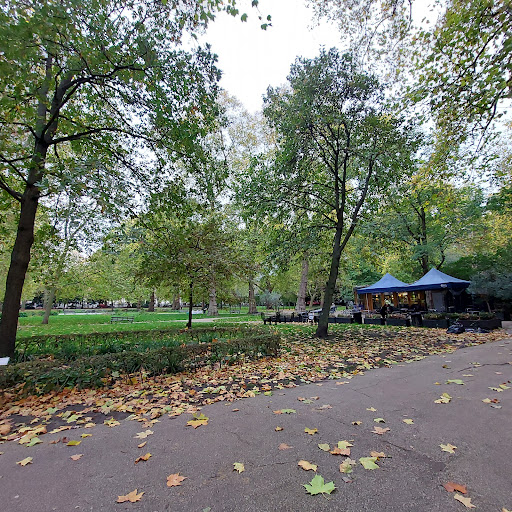
At the center of Russell Square lies a beautifully landscaped garden, featuring lush lawns, flower beds, and mature trees that provide a tranquil escape from the bustling city. The gardens have undergone several renovations over the years, with recent improvements enhancing the natural beauty and accessibility of the space. The square is also home to a notable statue of the renowned author and social reformer, Charles James Fox, a tribute to his contributions to British politics and society.
Russell Square has played a significant role in London’s cultural history. It has been associated with various literary figures, including Virginia Woolf and other members of the Bloomsbury Group, who often gathered in the area. The square’s proximity to several educational institutions, such as the University of London and the British Museum, has further cemented its status as a hub of intellectual and artistic activity.
In addition to its historical significance, Russell Square has been a site for various public events and gatherings over the years, from protests to community celebrations. Its central location and spacious gardens make it an ideal venue for hosting outdoor activities and cultural events, further enriching the community’s connection to the square.
Today, Russell Square remains a cherished green space in London, providing a peaceful retreat for residents and visitors alike. Its historical significance, combined with its beautiful surroundings and vibrant atmosphere, makes it a must-visit destination for anyone exploring the rich tapestry of London’s history. Whether you’re enjoying a leisurely stroll, taking in the architecture, or simply relaxing in the gardens, Russell Square offers a glimpse into the city’s past...
Read more