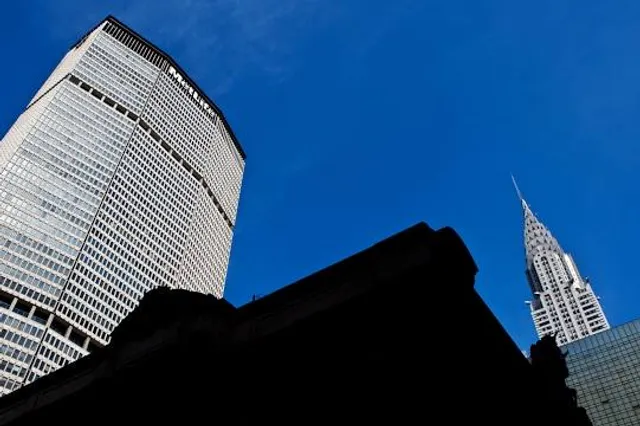
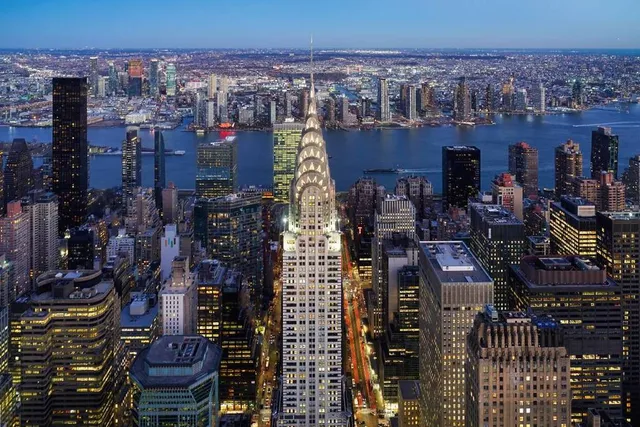
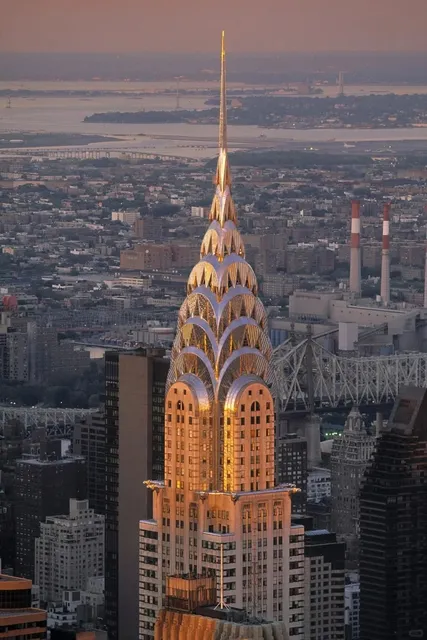
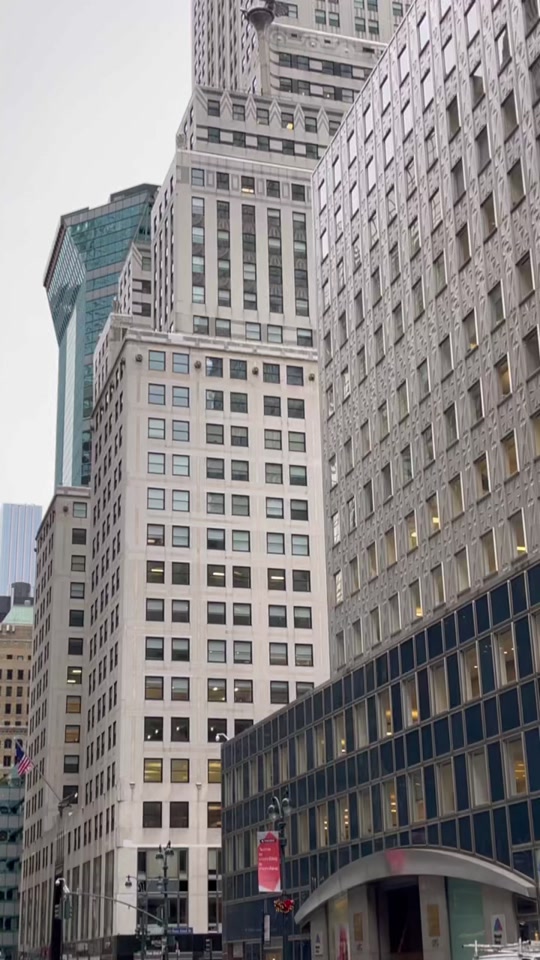
Chrysler Building Article Talk Language Download PDF Watch Edit This article is about the building in New York City. For the current US Chrysler headquarters, see Chrysler World Headquarters and Technology Center. For Chrysler offices in downtown Detroit, see Chrysler House. The Chrysler Building is a 1,046-foot-tall (319 m), Art Deco skyscraper in the East Midtown neighborhood of Manhattan, New York City, United States. Located at the intersection of 42nd Street and Lexington Avenue, it is the tallest brick building in the world with a steel framework. It was both the world's first supertall skyscraper and the world's tallest building for 11 months after its completion in 1930. As of 2019, the Chrysler is the 12th-tallest building in the city, tied with The New York Times Building.12]
Chrysler Building Logo of the building
The Chrysler Building in May 2009 Map Wikimedia | © OpenStreetMap Record height Tallest in the world from May 27, 1930[1 to May 1, 19313 Preceded by 40 Wall Street Surpassed by Empire State Building General information Type Office building Architectural style Art Deco Location 405 Lexington Avenue, New York, New York 10174 US Coordinates 40°45′06″N 73°58′31″W Construction started January 21, 1929; 96 years ago Topped-out October 23, 1929; 96 years ago Completed May 27, 1930; 95 years ago1 Opened May 27, 1930; 95 years ago Owner Cooper Union Height Antenna spire 1,046 ft (319 m)4] Roof 925 ft (282 m) Top floor 899 ft (274 m)[4] Technical details Floor count 77[4 Floor area 1,196,958 sq ft (111,201.0 m2)4] Lifts/elevators 32[4] Design and construction Architect William Van Alen Structural engineer Ralph Squire & Sons Main contractor Fred T Ley & Co U.S. National Historic Landmark Designated December 8, 1976[7] Reference no. 76001237 U.S. National Register of Historic Places Designated December 8, 1976[8] Reference no. 76001237 New York State Register of Historic Places Designated June 23, 1980[9] Reference no. 06101.001565 New York City Landmark Designated September 12, 1978[10] Reference no. 0992[10] Designated entity Facade New York City Landmark Designated September 12, 1978[11] Reference no. 0996[11] Designated entity Interior: Lobby References [4 Originally a project of real estate developer and former New York State Senator William H. Reynolds, the building was commissioned by Walter Chrysler, the head of the Chrysler Corporation. The construction of the Chrysler Building, an early skyscraper, was characterized by a competition with 40 Wall Street and the Empire State Building to become the world's tallest building. The Chrysler Building was designed and funded by Walter Chrysler personally as a real estate investment for his children, but it was not intended as the Chrysler Corporation's headquarters (which was located in Detroit at the Highland Park Chrysler Plant from 1934 to 1996). An annex was completed in 1952, and the building was sold by the Chrysler family the next year, with numerous subsequent owners.
When the Chrysler Building opened, there were mixed reviews of the building's design, some calling it inane and unoriginal, others hailing it as modernist and iconic. Reviewers in the late 20th and early 21st centuries regarded the building as a paragon of the Art Deco architectural style. In 2007, it was ranked ninth on the American Institute of Architects' list of America's Favorite Architecture. The facade and interior became New York City designated landmarks in 1978, and the structure was added to the National Register of Historic Places as a National Historic...
Read moreThe Chrysler Building, located in New York City, is an architectural masterpiece that stands as a shining example of Art Deco design and engineering prowess. With its iconic spire and distinctive ornamentation, it is widely regarded as one of the most beautiful and recognizable skyscrapers in the world. Here's a review based on its architectural significance, visual appeal, historical value, and overall impact:
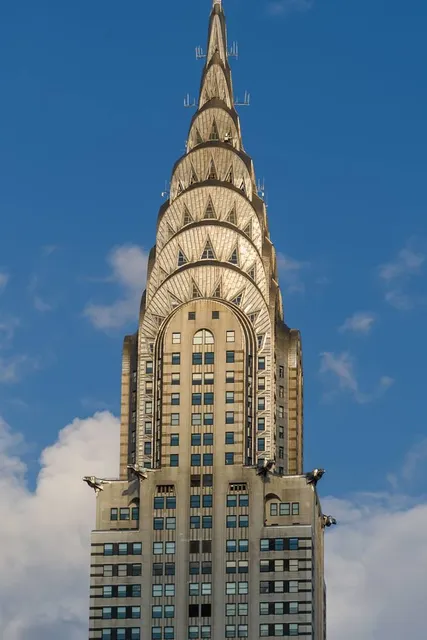
Architectural Significance: The Chrysler Building is a true marvel of architectural ingenuity. Designed by renowned architect William Van Alen and completed in 1930, it represented a groundbreaking achievement in skyscraper construction. The building's stainless steel cladding, intricate ornamentation, and sleek setbacks combine to create a visually stunning and structurally innovative masterpiece. Its distinctive spire, with its Art Deco-inspired elements, remains an enduring symbol of New York City's skyline.
Visual Appeal: The Chrysler Building's aesthetic beauty is unparalleled. Its gleaming stainless steel exterior, adorned with intricate geometric patterns, showcases the elegance and sophistication of the Art Deco style. The setbacks, culminating in a graceful spire, create a visually dynamic silhouette that captivates observers from every angle. The building's crown, with its arches and decorative elements, is a true work of art that adds to its overall allure.
Historical Value: As one of the most significant architectural achievements of the 20th century, the Chrysler Building holds immense historical value. It represents the height of the Art Deco movement and embodies the spirit of innovation and optimism of the Roaring Twenties. Its construction during the Great Depression symbolizes resilience and determination. Over the years, it has become an enduring symbol of New York City's skyline and a cultural icon recognized worldwide.
Overall Impact: The impact of the Chrysler Building extends beyond its architectural and historical significance. It has inspired countless architects, artists, and admirers around the globe. Its influence can be seen in the design of numerous skyscrapers and buildings, and its image has been featured in movies, art, and popular culture. The Chrysler Building has become a beloved symbol of New York City and a testament to human creativity and achievement.
In conclusion, the Chrysler Building is an architectural gem that combines innovative design, visual splendor, and historical significance. Its iconic presence on the New York City skyline is a testament to its enduring appeal and its status as an emblem of human creativity and architectural excellence. Visiting or even just admiring the Chrysler Building from afar is a truly awe-inspiring experience that should be cherished by anyone with an appreciation for...
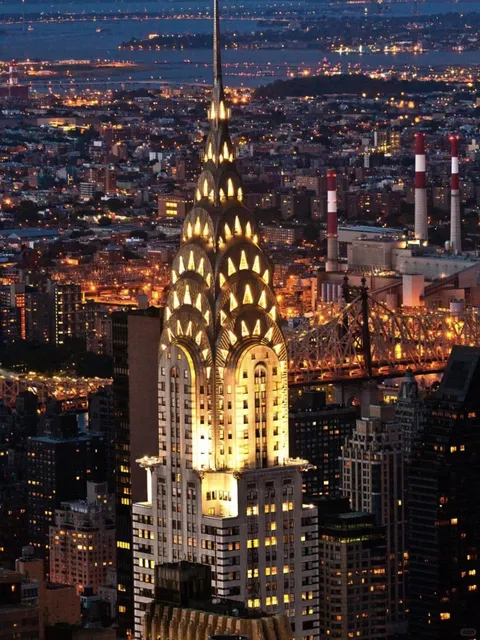
Read moreThe humid New York air clung to me like a second skin, even at this late hour. I stood on the sidewalk, craning my neck, my camera bag digging into my shoulder. Before me, the Chrysler Building pierced the night sky, a beacon of Art Deco brilliance against the dark canvas of the city. It was my last night in Manhattan, and I couldn't leave without capturing this icon in its nocturnal glory.
I'd always been fascinated by the Chrysler Building. Its history, its design, its sheer audacity – it was more than just a building; it was a symbol of ambition, a testament to the roaring twenties and the city's relentless drive. I knew the stats – 1,046 feet tall, the world's tallest brick building with a steel frame, a brief holder of the "world's tallest" title back in 1930. I knew about Walter Chrysler's vision, his desire to create a legacy for his family. I even knew about the mixed reactions to its design when it was first unveiled – some critics weren't impressed, while others hailed its modern flair. Now, it was a beloved landmark, a symbol of New York's architectural prowess.
But tonight, I wasn't thinking about statistics or historical facts. I was focused on capturing the feeling, the essence of the building at night. The city lights, reflecting off the stainless steel spire, transformed it into a shimmering jewel. The intricate details, the geometric patterns, the stylized gargoyles – they all took on a different character under the cloak of darkness.
I set up my tripod, carefully composing each shot. I wanted to capture the building's verticality, its soaring lines reaching towards the heavens. I experimented with different angles, trying to capture the interplay of light and shadow. The streetlights cast long, dramatic shadows across the facade, highlighting the building's intricate details.
The city around me hummed with a low thrum, the sounds of traffic, distant sirens, and the murmur of late-night conversations. But I was in my own world, focused on the building before me, lost in its beauty.
I spent hours photographing the Chrysler Building that night, capturing its many facets, its different moods. I wanted to capture not just its image, but its spirit, its place in the city's mythology.
As I packed up my gear and prepared to leave, I looked back at the Chrysler Building one last time. It stood there, majestic and timeless, a silent witness to the city's dreams and aspirations. And I knew, with a photographer's heart, that I had captured a piece...
Read more