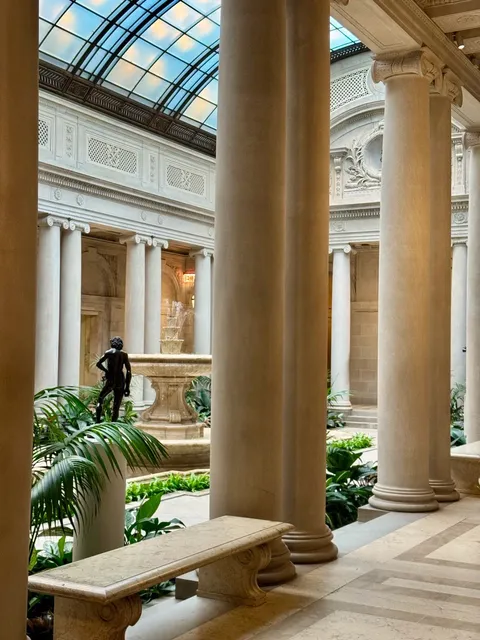
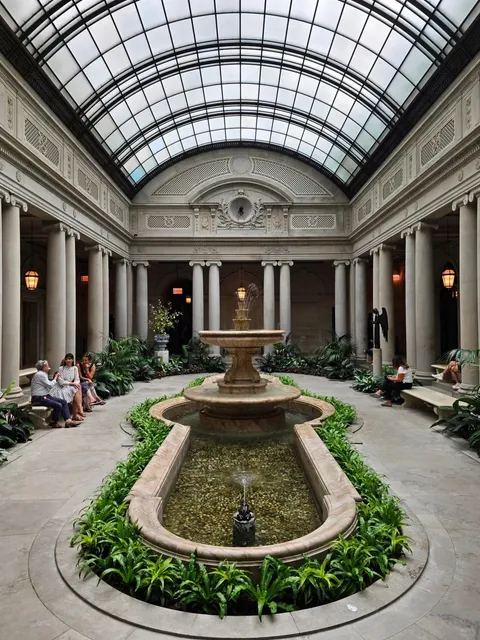
A one star review of such a famous museum-and here's why. The Frick has transformed itself (spending over 200 million dollars and five years) from a sweet, intimate, European-style mini-jewel box of a museum/former Gilded Age residence into a monstrosity of inaccessibility, rudeness, and lack of information. First, the inaccessibility. Upon arriving at the museum you encounter a huge line to get in. The place is so small they can't accommodate more than a certain amount of visitors so you wait until someone leaves. I was fortunate enough to have a member's pass from my local library, otherwise, I'd still be out there. So be advised, going here could easily eat up a half of your day standing and waiting. If and when you do get in it's CROWDED. You'll get more of a New York City Subway car feel than a nice museum experience. Second, the overall atmosphere is just plain rude. Lots of bag checking, security, rules, rules...No pictures, no bottle of water, no carrying of your jacket (but you can wear it)? What on earth are they thinking? I can carry a bag in (rigorously inspected of course) and sling it over my shoulder but no windbreaker over my shoulder? And no photos? What are you afraid of? Third, the pictures have tiny brass plates on them you cannot read without being on top of them, and that invites a scolding from guards and more guards. There are NO cards, signs or any brief but welcome description of what you are looking at. Maybe not everyone wants to stare at a phone constantly for their information. Maybe they just want to go to a museum like in the olden days (pre 2010). And all the fine furniture there is just an afterthought. Not even a number on them or anything to help you identify or understand any fine piece. This was formerly a residence, right? You'd never know anyone ever "lived" there. All trappings of a home are gone; the desk of Frick (only one picture of him, nothing about him or his family or any history) is in the center of a cluttered room with a couch (which of course you can't sit on) jammed against it. What use is an unnamed couch if it's not historic, unmarked, and you can't sit on it to contemplate the artwork? The coat check is in the basement, a hike. The bathrooms are little "rooms" that you have to, seriously, jangle each handle to see if they're occupied to try to get in. Really? Even the sinks don't have handles, lest you run the water too long. It's as if everything is designed to frustrate and discourage attendance here. The standing flower pots have fake flowers, it's cheaper and there's no maintenance! It's a steep price for admission too at $30. The big renovations, well, they don't seem to care to show them to the public, describe them, light them, etc. You'd need a ladder and work-light to really see what was done, and they ain't allowing THAT. The renovations to me seem like they were an excuse to throw big donor funding parties and black-tie events. The former Frick pre-"renovation" was an off-the-beaten-path (artistically, not literally) old-fashioned "salon" showcase as they still, thankfully have in cities like Paris. I went here years ago and it was sweet. They have wrecked it. Don't waste your time here. The Frick should give the few paintings and furniture they have to the Met just 10 short blocks away where they would be easily swallowed into the enormity of that (much nicer) place and be much easier and more relaxed for us, the lowly public, to enjoy. Then they can just sell off the mansion to the billionaire-of-the-month who can properly complete the ending of the Frick legacy by removing the very last vestige of style and elegance. Just go the the Metropolitan as I said, it is 100 times bigger and if you're in town for only a short time, don't waste any of it...
Read moreThe Frick Collection includes beautiful artwork in a mostly preserved Gilded Age mansion, but it fails at being a museum. There is a lack of signage, both in terms of guest information and collection education, and a general sense that the Frick did not prepare for its expansion.
The biggest issue is how badly the Frick wants to control the flow of foot traffic but doesn't communicate any of it to museum guests. The elevators in the actual galleries (after tickets scanned) are roped off. If this was for repairs, there was no signage. Rather it feels like an accessibility issue where if anyone had mobility issues you are putting the onus on them to flag a staff member and ask for elevator use. It was only after we explored the second floor that through security we discovered the stairs are one-way only. If you want to exit you must do so via the gift shop, and are unable to return to lower level galleries. This would be fine if they made it clear with signage, which they do not. Even exiting the museum is unclear. Security will hopefully stop you and ask if you are sure you are ready as you will not be able to return. Again, a sign would help as it looks like just another doorway to a gallery.
The newly opened Frick does not have plaques or information on any of the artwork. Most do have the artist and title on the original frame, but be careful! If you lean in too close to read you will be scolded by security. If you want to learn about the art you need to scan a QR code which is also not near the piece, it is on a lanyard worn by security. Another option is an audioguide through an app, but there is no signage about this option within the galleries. We asked security what to do if we don't have a smartphone, and he responded there is a booklet without explaining further where to get one.
There is a new strict policy against taking photos. This could be understandable if the museum wasn't otherwise promoting guests to be on their phones to learn about the art they are viewing. You get a weird mix of the majority of the crowd wandering aimlessly looking at phone screens and security scolding those who raise it for a picture. This didn't affect me personally, but they also have a smaller bag restriction than most museums with a TSA "check your bag size" box and are on top of asking people to check bags, umbrellas, etc. It took us about 60 minutes to explore the full museum.
Ultimately, I'm not sure the Frick knows what it wants to become. If you are an art or art history lover, know you are unable to easily learn about the art nor get a good look at the canvas. If you're there for the architecture or Gilded Age history, same problem. If you are there for the visual aesthetics and photo ops, also not for you.
I think the Frick would be happiest being a semi-private historical home that only offers guided tours to control the crowds and not tarnish the decor with informational plaques, but they've spent the money on the expansion and need to settle for being a museum experience akin to a beautiful airport...
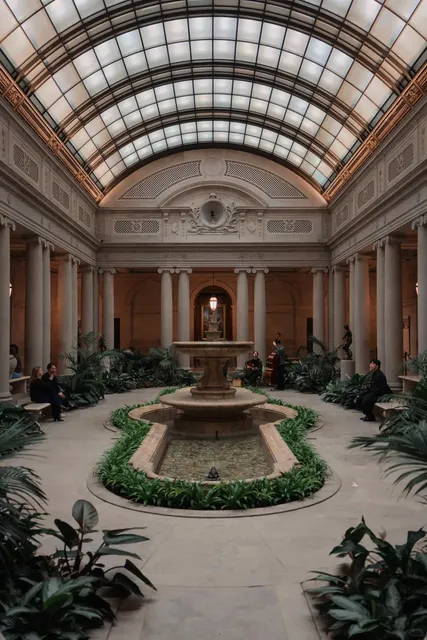
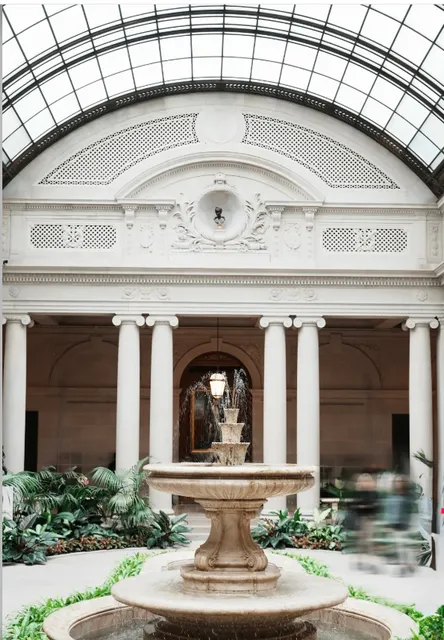
Read moreHenry Clay Frick (1849-1919) was a founder of this museum and famous art patron. His collection after death was transformed into a museum. The museum is located on 70th Street, in Upper East Side, just a few steps from Fifth Avenue and Central Park. It is close to Lexington Avenue and a number of MTA trains. The Frick Collection is famous for its extensive collection of European paintings, sculptures, and decorative arts, particularly its Old Master paintings. The collection includes masterworks from the Renaissance to the 19th century and is housed in the former mansion of industrialist Henry Clay Frick. Portico Gallery, tribute to porcelain, commonly known as "white gold", is located in a walkway to the Fifth Avenue. This space has a lot of items from Arnhold Foundation, named after Henry H.Arnhold (1921-2018), a great patron of the arts and longtime friend of The Frick Collection. In other rooms there are a lot of figures from Chinese Qing Dynasty, from Kangsi Period. Room named Highlights og Drawings represents artpieces from Pisanello, Altdorfer, Rubens, Rubens, Goya and others. Artists and sculptors represent the following art movements: Romantism, Renaissance, Realism, Baroque, Impressionism, Mannerism, Dutch Golden Age Baroque, Rococo, Venetian School, etc. The list of majority of artists and sculports includes the following: James McNeill Whistler William Hoghart Anthony Van Dyck John Constable Joshua Reynolds Jacques Louis David Joseph Chinard J.B. Greuze Jacob van Ruisdael Aelbert Cuyp Francisco José de Goya Henry Raebur Baron Francois Gerard El Greco Jean-Baptiste-Camille Corot Joseph Mallord William Turner RA Meindert Lubbertszoon Hobbema Claude Lorrain Paolo Veronese Frans Hals Rembrandt Harmenszoon van Rijn Johannes Vermeer Diego Rodríguez de Silva Velázquez Thomas Gainsborough Thomas Lawrence Gilbert Stuart George Romney Jean-Antoine Houdon Tiziano Vecellio Giovanni Bellini Hans Holbein The Younger Francesco Guardi Césarine Henriette Flore Davin-Mirvault Gerard ter Borch Salomon van Ruysdael Francois-Hubert Drouais Philips Wouwerman Agnolo Bronzino Bartolome Esteban Murillo François Boucher Giobanni Battista Moroni G.B. Tiepolo Lazzaro Bastiani Jacopo Robusti Tintoretto Eugene Carriere Frits Thaulow Claude Monet Eduard Manet Edgar Degas Jean-Antoine Watteau J.B.S. Chardin P.E.T. Rousseau Jean-Francois Millet C.F. Daubigny (sorry if I missed someone) The venue is beautiful, it has been recently renovated. Staff members are well organized, neat, polite and in uniforms. Members and students get free admission. Restrooms are in the basement, they are super clean. When you come there are 2 lines: one for visitors w/o tickets and the second one for members, students, and time tickets. Pay attention to this detail to avoid inconvenience. Taking pictures of paintings IS NOT ALLOWED. The museum gift shop is located on the 2nd floor. ADA accesible museum, there are 2 elevators. Enjoy, and I...
Read more