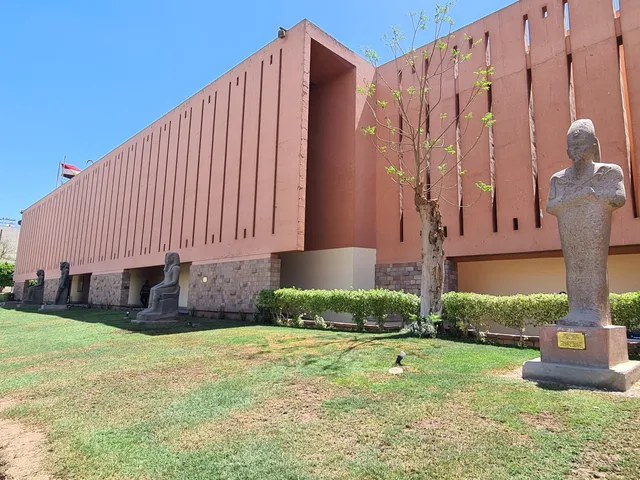
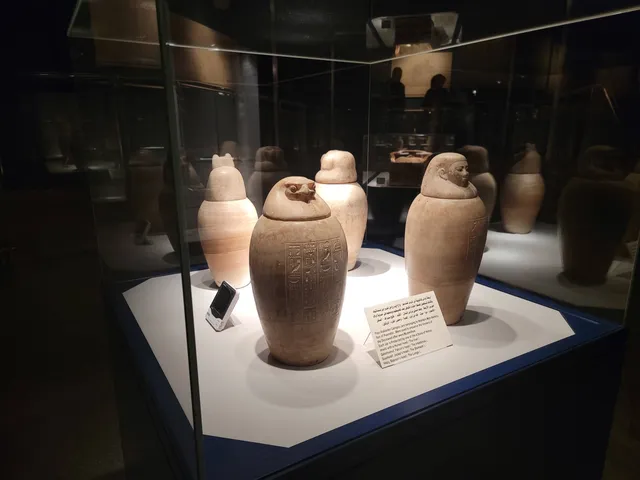
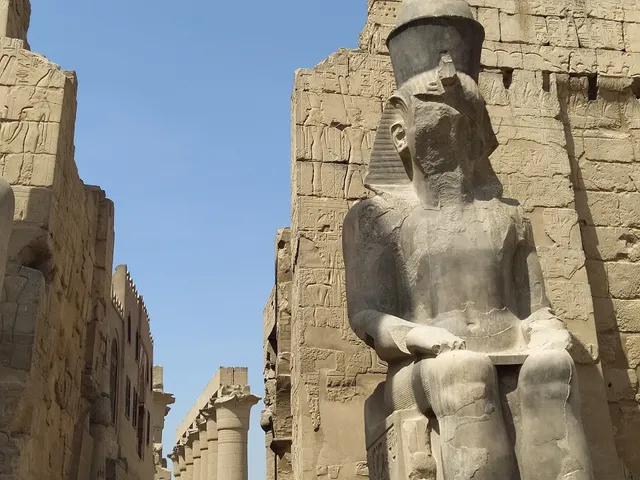
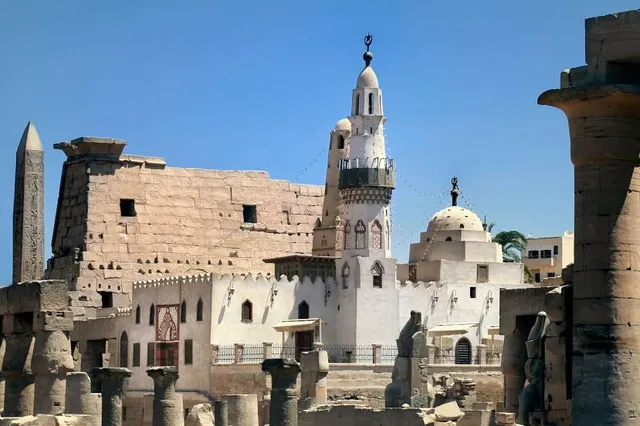
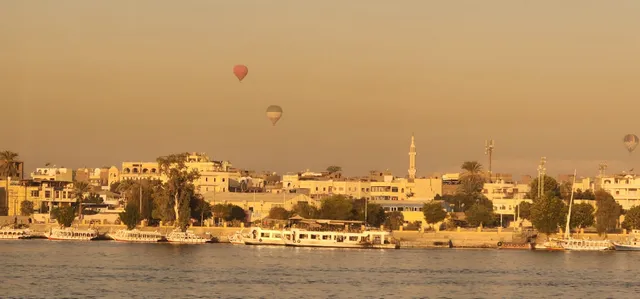
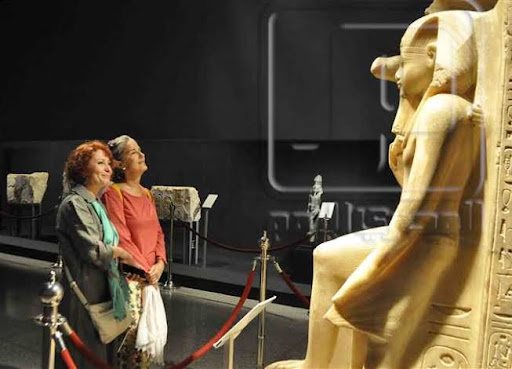
Luxor Museum adorns the Nile Corniche Road in the city center, and is considered one of the most beautiful regional museums in Egypt, and it largely meets the specifications of the museum as a facility as well as the museum display. It opened in 1975 AD, and it consists of two floors, the first floor includes a collection of rare monuments that were unearthed in Luxor such as the granite head of the statue of Amenhotep III and the head of the goddess Hathor in the form of a cow and the statue of the god Amun, and a rare head of King Senusert III, and the wonderful statue of King Thutmose III of stone The schest, the most beautiful and largest statue in Egypt of the alabaster of the god Sabk and Amenhotep III, and the Karnak plate that included a hieroglyphic text related to the rulers' good struggle with the Hyksos. As for the upper floor, it includes a group of statues of Akhenaten and a number of carved stones known as petals, which were part of one of the temples of Akhenaten in the east, the Karnak, some furniture, jewelry, amulets, utensils, and some Coptic funerary paintings, and in recent years a museum has been devoted to a hall in which most of the statues that emerged from the cache Luxor Temple, the most important of which is the statue of King Amenhotep III and the statue of Amun and Hathor and others. Among the most magnificent exhibits of the museum are a collection of antiques that were once in the tomb of King Tutankhamun, also statues representing the era of the New Kingdom, found hidden near the Luxor Temple in 1989 AD. Royal mummies of the pharaohs also find Ahmose I and Ramesses the First, where the museum's holdings were added in March 2004 AD as part of the museum's renovations, which included a visitor center and a large exhibition to restore the walls of the Akhenaten Temple in Karnak. Luxor Museum received during the 40th anniversary of its inauguration, 27 artifacts dating back to the era of the Central and Modern States, to be displayed in its own exhibition as a temporary exhibition of modern discoveries and good treasures in 2015, and these archaeological discoveries came through the work of the Egyptian-Spanish mission in the western mainland at Tuthmosis Temple The third from 2008 until that season, including what represents the lower part of a statue of King Thutmose III, foundation deposits and embalmed eggs, ivory articles, and some ornaments with marine motifs. Luxor Museum, the museum includes 376 pieces of rare holdings of several Pharaonic families, all of which were displayed accurately and with great care according to chronological order, as well as a large number of pieces in his store and a special gift shop at its entrance, and it consists of two floors, land and upper. The Luxor Museum includes a grand hall in which most of the statues that emerged from the cache of the western side are displayed in the courtyard of Aymanhotep III at the Luxor Temple, which was ingeniously hidden by the priests of the god "Amon" to protect them from any profane, which was discovered on January 22, 1989, under the court of Granite during excavation works to measure the level of groundwater in the courtyard of the Luxor Temple of King Imenhotep III, and after the expansion of excavation work was discovered a double statue of King "Hur loving." The museum also includes a statue of King "Hur-loving" in front of the god "Amon" kneeling, offering him two vessels of wine, as well as a statue of the crocodile of the god Sobek from Alabast, which was discovered in 1967 during the construction of a canal in the village of Dahmash in the city of Armant, west of the province, where he was discovered inside a tunnel . This statue is considered one of the artifacts of King Emonhotep the Third, standing on the right of the god Sobek, in the form of a human body and the head of a crocodile, wearing a crown called the "Ataq", and his right hand is holding the key to life, as we see him the king's face is full of youth and vitality, and among the distinctive statues also In the...
Read moreThis is a modern museum. Luxor Museum of Ancient Egyptian Art, known as Luxor Museum was opened to the public on 12' December, 1975. The museum was established specifically to revive art in the ancient city of Thebes "Luxor". The museum houses a unique collection of artifacts dating back to prehistoric times with a focus on New Kingdom , which represents the glory of Thebes until the art of the Islamic era. The museum consists of two floors, including five exhibition galleries:
Ground floor Entrance hall has a thematic display, as it displays the magnificence and glory of ancient Egyptian art, which reached its peak in New Kingdom.
Sobek Gallery Known by this name "Sobek" due to the statue of the God Sobek in the form of a crocodile with the King Amenhotep IlI, the display in the hall follows the chronological sequence that reflects the development of art from the Middle Kingdom to New Kingdom.
Glory of Thebes's Military and Technology Gallery It is a new gallery that was opened to the public on May 19, 2004 and consists of two levels in which a unique collection of artifacts are displayed, which reflects the golden age of wealth, power and prosperity, especially on the political and military. The objects also highlight the development in art, architecture, and technology Thebes, "Luxor", during New kingdom period.
Upper Floor Known as the "Talata!" Floor, Talatat stones of King Akhenaten "Amenhotep IV", which were discovered inside the ninth pylon in Karnak temples, which represent the daily life and Heb Sed celebration for King Akhenaten .It also displays various artifacts: such as jewelry, coins, wooden sarcophagi, tombstones dating back to the Christian period, and some ceramic vessels dating back to the Islamic era.
Cachette Gallery It was a hall for presenting lectures at the time of museum opening in 1975. On 12th September, 1991 it was converted into an exhibition hall for the artifacts were discovered in the Luxor Temple Cachette.
MUSEUM OPEN DAILY but LAST TICKET is at12,30 P.M. and 17,30...
Read moreAbout midway between the Temple of Karnak and the Temple of Luxor , the city's main attractions on the east side of the Nile. The two-storey museum building by the architect Mahmud el-Hakim was opened in 1975.
Findings of ancient Egyptian art from the royal metropolis of Thebes and the vicinity of Luxor (Thebes-East) can be viewed in the museum . Among them are some funerary goods from Tutankhamen 's tomb in the Valley of the Kings ( KV62 ), various statues from the New Kingdom period , and a reconstruction of part of the wall of the Aten temple at Karnak , the Gem-pa-Aton , built in the 14th century v. by Akhenaten . [3] The Aten temple had been destroyed by Akhenaten's successors and the building material used for other buildings.
The main exhibit of the Luxor Museum from the tomb of Tutankhamun is a "sacred cow", a head of an ox carved from a block of wood, the manifestation of the goddess Hathor.
Since 2004, the mummies of kings Ahmose I (16th century BC) and Ramses I (13th century BC) have been on display in the extension of the Luxor Museum . These are the first two royal mummies to be publicly displayed in Luxor, although the identity of the mummy of Ramses I has not yet been clarified beyond doubt. Both mummies come from the cachette of Deir el-Bahari in West Thebes, a depot for reburied pharaoh mummies. While the mummy of Ahmose I was in the Egyptian Museum in Cairo until his return to Luxor , the mummy attributed to Ramses I ended up in the late 19th centuryUnited States of America . There it was in the Niagara Falls Museum for a long time until it was returned to...
Read more