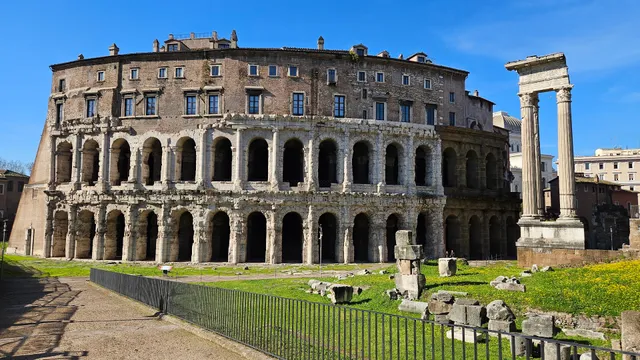
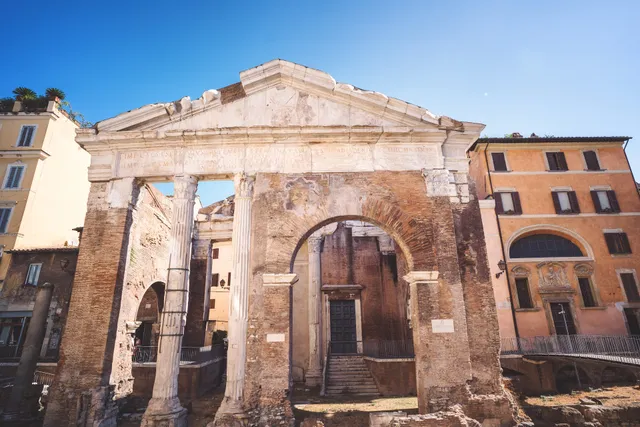
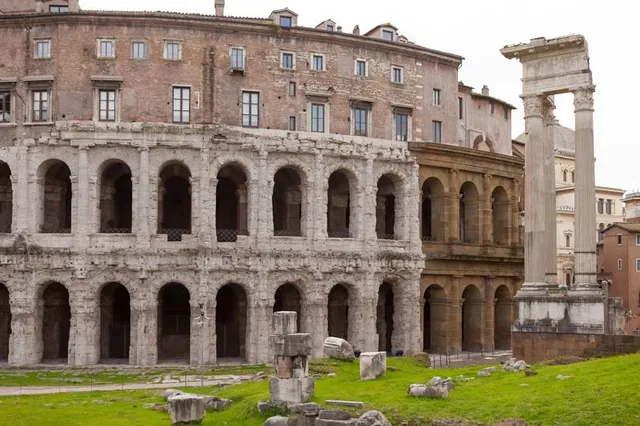
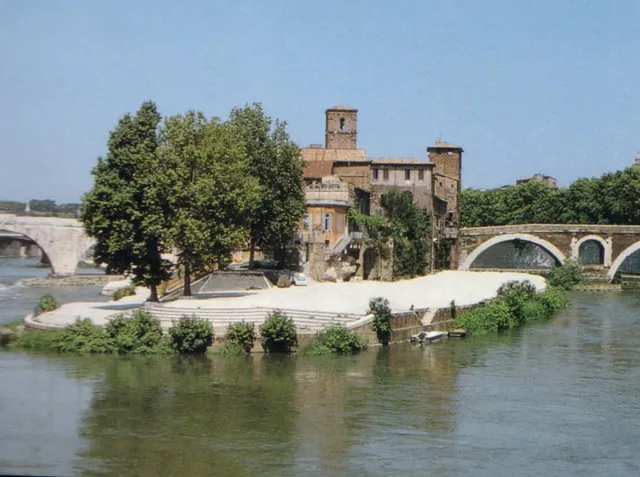
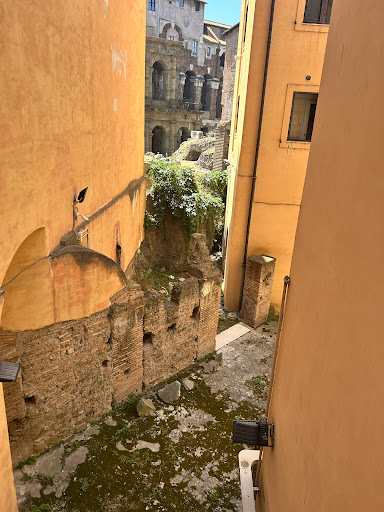
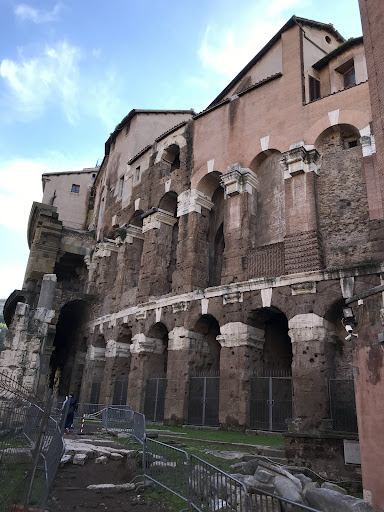
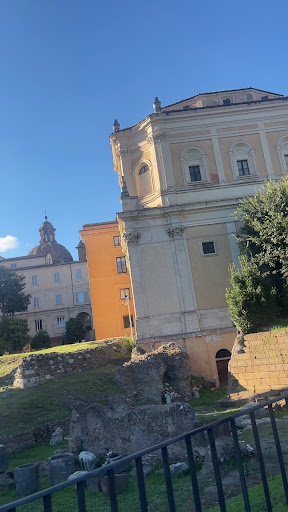
A grandiose building of ancient Rome, the Theatre of Marcellus was erected in the Campus Martius - traditionally consecrated to stage performances - on the site of the theatrum et proscenium ad Apollinis, connected to the temple of Apollo since 179 BC. The theatre project was started by Julius Caesar, who expropriated the area and demolished the existing buildings, and was taken over by Augustus, who, with new expropriations and demolitions, enlarged the site for the construction of a larger building than the one designed by Caesar.Probably completed as early as 17 B.C., the Theatre of Marcellus was inaugurated in 13 or 11 B.C. and dedicated to the memory of Marcus Claudius Marcellus, son of Octavia, the emperor's sister, and therefore nephew and designated successor, who died prematurely in Baia in 27 B.C.Restored by Vespasian and Alexander Severus, still in use in the 4th century, it was transformed into a fortress by the Pierleoni and Fabi families, given its elevated position near the Tiber. In the 16th century, Baldassarre Peruzzi erected a patrician palace on its summit for the Savelli family; two centuries later, it became the property of the Orsini family. Between 1926 and 1932, after having purchased the lower part corresponding to the ancient Roman theatre, the Municipality of Rome proceeded to a complete restoration of the building, freeing it from all the structures that had piled up around it and that had also occupied some of its rooms.The Theatre of Marcellus was a majestic building with a diameter of 130 metres, in which the Roman-type theatre was realised in a completed form. The cavea, semicircular in shape, was built on blocks of tufa, in opus reticulatum and brickwork, on which white marble tiers of seats rested. The exterior of the theatre had a travertine façade with a triple order, of which the two lower ones with arches on pillars with Doric and Ionic semi-columns are preserved today. The keystones of the lower floors were decorated with colossal marble theatre masks representing tragedy, comedy and satirical drama.The shallow stage was decorated with columns and statues of white and polychrome marbles, two triple-aisled halls opened at the sides, and a large elevated apse against the possible flooding of the Tiber was located behind it. The theatre was covered by a velarium and had a capacity of about 15-20,000 seats.Recently, the passage connecting Via Montanara - what remains of the piazza of the same name at the foot of the Tarpeian Rock, demolished in the 1930s - with the Portico d'Ottavia and the Jewish Quarter has reopened to the public. The pedestrian path does not interfere with the archaeological vestiges and is delimited by bollards and chains that redesign the accessibility of the area. The definition of the spaces makes it possible to get closer to the theatre to admire the majesty of the Roman architecture, right up to the edge of the fornixes, enhancing the visitor experience.The archaeological area surrounding the Theatre of Marcellus also contains the remains of the Temples of Apollo Sosianus and Bellona. Built in 296 BC, the Temple of Bellona, dedicated to the ancient Roman goddess of war, was a parallelepiped with six columns on the front and eleven on the long sides, erected on a high podium with front steps. Today, only the concrete core of the podium from the Augustan period remains of the temple.Erected in 431 BC, the temple dedicated to the god Apollo was restored several times and rebuilt, most recently in the Augustan age by Gaius Sosius with a structure similar to the one at Bellona, with two lateral staircases. Three Corinthian columns in white marble remain of it,...
Read moreThe theatre was started by Julius Caesar and finished by Augustus (27 BC - 14 AD) in 17 BC, when the Ludus Saecularesgames were held there. In 13 BC or 11 BC the theatre was dedicated to thememory of Marcellus, Augustus’s nephew and heir who died prematurely. The building stands on the site where theatrical events had been staged using removable timber structures that took up a part of the curved side of the Circus Flaminius. Later restoration work on the stagewas carried out under Vespasian. In the 13th century the theatre was turned into a fortress and in the 16th century into a noble palace of the Savelli family.This palace, the work of Baldassarre Peruzzi, was bought by the Orsini family in the 18th century. In the years 1926-32 the lower section, corresponding to the Ancient Roman structures, was purchased by Rome’s citycouncil that removed the buildings leaning on it and restored it. This building is the only one of the three permanent theatres (together with the Theatre of Pompey and the Theatre of Balbus) that has preserved most of its external façade. This was wholly built of travertine and originally had 41 arches flanked by pilasters and semi-columns – of the Doric type on the ground floor and Ionic style on the second storey. The third storey, now completely lost, had an attic enclosed with Corinthian style pilasters. The key stones of the arches contained large marble theatrical masks. The overall height of the building is thought to have been around 33 metres, while the 130-metre diameter cavea could accommodate 15,000 spectators, and could hold as many as 20,000 in particular conditions, as the Regionari Catalogues also report. Beyond the orchestra there was the stage, of which nothing remains today, flanked by two halls containing apses. Behind the stage there was a large exedra, the centre of which housed two small temples (dedicated to Pity and, perhaps, to Diana) that predated the theatre and were incorporated in it: they are also depicted in the Forma Urbis of the Severan age. The theatre, probably still being used in the 4th century AD, was covered by a canopy. The sources also report the presence of 36 bronze vases tofacilitate...
Read moreI love this place, I see it every morning as I go to work. Source: Sovrintendenza Capitolina ai beni culturali The building was erected at the southern limit of the ninth Augustan region, Campo Marzio, in the place that tradition had consecrated to the scenic representations, where from 179 to. C. there was the theatrum et proscenium to Apollinis, connected with the temple of Apollo.
The theater was started by Julius Caesar, who expropriated the area for a long time, demolishing the existing buildings including the temple of the Pietà, for which he was widely criticized.
Augustus resumed the project, proceeding with new expropriations to expand the surface and erect a larger building. Probably completed as early as 17 a. C. when it was used on the occasion of secular secrets, it was dedicated in 13 or 11 bC, giving it the name of Marcello, the nephew of the emperor, destined for succession, who died in Baia in 27 a. C ..
It was restored by Vespasiano in the scene and by Alessandro Severo. Still in operation probably in the fourth century, it subsequently underwent structural transformations.
Given the elevated position near the river, at a point where the ford was easy, it was turned into a fortress owned by the Pierleoni and the Fabi.
In the '500 Baldassarre Peruzzi erected the building still existing on behalf of the Savelli that two centuries later was bought by the Orsini. The lower part, corresponding to the Roman structures, was acquired in the '30s by the City of Rome, excavated and restored after proceeding to a radical liberation of the area. The Theater of Marcello was a grandiose building with a diameter of 130 m., In which the Roman-style theater was completed: a complete building with a solid architectural unity, not bound by any topographical or orographic requirements such as the...
Read more