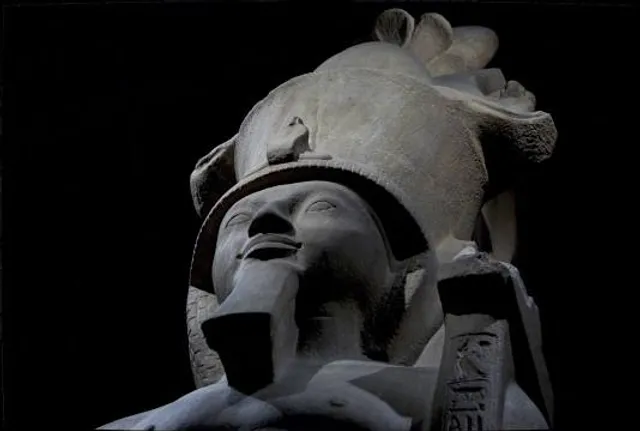
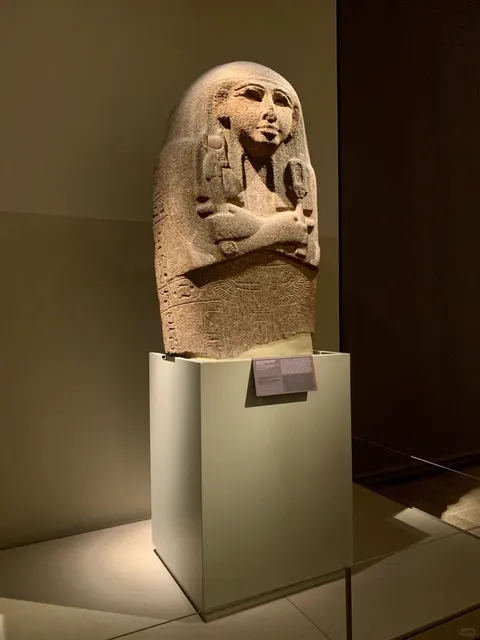
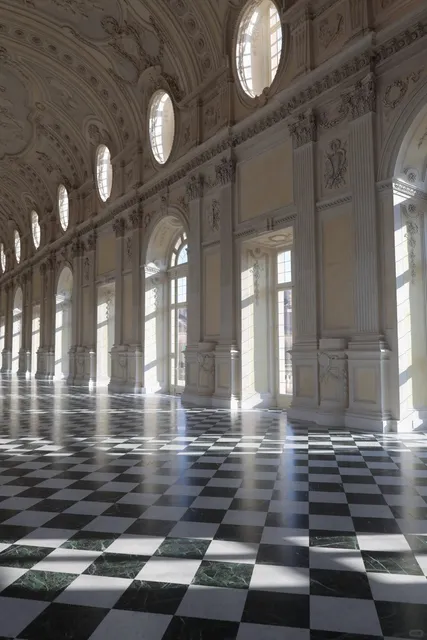
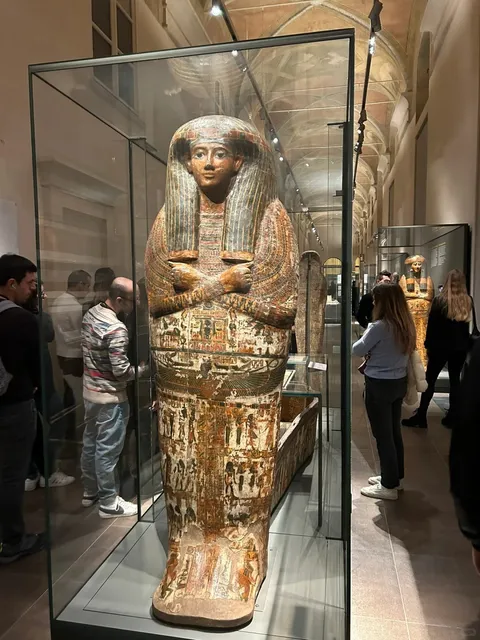
You must visit this museum when you come to Turin. The museum is entered from the Via Delle Accademia Science and your bag is scanned with a metal detector before entering. Down an escalator to the ticket hall, no backpacks are allowed in to the museum and you have to pay €1 for the privilege of a locker. Tickets are €15 for an adult, and no student fare is offered. Make sure you pick up your audio guide. The first rooms describe the accumulation of the collection, the history of the expeditions and about the curators. Much time is taken to state the museum's archaeological context. Up several escalators (or a lift), the first room you enter represents the predynastic era, complete with a very old mummy. There is a sign stating that all human remains are marked with a red triangle on the label and can be skipped if you so wish. All the artifacts are fully described and the location of the find is provided to add context. The audio guide and descriptions give much information on the items, their purposes and significance. On a balcony above is an open storage area full of artifacts, categorised with overall descriptions of the categories. The next room contains a three dimensional reconstruction of a tomb, with the locations of the original paintings as was and the reconstruction of a tomb with the grave goods and sarcophagi in the original locations along with mummies. Further on, more intact tombs are present with their grave goods, and there is more seating here, as with each room. These rooms contain artifacts from the New and Middle Kingdoms, and the audio guide describes the significance of each item the ideology, and their development throughout Egypt history im political, religious and social contexts. Archaeological information is also given, about the excavations as well as the construction of certain artifacts. Also in this room is a royal cubit, a linear unit of measure thay can be subdivided in many ways and is a wonderfully preserved specimen. The Deir el-Medina room shows Egyptian daily life, as well and the funerary, religious and cult worlds. It represents the unique site that gives us a view of the New Kingdom at a personal level, from that of "living" Egyptians compared to the sombre nature of the more typical sarcophagi and grave goods. The Missione Egitto temporary exhibition focuses on the work of Ernesto Schiaparelli, his life and work at the museum. There is a specific audio guide for this section and it is very engaging, giving the history in aneasily accessible, and dare I say it, amusing way. This exhibition is only open until 14th January 2018. The tomb of Kha is an almost fully complete example of a high status tomb. The grave goods were found intact and such variety had not been found before. It is important as it consists of usually perishable items like food and textiles, allowing speculation ofthe diet and clothing styles of the middle upper class of the time. The gallery of sarcophagi is a fantastic collection and a great resource to learn from. There are also several unwrapped mummies here, in fantastic condition for a several thousand year old body. The Late Period rooms show the development of the culture in many areas, like religious beliefs and technology. The Ptolomeic era room tells of the addition of Egypt to the Hellenistic empire. The Gallery of Kings is a room full of monolithic statues, detailing various pharoahs and their reigns. Such a wealth of information is available because of collections like this, the work that went in to interpret it and the ongoing research and conservation. The Egyptian Museum in Turin is an astounding collection spanning several thousand years of ancient history, brought to life in an engaging and...
Read moreThe museum houses a rich collection displayed mostly in chronological order. Certain selected topics are presented in dedicated rooms: Egyptian script in the highly informative Writing gallery; embalming procedures and human remains in section "In search of life"; coffin-making technology and design in the Coffin gallery & Tomb of Kha. These are probably the most interesting sections, the rest is the usual array of statues and objects from various periods. My visit lasted around 3.5hrs, there is a Lot to see and to read on info panels and exhibit labels.
As much as the collection itself is quite impressive, the crowds and noise throughout the building totally spoil the experience. Unless you've booked a tour guide, you'll be using an audio guide on your phone with your headphones - I'd recommend a noise canceling headset, it will block the sound of countless school groups that you'll encounter in literally every room.
I visited on a weekday in the morning, assuming the place would be rather quiet - it wasn't. Although you are required to book a ticket for a specific time slot, nobody actually checks this at the entrance, they just scan your ticket and you're good to enter. The number of visitors is way too high, the school groups in particular are very distracting and the constant stream of people from all directions makes it quite hard to focus on simply reading the labels and listening to the guide. It is almost as crowded as the Egyptian museum in downtown Cairo used to be. There are other Egyptian museums (or Egyptology sections) elsewhere (besides Egypt) which make for a much better visitor experience even though they don't house such vast collections: Munich, Toronto ROM, Berlin Neues Museum, Vienna KHM etc... There is a small coffeeshop somewhere in the middle of the building, with inadequate space for the number of visitors. Museum shop is also rather sad comparing to other similar large museums.
The audio guide "app" is a website link that will stop working whenever your internet coverage gets weaker in the building. The guide is quite brief, describing only selected items which you have to first locate in the room as they are not numbered in the app. It would work better just to place a QR code next to each exhibit. The audioguide didn't do much for me except block the noise from the excessive number of people.
Overall the museum facilities and organization unfortunately don't meet the expectations I had of "The top must-see" Egyptian musem...
Read moreProbably had too high expectations for this museum. For starters, the ticketing system for the museum is beyond believe. Having to book tickets exclusively online results in dozens of people standing around on the street in front of the museum entrance (discovering en place that the museum doesn't have any available tickets until 1-2 hours), while at the same time excluding less digital savvy people.
Exhibits in general or tasteful, informative and filled with Egyptian artifacts. A must see for Egyptophiles. Especially the gallery of Kings is an beautiful exhibition.
The museum however is not without hypocrisy. At the first exhibit the museum unironically asks itself "Why an Egyptian museum in Turin?". The obvious correct answer being here: colonialism and empire. The reader instead is presented a vague answer about the Savoy dynasty being interested in mythology, as a reason for a Egyptian museum in Turin. Two events that seemingly don't share correlation, let be causation.
Further on the museum wonders whether it's right or not to present human remains (e.g. mummies) as exhibits to the public. The museum hurdles itself to the vox populi for answer and presents a random crowd with questions like 'should mummies be allowed to be displayed to the public?'. While ignoring the wrongly positivist tone of the hypothesis, it's obviously wrong to consult the masses to answer questions that require specific knowledge in the same way that we don't ask our friends and families for expertise on whether we should have our inflamed...
Read more