Hazuri Bagh and Baradari (present form, early 19th century onward)
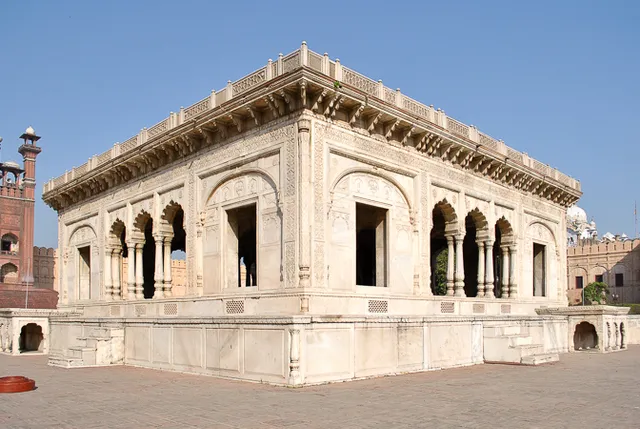
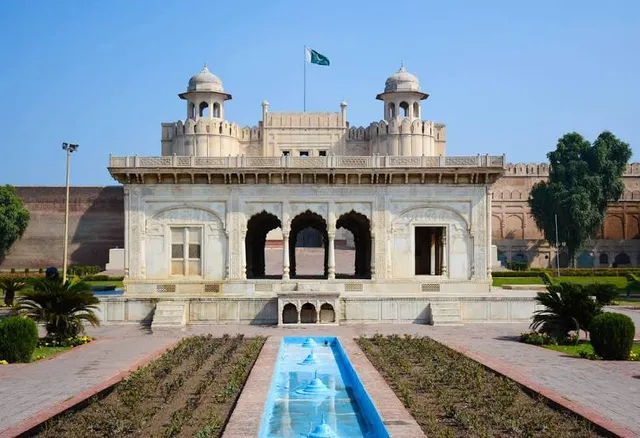
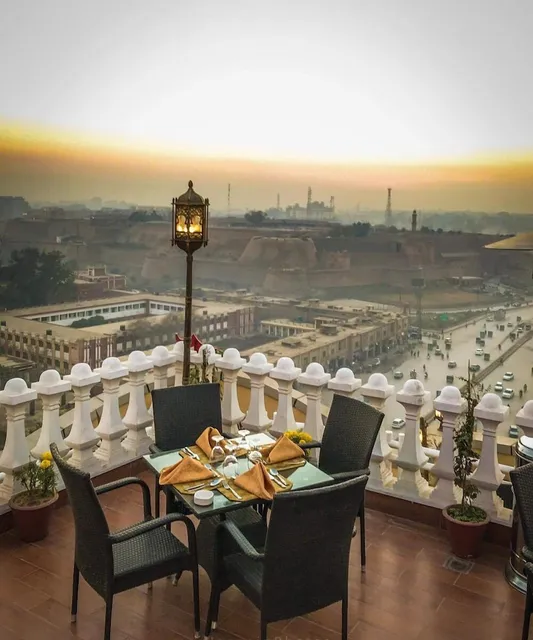
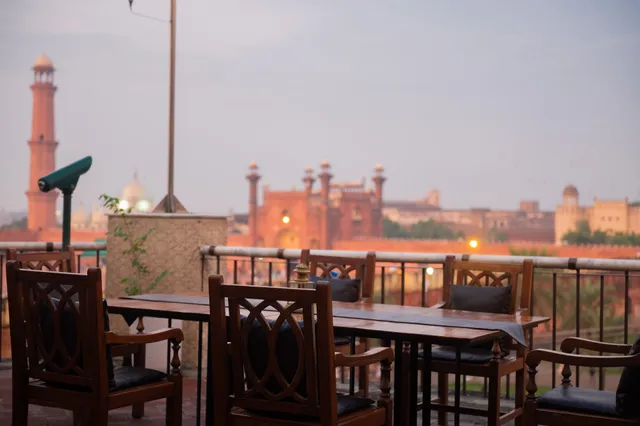
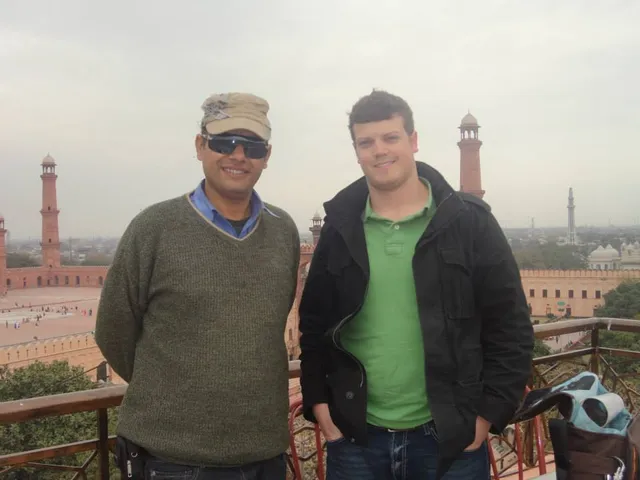
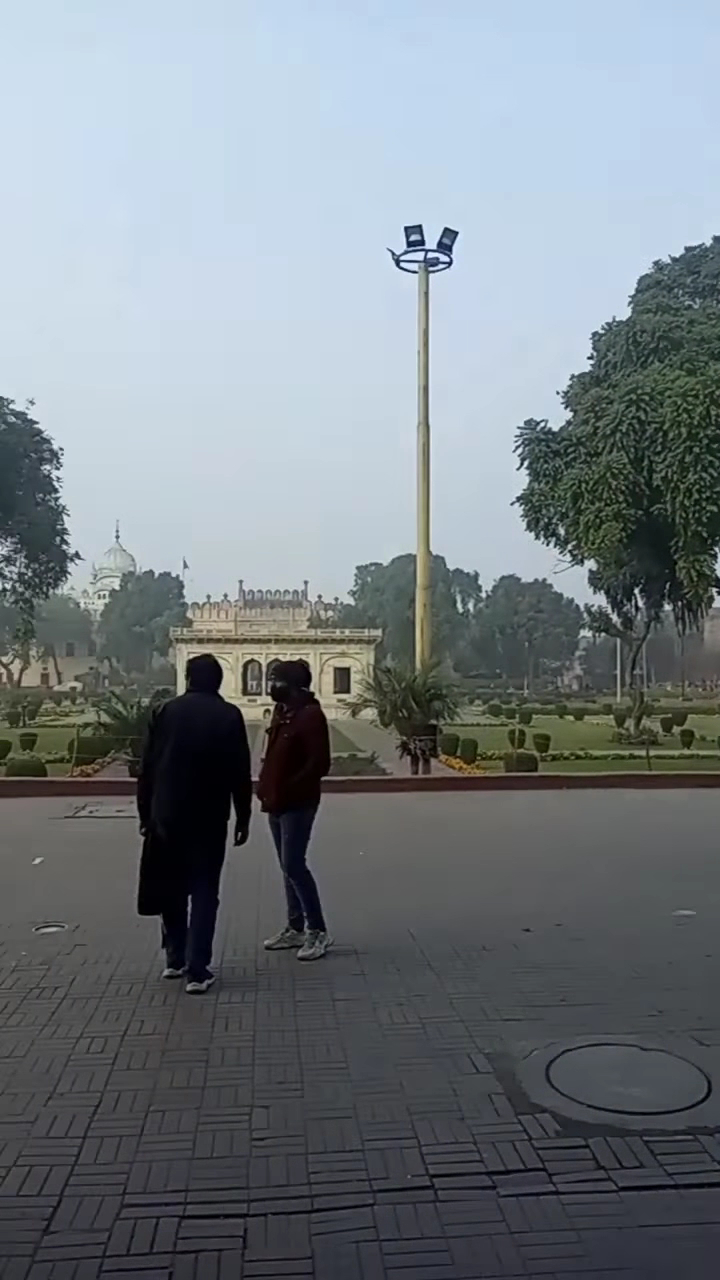
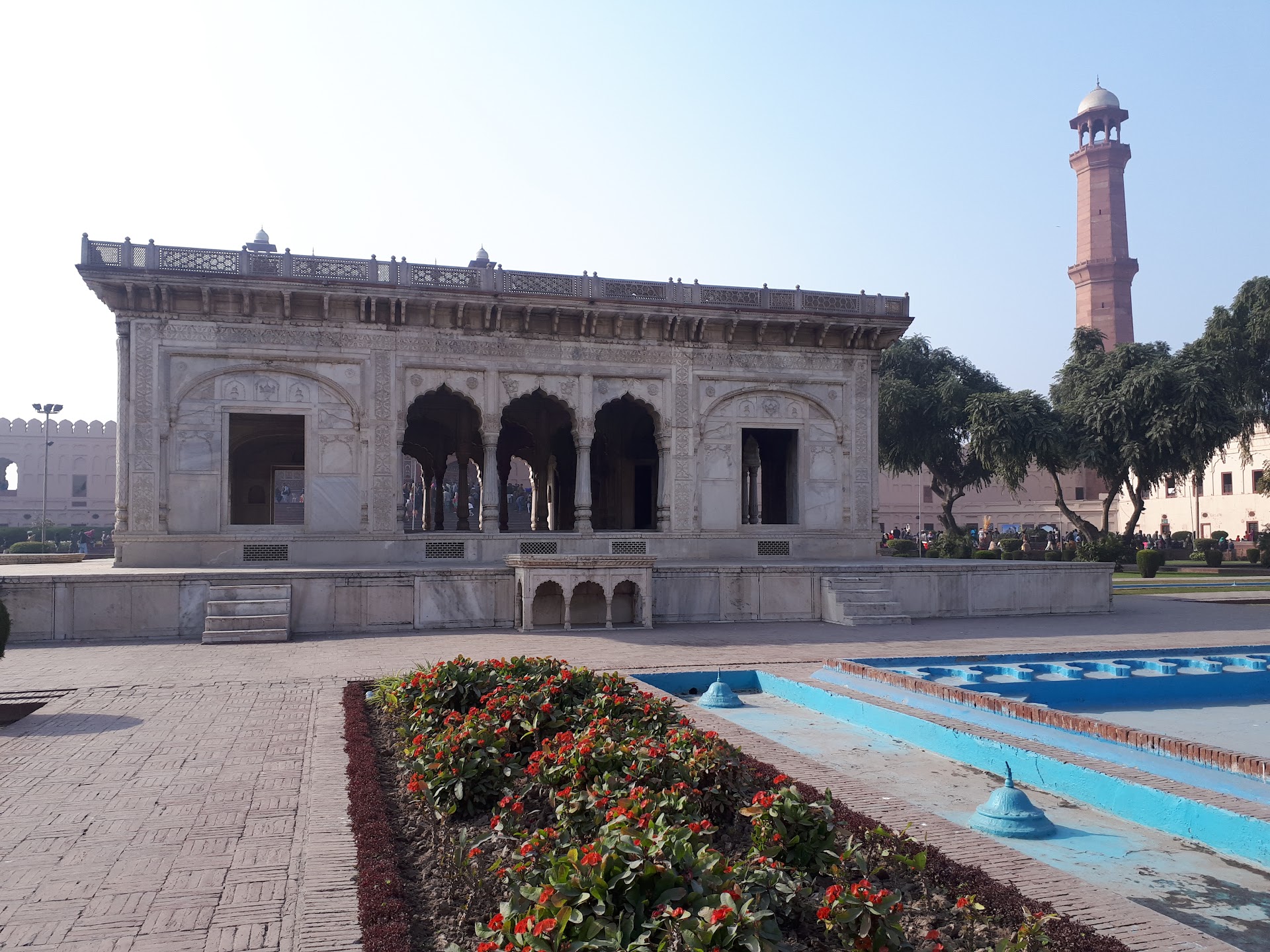
The Hazuri Bagh, or garden, is a vast quadrangle sandwiched between Lahore Fort to the east and the Badshahi Mosque to the west. Measuring about 150 meters on a side, the garden is arranged in a traditional four-part charbagh design with a marble pavilion, known as a baradari (literally, twelve doors), standing serenely at its center. Though the site appears harmonious today, it represents the culmination of several centuries of royal sponsorship, often with competing aims.
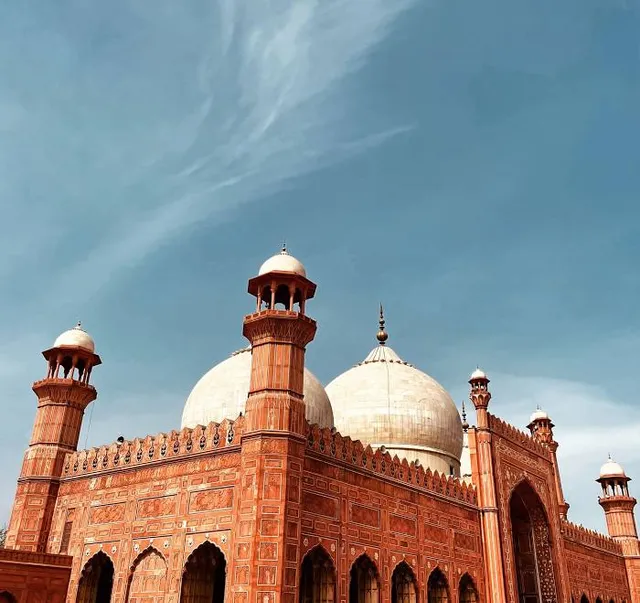
The origins of the garden date back to the reign of Aurangzeb (r. 1658-1707), the sixth and last of the great Mughal emperors. Aurangzeb was not a particularly prolific builder in the mold of his father, Shah Jahan, but he did sponsor a handful of important buildings such as the Badshahi Mosque, which was constructed in 1673. For liturgical reasons the mosque was oriented with its western facade canted toward Mecca, putting the building off-axis with the larger bulk of the Lahore Fort to the east. Perhaps to maintain symmetry between the two buildings, Aurangzeb constructed a grand gateway—now known as the Alamgiri gate—on the west side of the fortress. The gate served as a convenient passage for the Emperor as he made his way to and from the mosque for Friday prayers in pomp and ceremony. Latif describes the scene as follows:
"The enclosure now occupied by a garden and marble pavilion, was, in the time of Moghal ascendancy, thronged by the imperial cavalcade and vast bodies of armed retainers, who formed the king's procession, as the grand Seignior went to offer his prayers at the Royal Chapel, preceded by a cortege of mace-bearers, and followed by his Omerahs, grandees and nobles. Before he came out of the fortress, the passage he had to pass, was constantly watered 'because,' says Bernier, in his picturesque description of the imperial procession, 'of the heat and the dust'. From the king's apartments to the gate of the fortress a lane of several hundred soldiers was formed, and through it His Majesty passed with all the pomp of an eastern sovereign." (Latif, p. 117).
Besides satisfying the Emperor's vanity, the parade ground doubled as a caravanserai, a place where pilgrims and travelers could seek refuge for the night. Traditional caravanserai are large open-air courtyards with fortified outer walls and inward-facing accommodations, a form that roughly matched the quadrangle that formed the parade ground. If the space truly functioned as a caravanserai, it is reasonable to assume that the entire area was cordoned off, perhaps with walls on the north and south sides of the courtyard lined with rooms for travelers and their livestock. One surviving example that suggests how this space might have looked is the Akbari Saray a caravanserai between the tombs of Jahangir and Asaf Khan.
The rise of Ranjit Singh's Sikh empire in the late 18th and early 19th centuries undermined the ritual significance of the Badshahi Mosque, as Ranjit Singh remained devoted to the Sikh faith. The mosque fell into disuse and was even turned into a military magazine. As there was no longer any need for either the caravanserai or a parade ground, Ranjit Singh had the area converted into a garden. Although this garden survives today as the Hazuri Bagh, it is difficult to determine how much of its design would have been familiar to the Maharaja. As Wescoat notes, "the Hazuri Bagh is in fact a Pakistani conservation of a British reconstruction of a Sikh imitation of a Mughal garden" (Wescoat, p. 141).
One enduring feature is the marble baradari at its center, for which the entire garden is named. Measuring just 13.4 meters on a side, the lustrous baradari is dwarfed by the martial scale of the Alamgiri gate, the Badshahi mosque, the newer Roshnai gate to the north, and another gate to the south. Ostensibly built to celebrate the acquisition of the famed Koh-i-Noor diamond from arch-rival Shuja Shah Durrani, Ranjit Singh had the pavilion built in 1818 to serve as an al fresco hall of state...
Read moreHazuri Bagh, lined with cloisters for mendicants and holy men, was built as a forecourt for the grand mosque. The Hazuri Bagh pavilion that dominates the centre of the quad was built by Ranjit Singh. Opposite (south) is the Hazuri Bagh Gate, which was built as part of a boarding house for scholars and students attached to the mosque. An impressive gateway in the east, the Alamgiri Gateway, was built specially and oriented in the direction of the mosque to provide suitable emphasis when entered from the citadel.
Once known as Serai of Aurangzeb, the Mosque forecourt would be thronged by the cavalcade of the emperor when he came to offer his Friday prayers at the grand mosque. Hazuri Bagh provided the stage on which the pomp of the Mughal emperor was showcased, his train a throng of mace-bearers, omerah, grandees and nobles. The traveler Francois Bernier recorded that the way from the citadel, would be lined by hundreds of soldiers in their dazzling uniforms making a glittering passage for the emperor.
The entrance to the mosque with its lofty plinth, makes it imperative to climb its 22 steps to reach the platform, and provides a foretaste of the grandeur within the mosque enclosure. The Mughalised attractive marble baradari adorning the Hazuri Bagh was put together on the orders of Ranjit Singh in 1818 to celebrate the capture of the famous Koh-i-Noor Diamond from Shah Shuja of Afghanistan. Its Mughal character is beholden to the material removed from Mughal monuments and reused here.
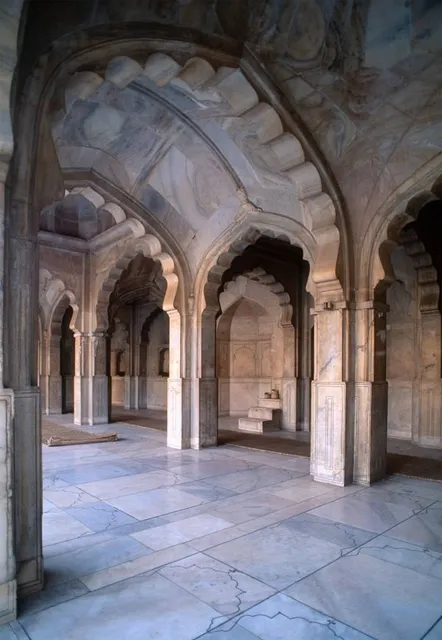
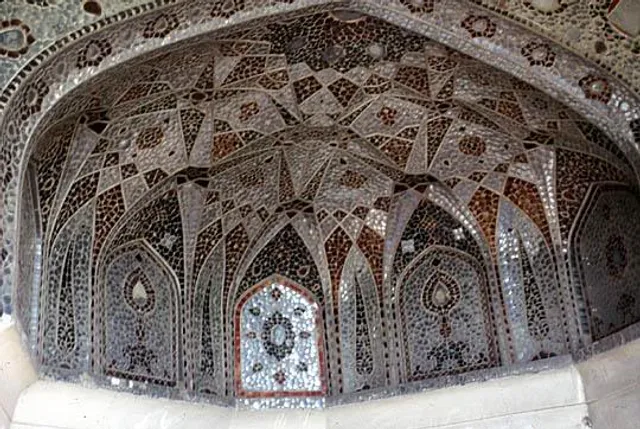
The pavilion was constructed in 1818 and originally consisted of a basement and two storey above ground. Elegant carved marble pillars support the baradari’s delicate cusped arches. The central area, where Ranjit Singh held court, has a mirrored ceiling. Both the garden and the baradari, originally a 45-foot, three-storey square with a basement approached by fifteen steps, suffered extensive damage during the fratricidal Sikh wars and was only reclaimed and laid out according to the original plan during the British period. On 19 July 1932, the uppermost story collapsed due to heavy rainstorm and lightning. Because of a paucity of funds the top storey was never restored; however, the first floor marble fretwork balustrade, which had also been severely damaged, was rehabilitated three years later.
From contemporary illustrations the design of the top storey is evident: a chamber punctured by cusped arch openings, set in the middle of a large terrace and well set back from the edge of the ground floor roof.
The Baradari was the focus of regal displays during the Sikh rule. Although the takht (or throne) was the citadel, Ranjit Singh used the venue of the baradari for conducting functions of state. After his death, the pavilion continued to be utilized by...
Read moreHazuri Bagh is a garden in Lahore, bounded by the Lahore Fort (east side), Badshahi Mosque (west side), the Samadhi of Ranjit Singh (north side) and the Roshnai Gate (south side). In the center stands the Hazuri Bagh Baradari, built by Ranjit Singh in 1813 to celebrate the capture of the famous Koh-i-Noor Diamond from Shah Shujah of Afghanistan. The Serai Alamgiri formerly stood here.
The garden was planned and built under the supervision of Faqir Azizuddin in the traditional Mughal style layout. After its completion, it is said, Ranjit Singh, at the suggestion of Jamadar Khushhal Singh, ordered that marble vandalized from various mausoleums of Lahore to construct a baradari (pavilion) here.
This task of builiding baradari was given to Khalifa Nooruddin. Elegant carved marble pillars support the baradari’s delicate cusped arches. The central area, where Ranjit Singh held court, has a mirrored ceiling. Both the garden and the baradari, originally a 45-foot, three-storey square with a basement approached by fifteen steps, suffered extensive damage during the fratricidal Sikh wars and was only reclaimed and laid out according to the original plan during the British period. On 19 July 1932, the uppermost story collapsed and was never reconstructed.
The tomb of tomb Muhammad Iqbal lies across from the garden outside of the Badshahi Mosque.
It is believed that the canopy was once the part of Jehangir's tomb, however this account was not known till 1880 - but only known that the marble of the baradari was taken from different tombs in Lahore.
Now question is, whether Jehangir's Tomb ever had a canopy over it or not - there are different account of history, Moorcroft, a traveller writes in 1820 - "the dome was believed to be taken by Aurangzeb" - Alexander Burnes in 1831 and Von Orlich in 1843, attributed its removal to Bahadur Shah. However, there are little documented evidence to support these three accounts.
The one important historical account is of "Muhammad Salih" a literary man of Lahore and held a post in "Lahore Darbar" during Shah Jahan's reign - He mentioned that "Emperor had directed in his will that his resting place should be devoid of structural decorations and that they should commit his body to the mercy of god in an open place" - so possibly a building was build around and keeping the grave open as like Akbar's tomb in Agra, and could be changed to...
Read more