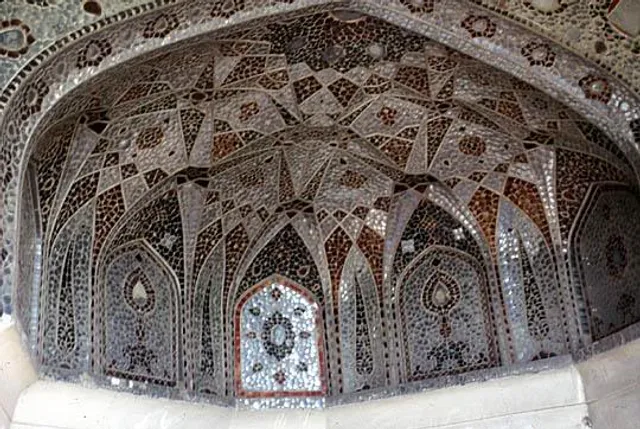
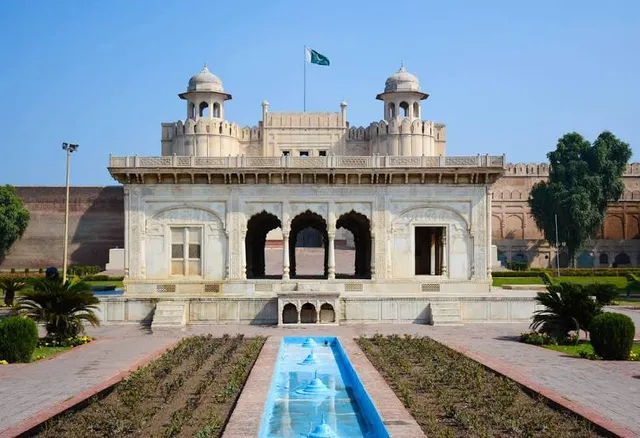
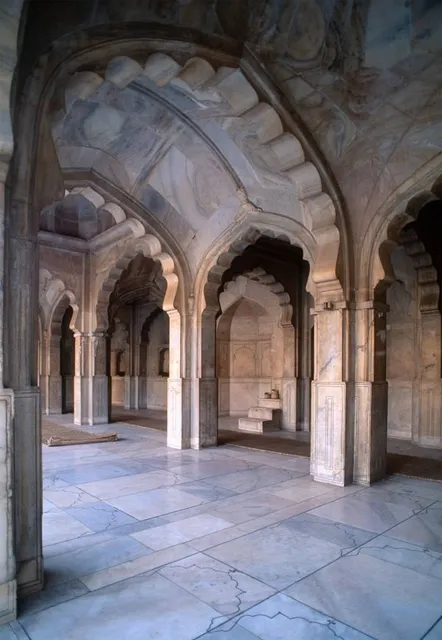
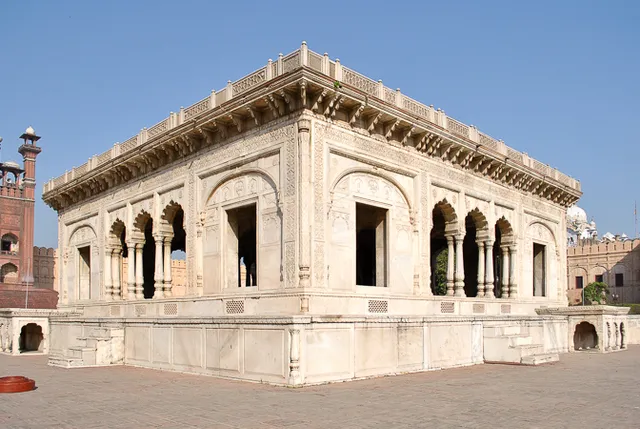
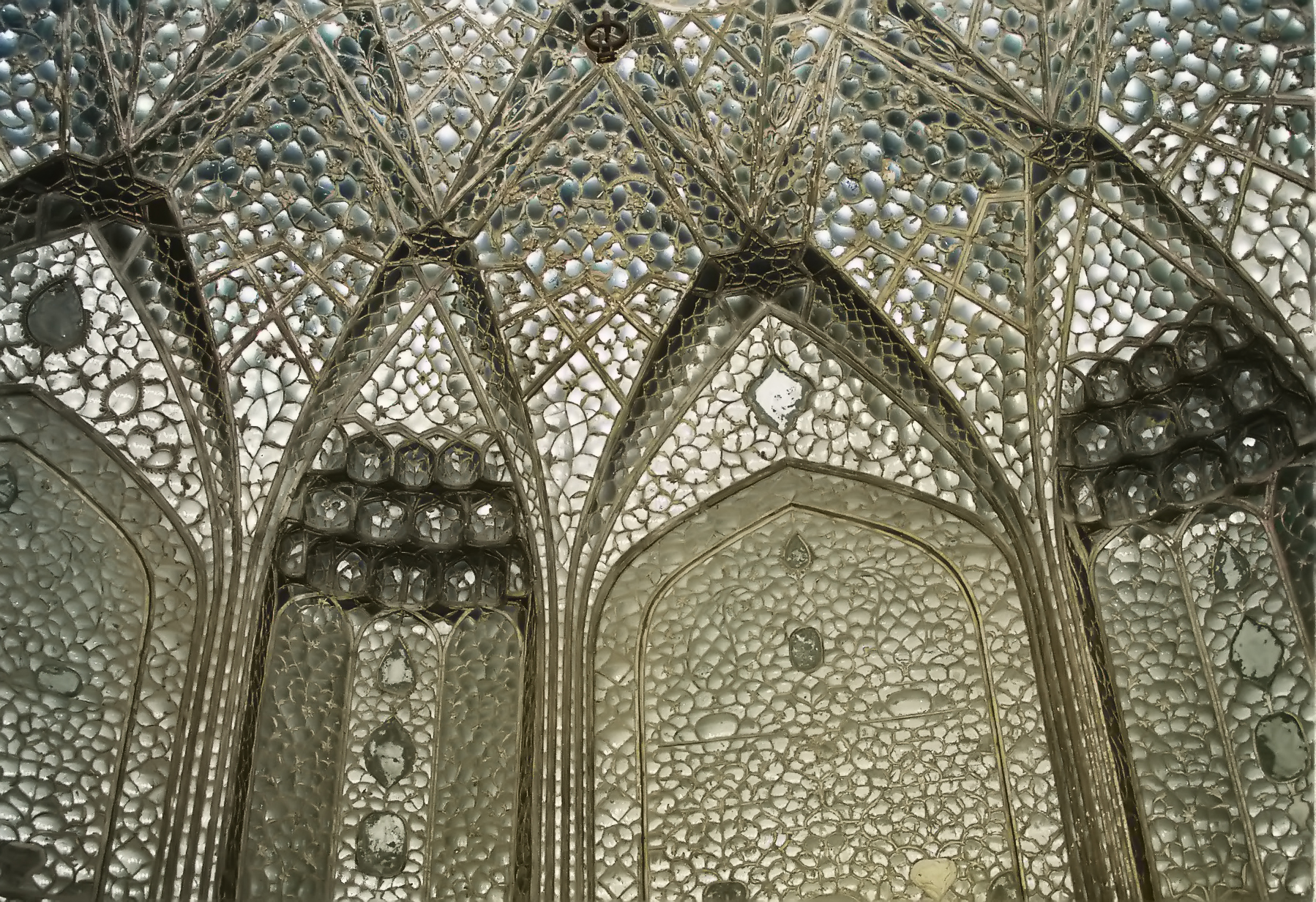
The Sheesh Mahal (Urdu: شیش محل; "The Palace of Mirrors") is a palace located within the Shah Burj block in northern-western corner of Lahore Fort. It was constructed under the reign of Mughal Emperor Shah Jahan in 1631–32, with some additions later under Sikh Maharaja Ranjit Singh. The ornate white marble pavilion is inlaid with pietra dura and complex mirror-work of the finest quality. The hall was reserved for personal use by the imperial family and close aides. It is among the 21 monuments that were built by successive Mughal emperors inside Lahore Fort, and forms the "jewel in the Fort’s crown."[1] As part of the larger Lahore Fort Complex, it has been inscribed as a UNESCO World Heritage Site since 1981. Sheesh Mahal, in Urdu language, literally means 'Crystal Palace'. However, with its pietra dura decorations[2] and intricate mirror-work inlaid into the white marble walls and ceilings creating gleaming effect,[3] the lavish room has come to be known as 'Palace of Mirrors', and sometimes the 'Hall of Mirrors'. Similar halls are also found in the contemporary palace of the Agra Fort, and show influence on the later additions to Amber Fort.
History edit
Close up view of the building's mirror-work The solid brick foundations of Lahore Fort were laid in 1566 under the reign of Mughal emperor Akbar the Great on the location of an earlier mud-fort. To build the new fort, the Emperor brought experienced artisans after the completion of Fatehpur Sikri.[4] Later, Shah Jahan converted the fort into a pleasure resort and added Diwan-i-Khas, Moti Masjid, Naulakha Pavilion, sleeping chambers, and Sheesh Mahal in to the complex. Sheesh Mahal is located within the Shah Burj (King's Pavilion) block that was actually built by his predecessor Jahangir. The chamber was exclusively used for private council meetings as part of the daily routine of the emperor, whereas the whole block was only accessible to the imperial princes, the vizier, and selected courtiers.[5] The extension work of private quarters by Shah Jahan continued between 1628 and 1634. The distinctive Shah Jahani architecture is reflected in the extensive use of white marble and hierarchical accents of the construction.[6] During the Sikh Empire, Shah Burj became Ranjit Singh's favourite place. He built a harem over the top of Sheesh Mahal.[4] Kangra style frescoes were also added during his reign, and the original entrance to the Sheesh Mahal quadrangle was closed off and the Athdara built in its place. This was also the place where he used to display his prized possession, the Koh-i-Noor.[7]
Design edit
The Sheesh Mahal is elaborately decorated with a myriad of reflective glass tiles.
The building's ceiling is also adorned with mirror-work. The Sheesh Mahal was built by Emperor Shah Jahan. It was built in the middle of Jahangir's rule. The façade, consisting of five cusped marble arches supported by coupled columns, opens into the courtyard. The engrailed spandrels and bases are inlaid with precious stones. The pavilion is in the form of a semi-octagon, and consists of apartments roofed with gilded cupolas and intricately decorated with pietra dura and convex glass and mirror mosaic (ayina kari) with thousands of small mirrors. At night they light candles.[8] The decorative features also include stucco tracery (munabat kari) and carved marble screens in geometrical and tendril designs.[9] The roof of the central hall rises up to two storeys. The hall was originally decorated with fresco paintings that were later replaced with glass mosaic in different colours.[1]
Conservation edit
Coloured glass was also used throughout the interior. The additional constructions carried out during the subsequent Sikh and British rules of Punjab on the top of Sheesh Mahal added to the dead load that made the structure vulnerable to collapse. In 1904–05, the plaster from the ceiling of main veranda fell apart, exposing the decay of internal wooden beams and the...
Read moreDeveloping and preserving the Sheesh Mahal (Palace of Mirrors) in Lahore Fort for international tourism can turn it into one of Pakistan’s most iconic attractions—on par with the Taj Mahal or Topkapi Palace—if approached strategically.
Here’s a comprehensive set of development suggestions for Sheesh Mahal:
⸻
🪞 Sheesh Mahal Development & Promotion Plan for International Tourism
⸻
🏗️ 1. Structural Preservation & Restoration
✅ Suggestions: • Partner with UNESCO and international conservation bodies for restoration funding & expertise • Use non-invasive restoration techniques to protect original mirror work and frescoes • Improve moisture control, drainage, and ventilation systems to prevent long-term damage • Digitally document the current condition (photogrammetry, 3D scanning) for future restoration tracking
⸻
💡 2. Lighting & Ambiance Enhancement
✅ Suggestions: • Install discreet LED lighting to highlight mirror work without damaging materials • Use motion-activated lights or guided light shows to create an immersive nighttime experience • Introduce controlled “mirror light reflection” shows using low-energy light mapping (projected reflections)
⸻
🧭 3. Visitor Experience Improvement
✅ Suggestions: • Introduce multilingual audio guides (English, Arabic, French, Mandarin, etc.) • Create a guided VR/AR experience to show what Sheesh Mahal looked like in its Mughal glory • Offer scheduled guided tours with trained heritage interpreters (in traditional Mughal attire)
⸻
🎥 4. Digital Engagement & Storytelling
✅ Suggestions: • Produce a short film or docu-series on the architecture, history, and mystique of Sheesh Mahal • Launch an interactive online tour on Google Arts & Culture • Use Instagram, YouTube Shorts & Reels to share: • “Reflection moments” • Historical trivia • Time-lapse of sunrise/sunset over the palace
⸻
🎭 5. Cultural Programming & Events
✅ Suggestions: • Host monthly classical music evenings or sufi nights inside the Lahore Fort complex (with Sheesh Mahal as a backdrop) • Organize Mughal-themed evenings with light projection shows narrating Mughal history • Invite foreign dignitaries, travel bloggers, and influencers to exclusive guided tours
⸻
🛂 6. Tourist Services & Infrastructure
✅ Suggestions: • Install clean, modern restrooms, tourist rest areas, and refreshment kiosks nearby • Add wheelchair accessibility where feasible (ramps, accessible viewing platforms) • Develop a souvenir shop with miniatures of Sheesh Mahal, handcrafted items, books, and local art
⸻
🌍 7. Global Branding & Partnerships
✅ Suggestions: • Market Sheesh Mahal under a “Mughal Marvels of South Asia” campaign • Partner with Indian and Turkish tourism boards to cross-promote Mughal/Ottoman heritage tourism • Apply for additional UNESCO World Heritage recognition for preservation and prestige
⸻
Example Tagline:
“Sheesh Mahal – The Mughal Jewel That Reflects a...
Read moreA Glimpse of Royalty: Sheesh Mahal - Lahore's Enchanting Jewel
In the heart of Lahore's historical tapestry, I had the privilege of visiting the spellbinding Sheesh Mahal - a place where time seems to stand still and the allure of Mughal opulence comes to life. This review aims to capture the sheer splendor and cultural richness that define this magnificent gem.
🕌 Architectural Opulence: The Sheesh Mahal's exquisite architecture is a testament to the unparalleled creativity of the Mughal dynasty. The intricate mirror work that adorns every surface reflects light in a dance of brilliance, creating an otherworldly atmosphere that transports visitors to an era of extravagance and elegance.
🎭 Historical Journey: Stepping into the Sheesh Mahal felt like stepping back in time, into the world of emperors and their luxurious courts. The connection to history is palpable, with every nook and cranny whispering stories of royalty, romance, and artistic mastery. It's a living testament to the creative spirit of the Mughal artisans.
🌌 Starlit Fantasy: As night descends, the Sheesh Mahal takes on an even more enchanting aura. The mirrors catch the soft glow of moonlight and the flicker of candlelight, creating a dreamlike ambience that's nothing short of magical. The interplay of light and reflection is an experience that stays etched in memory.
🎨 Artistry Beyond Imagination: The level of craftsmanship showcased within the Sheesh Mahal is nothing short of awe-inspiring. The intricate mirror work, detailed frescoes, and elegant archways are a testament to the dedication and ingenuity of the artisans who brought this architectural wonder to life.
📜 Cultural Treasure: The Sheesh Mahal is not just a monument; it's a living embodiment of the cultural heritage of Lahore and the Mughal dynasty. Its role as a symbol of artistic excellence and architectural grandeur cements its place as a jewel in Pakistan's historical and cultural crown.
💫 Visiting Experience: My visit was a seamless and immersive experience, thanks to the knowledgeable guides and well-maintained premises. The ease of access, informative plaques, and the chance to walk in the footsteps of emperors added depth to my understanding and appreciation of this treasure.
In conclusion, the Sheesh Mahal is a dazzling masterpiece that transcends time and invites visitors to experience the grandeur of Mughal royalty. Its breathtaking beauty, cultural significance, and immersive ambience make it an absolute must-visit for anyone seeking to connect with the rich heritage of Lahore and the Mughal era.
#SheeshMahal #ArchitecturalSplendor #CulturalHeritage...
Read more