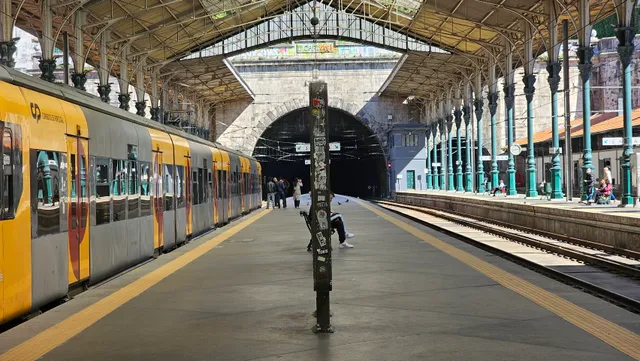
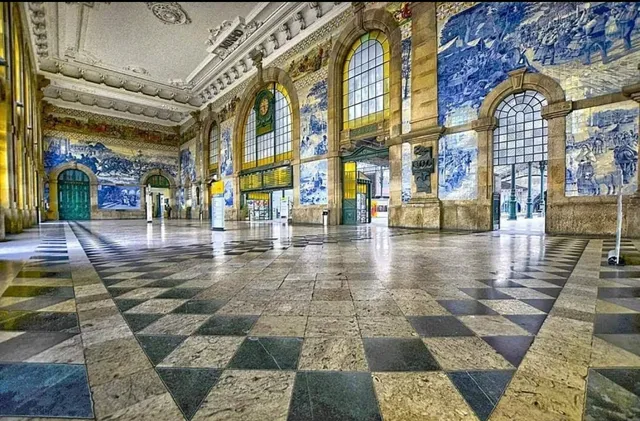
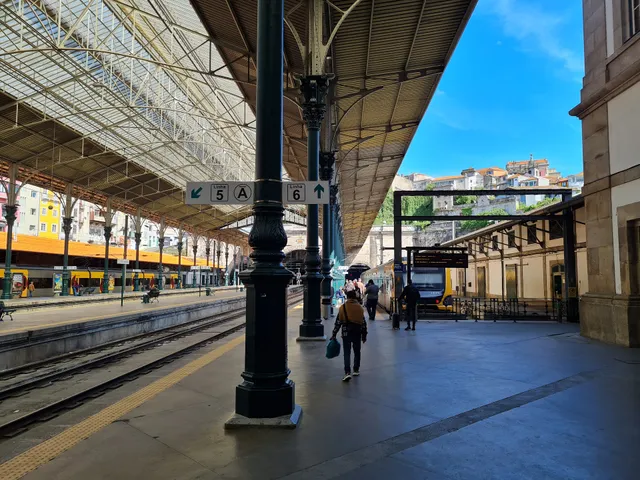
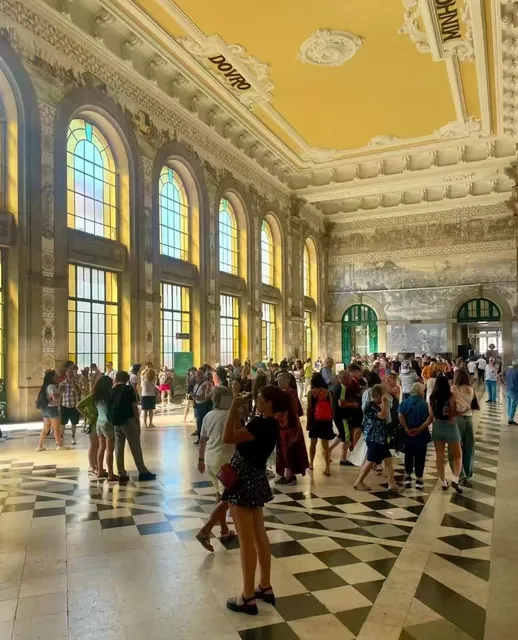
Panaromic photo of famous Sao Bento railway station.
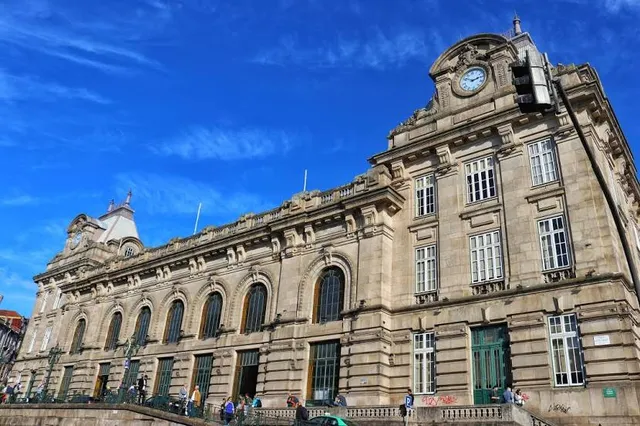
The São Bento Railway Station (Portuguese: Estação Ferroviária de São Bento) is a 20th-century railway station in the civil parish of Cedofeita, Santo Ildefonso, Sé, Miragaia, São Nicolau e Vitória, in the municipality of Porto, district of Porto.
Even by 1864, the Guia Histórico do Viajante do Porto e Arredores (Historic Guide for the Traveller to Porto and Surroundings) there was information suggesting that the construction of central station, to located in the Palacette of the Quinta do Cirne (Campo 24 de Agosto).
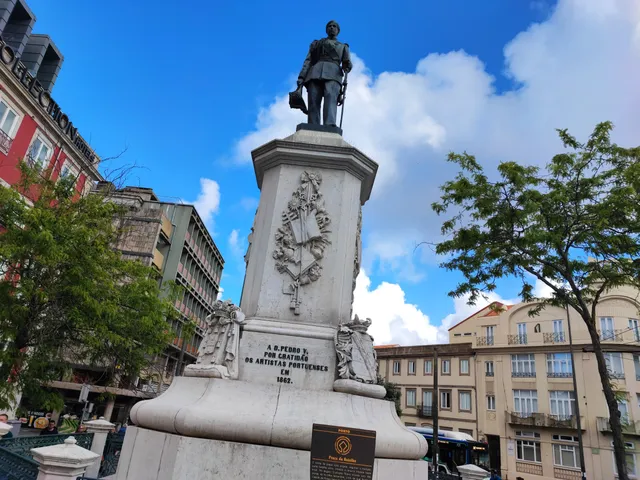
In 1887, José Maria Ferreira and António Júlio Machado, alderman, presented to the municipal council a project for a Central Station in Porto, elaborated Hippolyte de Bare. The following year, Emídio Navarro, Minister of Public Works, authorized the construction a line of railway between Campanhã and a central station, which would be established in the proximity of Praça de D. Pedro.
First steps to renovate the site began in 1992, with work on the facades, recuperation of the boxes and ceiling, that included work on the station and exterior illumination.
The station is located in the historic centre, occupying a large space delimited by the Praça Almeida Garrett, Rua da Madeira and Rua do Loureiro, as well as the escarpment of Batalha, where a tunnel has been carved into the hill.
The symmetrical, three-story, granite building has a "U"-shaped plan, with its principal facade oriented to the southwest. A building of geometric rigor, it has a central corp corresponding to the principal atrium and on either extreme two volume.The central body has strong architrave cornice over corbels, with dense repetitive rhythm that covers the whole building.Rounding the facade, is a robust frame with similar fenestrations, while the lateral facades maintain a relation between span symmetry, content and decoration.
The vestibule is framed by pilasters, covered in azulejo tile.
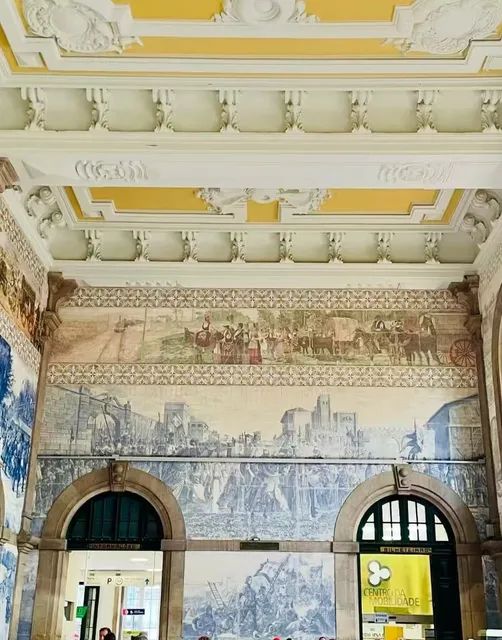
Near the ceiling, is a blue and gold frieze decorated with stylized flowers, while below them is another polychromatic frieze, evocative of the history of the road in Portugal.
Below the friezes are large azulejo "paintings" representing historical events in Portuguese history.The azulejo are integrated into the architecture by frames in granite which decorate the lines of the atrium.
Vestibule
There are approximately 20,000 azulejo tiles, dating from 1905–1916, and were composed by Jorge Colaço, an important painter of azulejo of the time.
The first tiles were placed on 13 August 1905.To the left of the entrance is a scene depicting the Battle of Arcos de Valdevez and Egas Moniz before Alfonso VII of Castile, while to the right, is D. João I in Oporto, with his fiancé and the Conquest of Ceuta. On the border wall at the entrance are small panels depicting countryside scenes.
The upper part of the frieze are lined with polychromatic azulejos depicting a chronology of some forms of transport used by man in Portugal.The lower and upper frame of the frieze consists of a line of tile in blue, browns and yellow in a stylized geometric pattern.
Under this, on the top of the north wall, is a large composition that covers the entire wall, depicting the Battle of Valdevez (1140), with two groups of antagonists and other knights in the background.
This monochromatic composition is executed in blue and white tile, similar to all the other main azulejo "paintings".
Below it is another composition that represents meeting between the knight Egas Moniz and Alfonso VII of León in Toledo (12th century), offering his life, his wife and his sons during the siege of Guimarães. In the south, is a painting of the entrance to Porto of King John I and Philippa of Lancaster, on horseback, to celebrate their wedding (1387).
Below that is the Conquest of Ceuta (1415), with the principal figure of Infante D. Henrique who...
Read moreSão Bento Railway Station is a must-see for any visitor to Porto. Built in the early 20th century, the station is a stunning example of Beaux-Arts architecture. The station's façade is decorated with azulejos, or traditional Portuguese tiles, that depict scenes from Portuguese history. The interior of the station is equally impressive, with a large hall that is also decorated with azulejos. These tiles depict scenes of everyday life in Portugal, as well as historical events.
The Azulejos
The azulejos at São Bento Railway Station are some of the most beautiful in Portugal. They were created by Jorge Colaço, a renowned Portuguese artist. The tiles depict a wide range of scenes, from historical battles to everyday life in the early 20th century. The tiles are a great way to learn about Portuguese history and culture.
What to See and Do
In addition to admiring the azulejos, there are a number of other things to see and do at São Bento Railway Station. Visitors can also take a train from the station to explore the rest of Portugal.
Tips for Visitors
Admission to the station is free. The best time to visit the station is during the day, when the natural light illuminates the azulejos. There is a café located in the station where you can grab a bite to eat or a drink. The station is located in the city center, so it is easy to get to by public transportation. Overall, São Bento Railway Station is a beautiful and historic landmark that is well worth a visit. The azulejos are a must-see, and the station is a great place to learn about Portuguese history and culture.
Here are some additional details about the station that you may find helpful:
The station is served by both regional and intercity trains. The station is located near a number of other popular tourist attractions, including the Ribeira district and the Douro River. The station is a popular spot for photo ops, so be sure to bring your camera! I hope this helps! Let me know if you have any...
Read moreUnravel Portugal's artistic and historical past as you step into one of its most astonishing landmarks – the São Bento Train Station. Beyond its functional role as a transportation hub, this remarkable edifice is an awe-inspiring architectural gem, adorning the heart of Porto with an exquisite ensemble of 20,000 blue and white azulejo tiles. The São Bento Train Station was born from the creative mind of José Marques da Silva, an architect who left his indelible mark on the landscape of Porto. His masterpiece was completed in 1916, standing tall and proud as a U-shaped, three-story granite marvel that harmoniously balances symmetry and grandeur. The natural spectacle, however, lies within its walls and across its exterior. A staggering 20,000 azulejo tiles, each carefully hand-painted, blanket the station, narrating tales of Portugal's rich history. The maestro behind these vibrant chronicles was Jorge Colaço, whose artistic prowess transformed the station into an immersive historical gallery. Nestled within the civil parish of Cedofeita, a name which translates to "St. Benedict," São Bento Train Station is a testament to the enduring beauty of the Azulejo tradition. Originating from the Moorish influences of North Africa, these traditional ceramic tiles were introduced to Portugal in the 15th century. Initially blue and white, their palette evolved, mirroring the changing artistic trends of the periods they were crafted in. Today, these resplendent tiles are heralded as emblems of Portuguese heritage, coloring the facades and interiors of buildings nationwide. Whether you're waiting for a train at the São Bento station or exploring the winding streets of Porto, the azulejo tiles are waiting to...
Read more