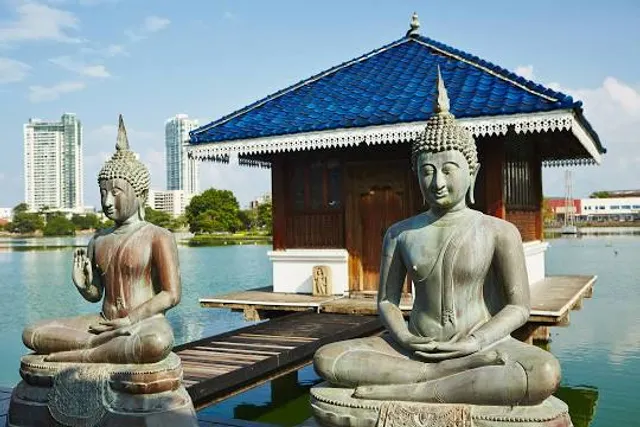
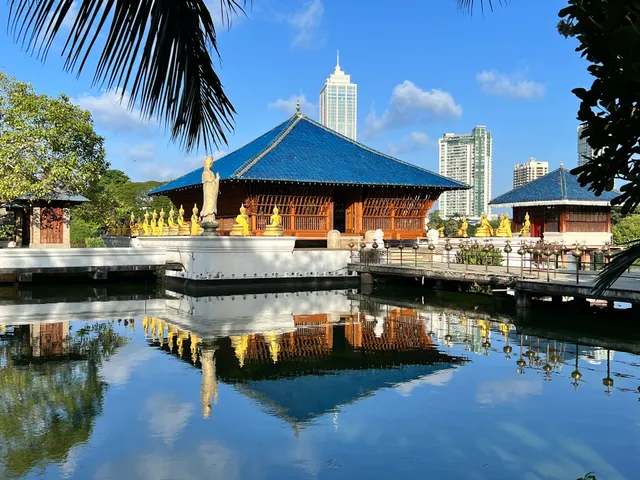
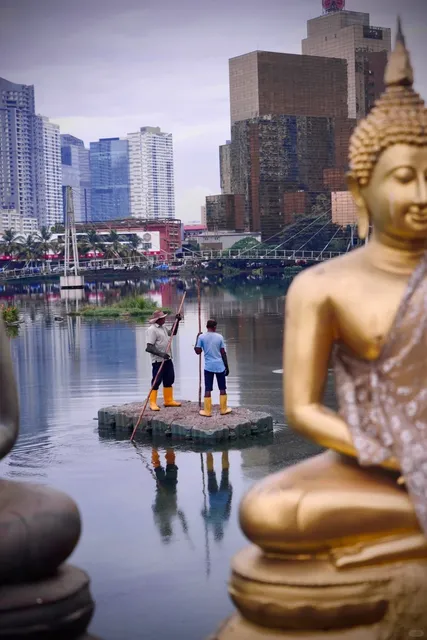
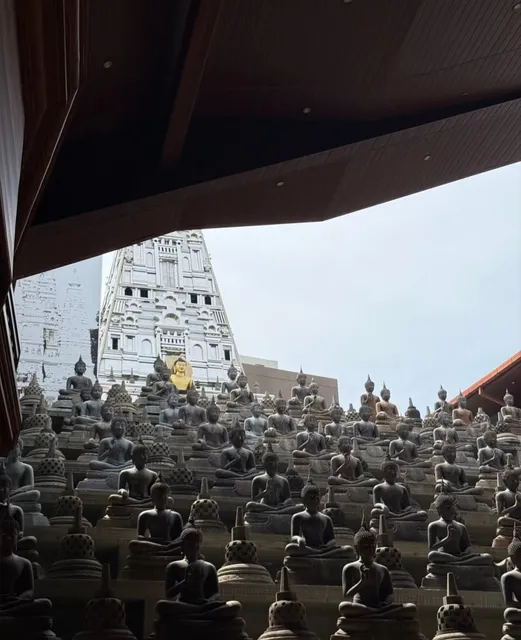
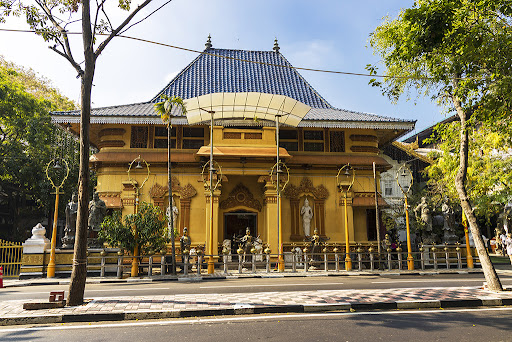
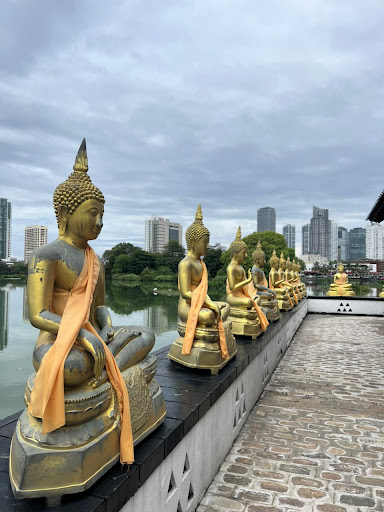
Elephant Visits the Temple! I visited the temple twice, once in the morning on 16th and again in the evening on 18th March 2020. Visitors need to remove their shoes at the entrance to the temple. Being a place of worship, there is no entrance fee for locals. The tourists over 12 years are charged Rs 400 (USD 2.25) per person. The temple is open to the public from 0530 until 2200 hrs. The main attractions at the temple are an Image House, Samadhi statue and Stupa, Atavisi Hall, Bo tree, imitation of Indonesian Borobudur monument, museum, relic chamber, library as well as alms and educational halls. A three storeyed building houses priests and includes rooms that provide space for their education at the monastic college (pirivena). I spent about two hours within the temple on the 16th. As I was coming out at about ten o’clock in the morning, I was lucky and fortunate to witness the fascinating spectacle of the temple elephant coming in through the entrance with a lotus flower atop its raised trunk. It walked in, attended by the mahout, walked up through the temple courtyard up to the Samadhi Buddha statue and paid homage, kneeling and prostrating itself on all fours and placing the flower gently on the offer table! Though the elephant had some chains around its neck, it walked with a bouncing gait and went away presumably for its daily walk on the streets around the temple. It was an unusual and a spectacular sight that I witnessed that morning! I am an animal lover and was glad to see that the elephant was not forced in anyway to perform this act – though it must have been trained to do that ritual! My first stop was the Image House or Viharaya. A large sized seated buddha statue in meditation is the central attraction within. Flanked are many other statues and statuettes of heavenly beings as well as paintings related to Buddhist narratives and stories all decorated in golden yellow. The white Samadhi statue, chiselled out of white jade, was my next stop. The statue sits in an intricately sculpted stone house flanked by two elephant tusks. It is at the offer table here, that I later saw the temple elephant placing the lotus flower. Behind the Samadhi statue is the white domed stupa. The bo-tree is at the upper level. This is one of the key items in Buddhist worship. Buddha is reputed to have attained enlightenment under a bo-tree. At the upper level also are an alms hall for priests and an educational hall for the public to listen to Buddhist preachings by priests. Within the relic chamber are housed relics of Buddha and some of his disciples. A large collection of objects of historical, cultural and religious significance are housed in the museum that is entirely filled with objects. These include vast arrays of Buddhist artefacts, old coins, statues, ola-leaf writings, jewellery and many others Though not within the museum, there is an array of vintage cars, watches, clocks and other mechanical equipment. An imitation from the Borobudur temple in Indonesia depicting an array of buddha statues on stacked platforms, sits behind the relic chamber. The Seema Malaka on the adjoining Beira lake too is part of this temple, although TripAdvisor provides it a separate listing. The Navam Perahera, a colourful pageant is held annually in February. This grand spectacle of hundreds of dressed up and costumed elephants together with many troupes of dancers, drummers and other performers touring in procession is watched by tourists and visitors perched on multi-level stages that are erected along the roads. The temple contributes to and carries out several community projects too. Among these are vocational training centres, homes for abandoned and street children, homes for the elderly as well as publication of Buddhist literature. The temple swarms with tourists and devotees throughout the day. Early morning is the best time to...
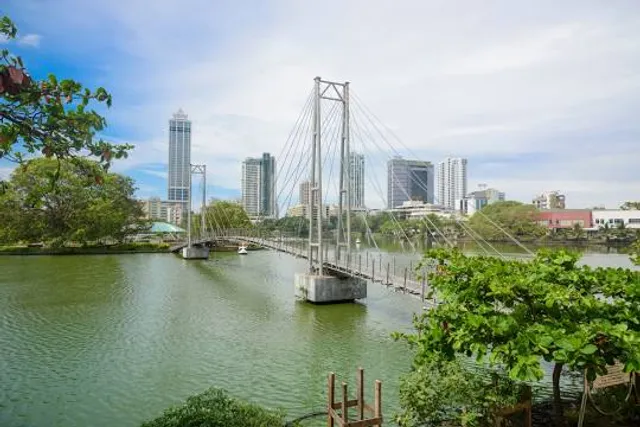
Read moreGangaramaya Temple is one of the most popular and iconic temples located in Colombo. Gangaramaya temple's architecture features a heterogeneous mix of Sri Lankan, Thai, Indian, and Chinese styles. Located on the banks of the famous Beira Lake in Colombo 2, the Gangaramaya consists of the main temple, a museum, a library and vocational training centers.
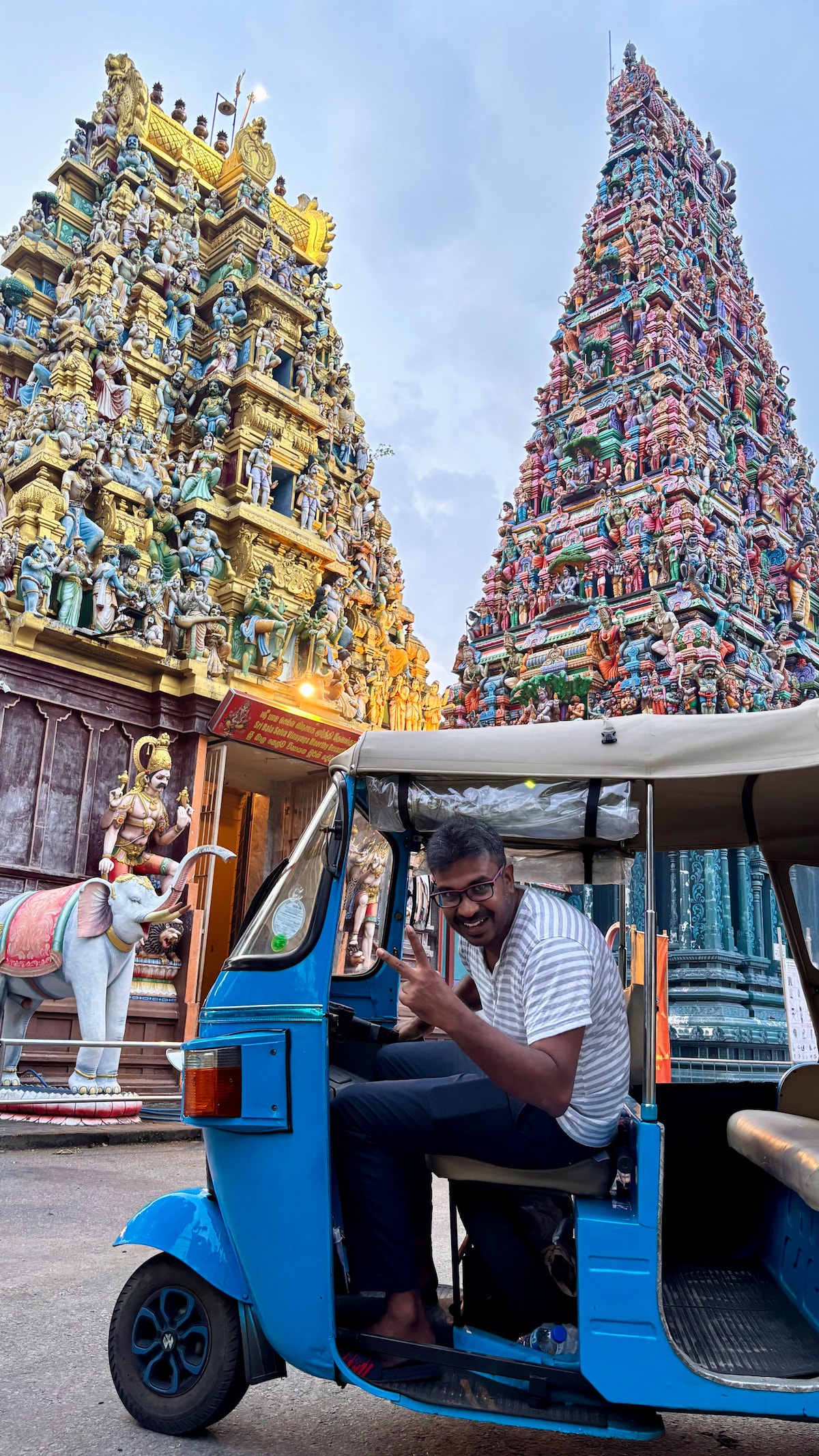
The 120-year-old Gangaramaya is not the typical Sri Lankan temple. Situated in the bustling inner-city Colombo, nearby the scenic Beira Lake, this intriguing temple complex is simultaneously a hugely popular tourist attraction, a place of worship and a learning and vocational training center. Rather than huge, open spaces and tranquility, expect huge collections of fascinating artefacts and crowds at Gangaramaya Temple Colombo. The temple is mostly celebrated for its lavish architecture and statues showcasing Sri Lankan, Chinese, Thai, Burmese and many other artistic styles. The exterior of the temple is boldly decorated in elaborate designs and golden adornments. The temple grounds are black slate tiled, with various statues—Buddha, lion, nymph—and china vases placed randomly.
Two medium-height golden Buddha statues stand like sentinels at the door leading to the main sanctuary of the temple. The door itself is an impressive work of craftsmanship, with intricate wood carvings of elephants and swans reminiscent of the island’s ancient artisanship. (The door to the exit is similarly engraved.) The temple’s main sanctuary is a soothing room decorated in soft yellowish hues, housing a massive Buddha statue in meditation pose flanked by statuettes of heavenly creatures. The ceilings are enchantingly decorated with vibrant pastel paintings depicting Buddhist stories. The columns of the sanctuary are breathtakingly festooned with traditional Sri Lankan art. Many white-clad devotees go through the main sanctuary to offer colorful lotuses to the Buddha and exit out into the courtyard to light oil lamps and burn incense. There is a distinguishable stepped wall out here with many stone statues of the Buddha and stupas. The Bodhi tree and the courtyard of the coral-white stupa are excellent places to bask in serenity.
The temple’s most distinguishing feature is its treasure-trove museum that holds an innumerable number of Buddha statues from all over the world along with statues of Hindu gods, old watches, Dutch coins and many other antique collectibles. The temple museum proudly houses the smallest Buddha statue on the island, carefully encased in a glass box, which visitors can view with a magnifying glass. Most of the bejeweled and shiny trinkets here are gifts from devotees to the temple’s head monk, Ven. Galaboda Gnanissara Thero, one of the island’s most recognizable religious figures, who assumed administration of the Gangarama as a 16-year-old novice monk. An ardent traveler, the temple is overrun by outlandish souvenirs Gnanissara Thero has gathered from places he’s been to, such as a “hip” Buddha statuette sporting a pair of sunglasses. The venerable monk is also an antique car lover and visitors can marvel at his collection of old Rolls-Royces and Mercedes, including Sri Lanka’s very first Mercedes.
The stunning Gangaramaya temple Colombo is open to everyone,...
Read moreGangaramaya Temple (Sinhala: ශ්රී ගංගාරාම මහාවිහාරය śrī gangārāma mahāvihāraya, Tamil: ஸ்ரீ கங்காராம மகாவிகாரம் Srī Gaṅgārāma Makāvikāram) is one of the most important temples in Colombo, Sri Lanka, being a mix of modern architecture and cultural essence. Located on the Beira Lake, it was completed in the late 19th century
Architecture
edit
The temple's architecture demonstrates an eclectic mix of Sri Lankan, Thai, Indian, and Chinese architecture.[1]
This Buddhist temple includes several imposing buildings and is situated not far from the placid waters of Beira Lake on a plot of land that was originally a small hermitage on a piece of marshy land. It has the main features of a Vihara (temple), the Cetiya (Pagada) the Bodhitree, the Vihara Mandiraya, the Seema malaka (assembly hall for monks) and the Relic Chamber. In addition, a museum, a library, a residential hall, a three storeyed Pirivena, educational halls and an alms hall are also on the premises.
Most notable for tourists is the architecture of Seema Malaka, which was built with donations from a Muslim sponsor to the design of Geoffrey Bawa.
Famous incumbents
edit
It was the home for erudite scholars such as Ratmalana Sri Dharmarama Thero, Waskaduwa Sri Subhuti Thero, Weligama Sri Sumangala Thero, Welivitiye Dhammaratna Thero, and Pandit Batuwantudawe.
Don Bastian (de Silva Jayasuriya Goonewardane, Mudaliyar), a 19th-century shipping merchant who was seeking suitable land to build a temple for the Matara Sri Dharmarama thero, bought a beautiful tract belonging to three Moors, and filled and prepared the land at great expense. The land was bordered on two sides by the Moragoda Ela and the Pettigala Ela was used to build the temple, which was subsequently named the Padawthota Gangaramaya Viharaya. The Mudaliyar, with the assistance of the people built a great 'Chaitya' (Dagaba) of 30 Riyans, and built a great decorative arch (thorana) and a 'Sandakada pahana' modeled on the ones found at Anuradhapura, at the entrance to the temple. A 'Bo' sapling brought from the great Sri Maha Bhodiya in Anuradhapura, was planted with his own hands and nurtured. He also built a three-storied preaching hall, walls, railings and the moat around the temple.
Today Gangaramaya serves as a place of Buddhist worship and a learning centre. The temple is involved in Buddhist welfare work including old peoples' homes, a vocational school and an orphanage. The temple is uniquely attractive and tolerant of members of many different religions. It has been instrumental in establishing the Buddhist temple on Staten Island (US) the Buddhist Center in New York and the Buddhist Centre in Tanzania, thus helping to propagate the Dhamma in...
Read more