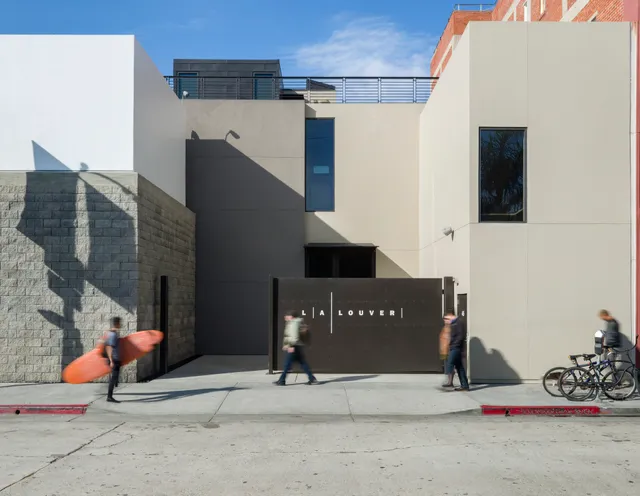
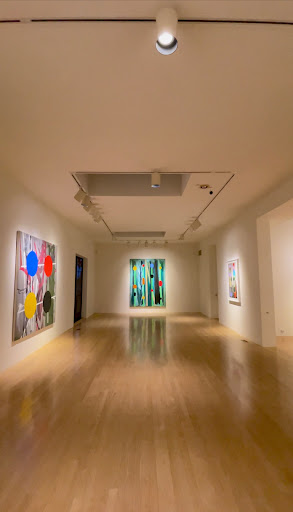
Stepping into LA Louver is like crossing a threshold into a different frequency—a portal where ideas materialize through paint, steel, ink, and spirit. The gallery’s layout itself encourages a kind of ritualized wandering, each piece acting as a compass, an altar, or an echo. It’s rare to find a space that feels both cosmopolitan and deeply personal, but LA Louver manages to do just that.
One of the most thought-provoking features was the six-panel conceptual series depicting “Real” elements: REAL WORDS, REAL TURQUOISE, REAL GOLD, REAL EMERALDS, REAL OBSIDIAN, and REAL FLINT. Each piece seemed deceptively childlike at first glance—marker lines, elementary symbols, naïve compositions—but the deeper you looked, the more they transformed into maps of consciousness. Each medium becomes a relic, each word a kind of coded invocation. I found myself lingering here, struck by the alchemical relationship between language and material. The phrase “REAL WORDS” paired with an abstract syntax reminded me that sometimes art must operate outside the rational mind to reach deeper truths.
The scale and geometry imposed a meditative stillness, a kind of visual mantra where precision became its own form of spirituality.
In the center of the gallery stood a captivating sculpture—a white bust with organic growths emerging from the head and chest, seated atop a rusted circular base. The expression on the face was gentle yet strong, timeless and genderless, suggesting both ancestral wisdom and futuristic presence. There was something animistic about it. It didn’t just occupy space—it blessed it. This piece marked a grounding point for the entire exhibit, functioning like a guardian spirit or ceremonial fire around which the rest of the work orbited.
Nearby, a towering black monolith pulled me inward. Its polished surface reflected my body and the room around me in distorted fragments. In that moment, I became part of the installation—half spirit, half voyeur. This wasn’t a passive experience; it was participatory, interactive, and strangely humbling. To confront one’s own reflection in a space surrounded by so much artistic intention was a spiritual moment.
The figurative works added yet another layer. A reclining nude female figure, stylized with exaggerated curves and classical reference, felt at once erotic and melancholic. She was not just lounging—she was gazing, challenging the viewer to understand beauty, vulnerability, and decay all at once. In contrast, a set of monochromatic etchings depicting grief and turmoil struck a more sacred chord. In one, a group of mourners surrounded a limp body, rendered with such immediacy it felt like a living moment frozen in ash and ink. The line work wasn’t just technical—it was emotional, intuitive, and ancestral.
And then, there was the mural-like painting full of commotion and crowd. It was like witnessing a history you hadn’t lived but still remembered in your bones. It tied together themes of struggle, labor, and public resistance—humanity in motion, pressed together by the weight of time and architecture.
As a First Nations artist myself—working under the banner of The Eagles Talon Group—I couldn’t help but imagine what my own work might contribute to such a spiritually and intellectually rich space. My practice, rooted in Indigenous frequency, philosophical layering, and quantum intentionality, speaks to the same currents I witnessed within LA Louver’s walls: reverence, resistance, reclamation.
Though I understand that LA Louver is not currently accepting submissions, I see this not as a closed door, but as a future alignment waiting to happen. My work—like many others from underrepresented traditions—exists in conversation with the sacred, the physical, and the imagined. And I truly believe that one day, that conversation will unfold within these walls.
Until then, LA Louver remains not just a gallery but a sanctuary. For any artist, collector, or seeker of deeper meaning through visual form, this place is a rare and necessary...
Read moreIt was love at first sight: in 1979, as a young art student, I, like many others of my generation, were captivated by David Hockney’s supreme draughtsmanship and uncluttered painterly portals onto a cloudless Californian lifestyle.
But a lot has happened since then; Tracey Emin, digital photography, tablet devices, Creative Suite©, Instagram©, not to mention Barthes’ Camera Lucida - and a whole lot more. To place things into a proper perspective, over the past five decades, Hockney has always been an early adopter of new technologies, bringing both his sensibility and style to acrylic, Polaroid© and digital imaging by turns.
The shows at Annely Juda/L.A. Louver are based around what Hockney describes as ‘the void’ between the convention of perspective, the image surface and the viewer, and though his depiction of this perceptual disjunction may lack the poignancy of Barthes or the incisiveness of Sontag, it also comes with an understanding of the act of seeing along with an understanding of that act embodied in a practice which remains pointedly distinct from any other living artist.
Lest we forget: beyond the words and the technologies, Mr. Hockney still touches paint to canvas with a consummate brilliance that can only be sustained by the combined qualities of determination, practice and talent. This may of course be a statement of the blooming obvious, but even on a bad day, David Hockney remains one of the best painters England ever exported.
But beyond sentiment and back to the present, Hockney’s latest show is fascinating for a number of reasons; essentially he is attempting to unravel, on our behalf, the conventions of seeing, painting and photography that have become tangled through the convergence of digital and analogue image-making.
The typical portraits that comprise just less than half of the works in the show are apparently a foretaste of some 70 painted portraits that will be shown at major venues next year, and many of these are classic Hockney; stunning lines of brushwork against flattened slabs of intense colour. This juxtapositional use of paint has the effect of rendering the paintings expressive and expressionless at the same time. The portraits offer not only an insight into the artist’s vision, but also an incidental snapshot of his encounters with individuals in his social and professional orbit. Aesthetically and metaphorically, the deadpan Liquitex© flatness of Hockney’s painting is perfectly suited to the laconic depiction of his models and a sense, not of timelessness, but of subjects slipping into time.
In summary though, there is no implication here that this show is some kind of Curate’s Egg; it is altogether interesting, with never a dull moment, never a sense that the artist is recumbent on the laurels and always the sense that he is striving for more, for better, and driving hard to understand how human perception sits alongside the sensory extensions offered by technology. After spending an hour here, I just knew it...
Read morefree entry just reserve an appointment time online at their website.
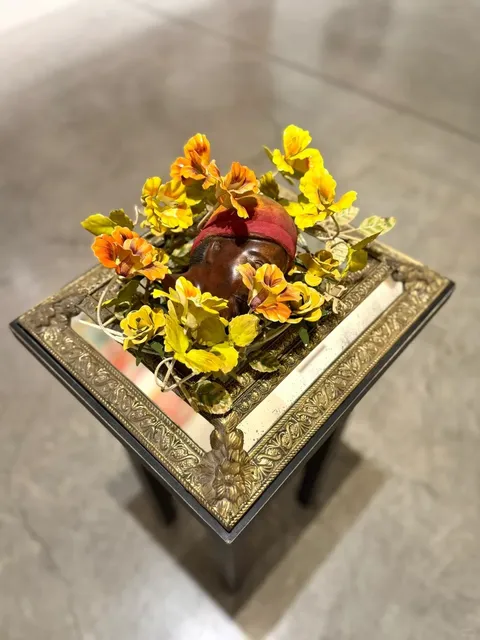
i’m glad i stopped by because vanessa german and don suggs were exhibited this time around.
not sure what it is about suggs’ work - i was captivated by the vague figurines. my favorites are asunción and woodman.
pay this local art exhibit a visit if...
Read more