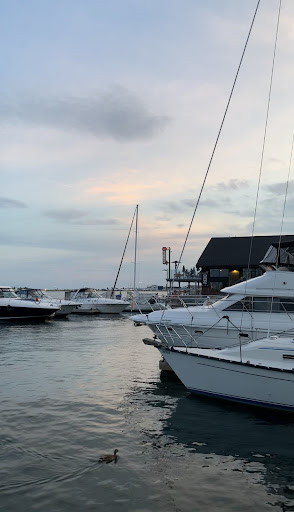
The Toronto waterfront is the lakeshore of Lake Ontario in the City of Toronto, Ontario in Canada. It spans 46 kilometres between the mouth of Etobicoke Creek in the west, and the Rouge River in the East.
Lake Ontario is a recent lake. As the last glaciation, the Laurentian glaciation receded, a number of proglacial lakes filled in basins adjacent to the glacier. One of those proglacial lakes was Lake Iroquois. Lake Iroquois was considerably deeper than Lake Ontario, as a lobe of the Laurentian glacier still filled the valley of what is now the St. Lawrence River. The southern boundary of Lake Iroquois was the Niagara escarpment. The lake flowed over the Niagara Escarpment east of Rochester, and flowed to the Atlantic Ocean down what is now the Mohawk River, to the Hudson River. The shoreline of Lake Iroquois can be observed in steep hills, such as that on the north side of Davenport Road. Casa Loma has a good view of the harbour, four kilometres away, as it is on the height of the old shoreline.
When the glacier retreated from the St. Lawrence Valley, the shoreline receded to a much shallower level than today's lake, as it takes time for land that had been under a heavy glacier to rebound. This lake was call Admiralty Lake. Some sources suggest the drainage of the lake triggered the Upper Dryas climatic change. Some sources suggest the lake drained all the way to sea level and the lake became brackish.[citation needed]
Since the last ice age, silt deposits, borne mostly from the erosion of the Scarborough Bluffs and the eluvial rivers to the east were swept by strong, natural Lake Ontario currents creating prominent fingers of land away from the lakeshore in the current central waterfront area, including the Toronto Islands. The shore of Lake Ontario (at least within present-day Toronto Harbour) is mostly landfill, extending a kilometre or more from the natural shoreline.
Adding to the existing silt deposits, Ashbridges Bay was filled in and the Port Lands area (Cherry Street to Leslie Street) was created in the early 1900s. The bay was filled in partly due to concerns about public health â locals had disposed of sewage, farm animal carcasses and household waste in the bay for years. During this period, the Don River, which used to flow into the bay to the south-west, was diverted (straightened) toward the harbour, first directly southward and later westward through the current configuration of the Keating Channel. Currently, there are proposals to restore the original natural watercourse of the Don, which would bring it closer to the downtown core. The modern harbour area was mostly formed through landfill in the years around the First World War, to allow for deeper container vessel wharf access. The central waterfront functioned as an important industrial area for many years, providing shipping access to communities from Port Union in the east to Mimico in the west.
To the east and west, Toronto expanded along the waterfront with new residential suburbs. West of the Humber River, outside the city limits, the waterfront has been mainly private lands fronting on the lake. East of the Humber River, within the city limits, the waterfront has been under the control of the government. The Sunnyside lakefront from the Humber east to Jameson was filled in, creating new lands for recreational and park land uses. To the east of Sunnyside, the lands were originally military grounds, centred on Fort York. The Garrison lands became the Exhibition grounds and have been public ever since. To the east of the harbour area, parklands were built along the waterfront from Ashbridges Bay east to the eastern city border at Victoria Park. Further east, the Scarborough lands have been dominated by the Scarborough Bluffs and development could not proceed to...
   Read moreThe Toronto waterfront is one of the greatest assets and popular sites for tourists and Torontonians alike. Sunnyside is in the west-end with a swimming pavilion and boating. The Ontario Place has a magical presence on the water and the Canadian National Exhibition has everything money can buy.
The Toronto Island has several islands, with marinas, a small amusement park wonderful sandy beaches and a camp site on Snake Island.
Biking on the island is a dream come true, with flat, smooth-paved paths cooled from a steady breeze off the lake. Swimming is best in the south side of the island because of occasional fecal contamination elsewhere. There is a unbelievably beautiful boardwalk looking at the open Lake Ontario on the south side of the island east to Wards from Center Island.
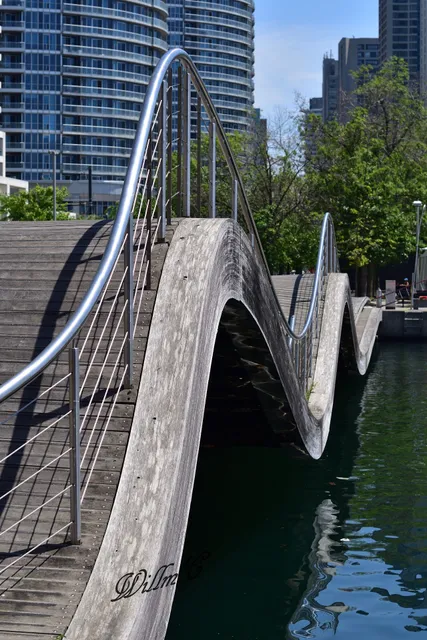
Many homes on leased lots can be found on the east side of the island and Wards Beach is one of the best in Toronto. The arched bridge to Algonquin Island is like a fairytale. The cafe is a must see. The islands, sand deposits from the Scarborough Bluffs, are also a significant migratory route for birds and butterflies and there is a great number of indigenous wildlife.
The East Beaches from Greenwood to Victoria Park are awesome. Kitesurfing is available here and there is a magnificent set of 3 pools at the foot of Woodbine. Boardwalks run along the lake
East of Victoria Park is the Scarborough Bluffs with great sandy cliffs and marinas. Still east is the Rouge National Urban Park with a beautiful walking path and a quiet spot for everyone.
Toronto's greatest asset, without a doubt, Lake Ontario serves as a source or drinking water for 9 million people. Although polluted by mass industry for almost 100 years, it has greatly recovered. Let's keep Lake Ontario clean....
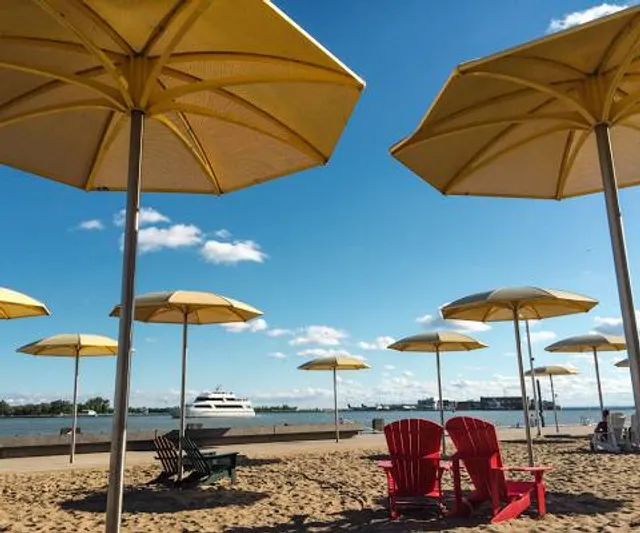
   Read moreThe Toronto waterfront is one of the cityâs true hidden treasures, a place where the pulse of the metropolis softens into something serene and restorative. Walking along the boardwalk, you quickly realize that this stretch of the city is not just about water meeting landâitâs about balance, reflection, and escape. HTO Park, with its golden sand and bright yellow umbrellas, feels like a slice of urban beach paradise. Itâs almost surreal to sit there and look out at the shimmering lake, with the city skylineâglass towers and, of course, the CN Towerâstanding proudly behind you.
As you continue east, the Toronto Music Garden unfolds like a lyrical surprise. Designed in part by Yo-Yo Ma, it is both a garden and a performance space, where nature and artistry intertwine. Every curve of the path feels like a measure in a song, and if you are lucky enough to hear live music, it becomes an experience that resonates far deeper than sight alone. Nearby, the Toronto Book Garden offers another kind of quiet magicâa place where literature, reflection, and greenery mingle, encouraging you to slow down and perhaps lose yourself in words as well as in views.
The entire walk is meditative. The lapping waves of Lake Ontario, the gentle chatter of birds, the sway of trees, and the hum of bicycles along the trail create a soundtrack that is both calming and alive. This waterfront is more than a destinationâitâs an oasis. It offers you the chance to step away from the constant rush of Toronto and breathe in tranquility, all while the city itself remains in sight, reminding you that peace and hustle can coexist,...
   Read more