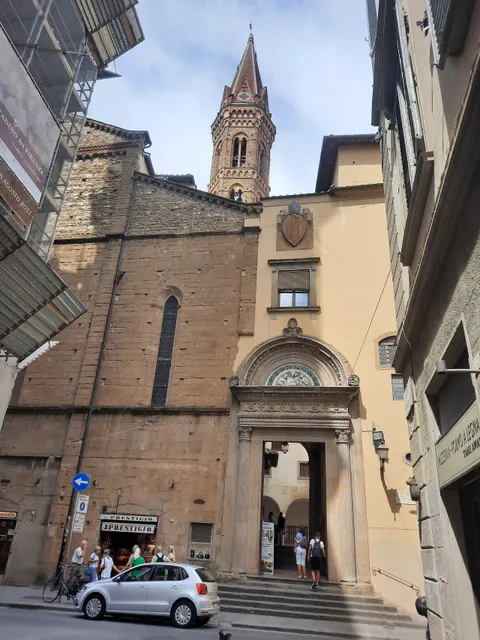
The Badìa Fiorentina is an abbey and church now home to the Monastic Communities of Jerusalem situated on the Via del Proconsolo in the centre of Florence, Italy. Dante supposedly grew up across the street in what is now called the 'Casa di Dante', rebuilt in 1910 as a museum to Dante (though in reality unlikely to be his real home). He would have heard the monks singing the Mass and the Offices here in Latin Gregorian chant, as he famously recounts in his Commedia: "Florence, within her ancient walls embraced, Whence nones and terce still ring to all the town, Abode aforetime, peaceful, temperate, chaste." In 1373, Boccaccio delivered his famous lectures on Dante's Divine Comedy in the subsidiary chapel of Santo Stefano, just next to the north entrance of the Badia's church.
The abbey was founded as a Benedictine institution in 978 by Willa, Countess of Tuscany, in commemoration of her late husband Hubert, and was one of the chief buildings of medieval Florence. A hospital was founded in the abbey in 1071. The church bell marked the main divisions of the Florentine day. Between 1284 and 1310 the Romanesque church was rebuilt in Gothic style by famous Italian architect and sculptor Arnolfo di Cambio, but in 1307 part of the church was demolished to punish the monks for non-payment of taxes. The church underwent a Baroque transformation between 1627 and 1631. The prominent campanile, completed between 1310 and 1330, is Romanesque at its base and Gothic in its upper stages. Its construction was overseen by the famous chronicler Giovanni Villani.
Today the Badia is the home to a congregation of monks and nuns known as the Fraternità di Gerusalemme. They have sung vespers at 6pm and mass at 6:30pm every day. Locals and tourists alike claim attending their Vespers or Mass to be one of the most beautiful experiences in Florence.
The legend tells that Dante saw for the first time Beatrice in this church.
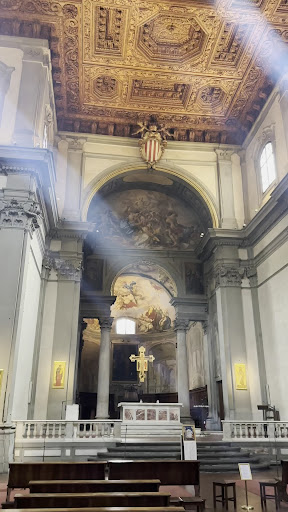
Major works of art in the church include the Apparition of the Virgin to St. Bernard (c. 1486) by Filippino Lippi (originally commissioned by Piero del Pugliese for his chapel at Chiesa di Santa Maria del Santo Sepolcro or delle Campora) and the tombs of Willa's son Hugh, Margrave of Tuscany (died 1001) and the lawyer and diplomat Bernardo Giugni (1396–1456), both by Mino da Fiesole (latter completed c. 1466). The murals in the apse were completed by Giovanni Domenico Ferretti in 1734.
The attached Chiostro degli Aranci (Cloister of the Oranges) contains a fresco cycle (c. 1435–1439) on the life of St Benedict, rooted in the context of the Badia's revitalizing by a prominent monastic reformer of Portuguese origin, Abbot Dom Gomes Eanes (OSB) ("Beato Gomezio" in the contemporary Italian sources) (c. 1383–1459). Many attribute the frescos to the Portuguese painter Giovanni di Consalvo, a generally unknown follower of Fra Angelico. They are more likely the work of Zanobi di Benedetto Strozzi(1412–68) under the guidance of Angelico himself. The fourth scene in the cycle was repainted c. 1526-1528 (St. Benedict chastising himself) by the young Bronzino. The cloister itself was built under the direction of Antonio di Domenico della Parte and Giovanni d'Antonio da Maiano, with some assistance by...
Read moreThe monastic communities of Jerusalem have the mission to live in the heart of the city of God. The first community was founded on November 1, 1975 in Saint-Gervais-Saint-Protais Church by father Pierre-Marie Delfieux, with Cardinal François Marty’s approval. And since September, 8 1998 they have been called by Cardinal Silvano Piovinelli to settle at Florence in Santa Maria Assunta Church in Badia of Faenza-Modigliana’s desire to “give life” to the hermitage of Gamogna. The essence of their vocation could be summed up in Jesus’ own prayer: “ Fsther, I do not pray that you take them out of the world, but that you keep them from evil one ( John 17,15), which guides all their life. Since human beings are created as the most beautiful image of God, the brothers and sisters of Jerusalem want to pray and meet God in the city, among its inhabitants. Through a life of contemplation and community, they want to reach out and serve all the men who seek God. This, the monks and nuns of Jerusalem strive to put the prayer in the heart of the city and carry the city in the heart of their prayers. They want to create an oasis in the urban “desert “ of alienation and anxiety, loneliness, yearning or indifference by “giving life” to a place of silence and prayer which would be also a place of welcome and sharing. Concretely, the vocation of the brothers and sisters of Jerusalem is typified by five distinctive characteristics: ✅ First, they’re city dwellers, because urbanisation is without a doubt one of the most important developments of modern times, and the rapid expansion of big cities has become a universal phenomenon ✅ They rent their housing, as do most other city dwellers today and do not own any property, in order to avoid the risk of becoming too settled and of accumulating property ✅ They are wage-earners , and work only at part-time, looking for being in solidarity with everybody, and not being a charge for nobody. ✅ They are directly part of the diocesan church, in the spirit of Vatican Council II, in order to adapt better to different situations, sensibilities and cultures and to live fully the reality of each local Church ✅ They have , no walled cloister though they live a spirit of enclosure by keeping clearly defined them to live “apart” , always in a spirit...
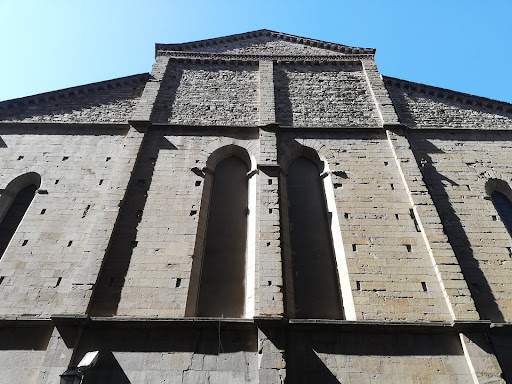
Read moreEsisteva in questo luogo la chiesa di Santo Stefano detta "del popolo", che è ricordata già nel 960, quando venne venduta da un privato a Willa di Toscana, madre del marchese Ugo, per costruirvi attorno l'abbazia benedettina detta poi Badia Fiorentina (badia significa abbazia). L'abbazia fu fondata invece nel 978. Ugo, divenuto marchese di Toscana, accrebbe con grande munificenza le donazioni della madre e il suo ricordo è stato perpetuato nei secoli, tanto che ogni 21 dicembre viene ancora celebrata una messa per il nobile benefattore, detto da Dante il Gran barone: sulla sua tomba posto un cuscino di fiori bianchi e rossi (i colori del suo stemma) e celebrata all'altar maggiore una messa solenne di suffragio con la partecipazione di popolo e autorità. Grazie ad altre ingenti donazioni ed anche ai privilegi concessi da papi e da imperatori, l'abbazia acquistò o ereditò varie proprietà ad essa circostanti, ove aprirono le loro attività cartolai, miniatori, legatori, librai, che connotarono la zona con una produzione legata alla realizzazione di libri e pergamene. Bonifacio di Canossa insediò come abate della badia il monaco eremita benedettino San Maurilio, che lasciò l'incarico nel 1055 per essere eletto da Guglielmo I d'Inghilterra vescovo di Rouen. Nel 1285 la chiesa subì un radicale rifacimento in stile gotico ad opera di Arnolfo di Cambio, che ne cambiò l'orientamento con l'abside verso via del Proconsolo. L'orientamento era quello più tradizionale, con le finestre del retro a oriente per ricevere la luce solare ogni mattina. Ancora sono chiaramente visibili su via del Proconsolo i profili delle finestre gotiche, ormai cieche, e la parete absidale esterna, sulla quale è stato appoggiato, con una strettissima intercapedine, la struttura della chiesa odierna. Il campanile (1310-30) cuspidato e a base esagonale è un punto celebre del profilo cittadino e si staglia fra le torri di Palazzo Vecchio e del Bargello (ultimo restauro terminato nel 2001). Per secoli le sue campane hanno scandito le ore in tutta la città. Fu costruito a base esagonale al posto di un vecchio campanile a base circolare. Nel 1307 il campanile fu abbattuto a metà per punire i monaci riluttanti a pagare una tassa cittadina, ma fu comunque restaurato presto nel 1330. La sua altezza attuale è di circa 70 metri. L'interno della chiesa, ulteriormente trasformata anche nel Settecento, presenta una sovrapposizione di stili e strutture. L'aula è dominata da un sontuoso soffitto ligneo intagliato, realizzato da Felice Gamberai nel 1631, che nasconde le capriate gotiche. Posta a sinistra spicca la grande pala di Filippino Lippi Apparizione della Vergine a san Bernardo,(1482-1486). Un particolare curioso è la raffigurazione di un demonio coperto di pelliccia e con minacciose zanne nascosto nella roccia sotto al santo, il quale è raffigurato in estasi per la visione mariana. La barocca Cappella di San Mauro, a destra, anticamente la seconda campata della navata, è completamente stata affrescata da Vincenzo Meucci (1717). Sopra la cappella si trova un grande organo in legno intagliato e dorato risalente al 1717. Le due cappelle a fianco dell'altare ospitano le tele della Pentecoste di Mirabello Cavalori (a destra) e della Salita al Calvario di Giovan Battista Naldini (1570 circa, a sinistra). Sulla parete sinistra, sopra il monumento a Ugo di Toscana, nella cantoria è conservata la pregevole tela dell'Assunta e santi di Giorgio Vasari (1568). Nonostante le trasformazioni subite nei secoli, la Badia ha mantenuto integro all'interno del complesso il suggestivo Chiostro degli Aranci realizzato tra il 1432 e il 1438 da Bernardo Rossellino. Infine degna di nota la denominazione "Badia", contrazione popolare della parola abbazia. A Firenze e dintorni sono esistite cinque abbazie, situate come ai punti cardinali della città: a nord la Badia Fiesolana, a ovest la Badia a Settimo, a sud l'abbazia di San Miniato, a est la Badia a Ripoli e al centro la...
Read more