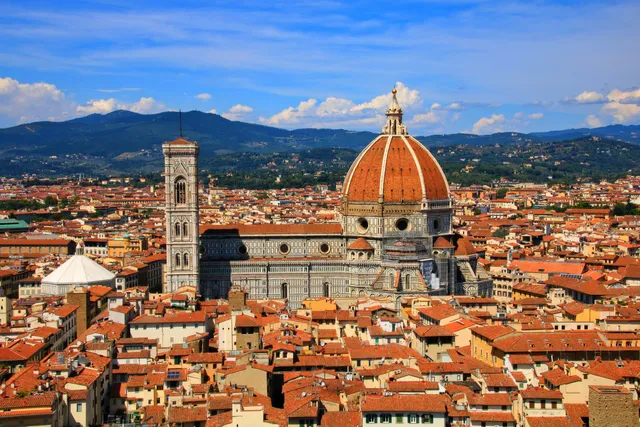
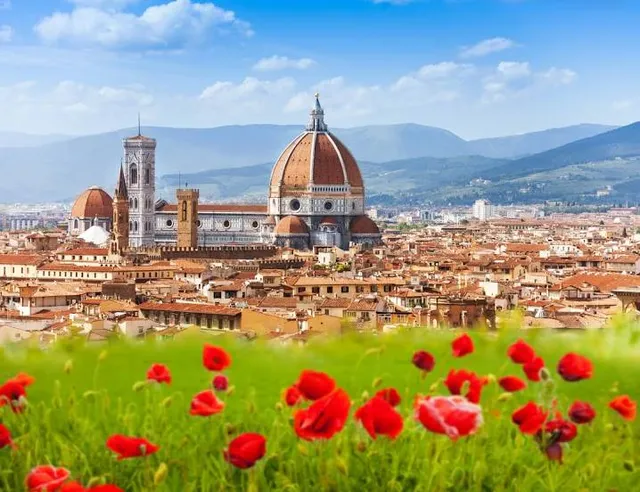
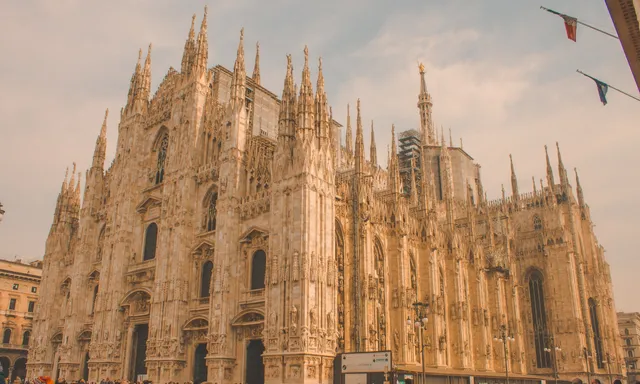
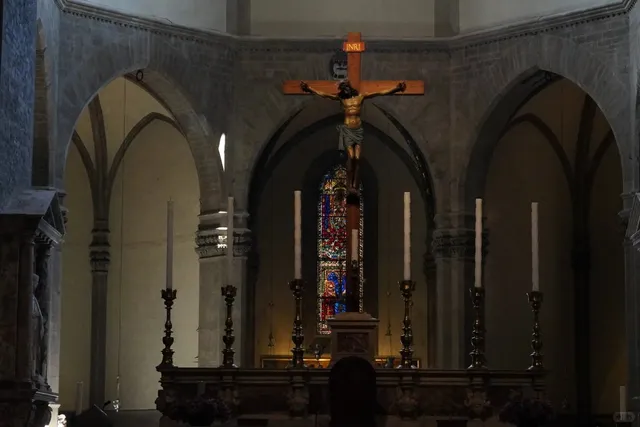
Like many Cathedrals that have a long construction time, 1296-1436 for this one, it had many master builders and artisans. Starting in the Gothic Style by the Arnolfo di Cambio it had progressed through the Romanesque, the Renaissance into the Gothic REVIVAL for its facade. This cathedral was built around a previous cathedral dedicated to Saint Reparata from 393. It was demolished midway through the construction. The beauty of this cathedral is in it's raw presentation of the construction especially after it's exterior embellishment, leaving the interior very simple yet elegant. Having been an early go at this, it has groin vaults and a simple plastered finish. So it's austerity allows you to feel the space without all of the soon to be fashionable Romanesque, And Renaissance complications of Baroque and Rococo. Each of these movements/styles became an exercise in the expansion of the disciplined orders into fashionable visions made possible by the technological enhancements of craftsmanship and skill. Depictions of this cathedral early on would show the raw force of the austere forms. In contrast to later churches, a lot of the field finishes in each quadrant of the vaults and the walls would became much busier. It wasn't until the mid 19th century that the polychromatic facades were added. Noting that this was long afterwards in the Gothic REVIVAL period by Emilio De Fabris. As I mentioned in my review of the Milano Duomo, the power and control over the tendering of these designs to architects led to long periods of delay while the apprentices or transitional master builders could replace the previous one. A few times as architects died and for the black death construction was paused. It's a fascinating story to investigate. Wikipedia has a great summary for your review.
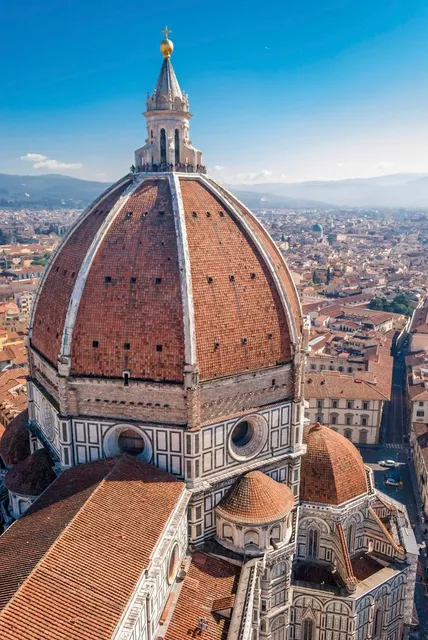
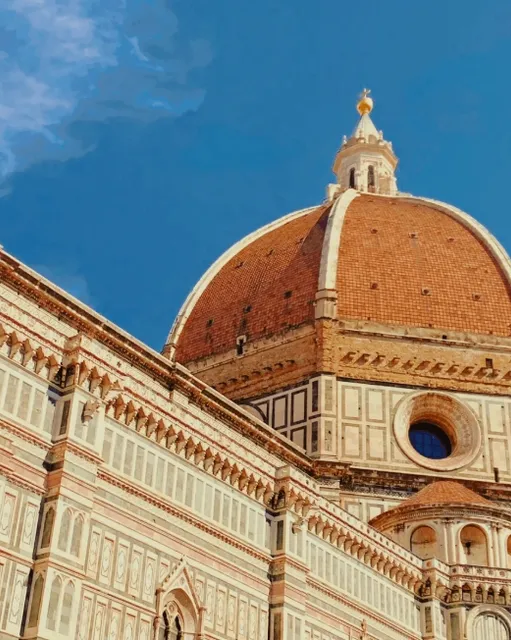
The nave and the apse, the two crossing aisles that intersect at the transcept, were finished first. But the dome above the transcept stood without a cover for a time. In fact the actual engineering for the dome was not even thought of prior to Brunilescci winning the competition. Of course he was backed by the Medicis so, well you know, money, money, money. The intriguing point about Brunalleschi's solution was complex. Using an inner and outer dome, the progress was done without inner supports underneath. The principle is not just stepping masonry inward with each rise across a decreasing slope as it rises, (like at the Pantheon but elliptical), but it involves a connection between the inner and outer dome.
This connection helps the outward forces by acting like a truss. Because only at these connecting points you have reactions to the gravity from the weight of the masonry, you do not have that mass of those connection components. This is the basic principle of trusses. With a beam the longer the span the deeper the beam. With a trust, you can eliminate material & cost as well. For this application the elimination of the mass allows for the masonry to do its job without having to be overly thick in dimension. I believe to this day it's the largest masonry done so he did something correct.
You can see the Nave and side aisles for free, but still usually a line. For the Coupola you will need tickets in advance as well for the Campanile Tower, each will have their own lines just as long. Note that on your trip up, you will go between the inner and outer dome and move inward as you work your way around the connection points between each dome structure.
Recommend getting there BEFORE your time. Also if you're looking for the shot to take home, arrive before 7am~ish to have an unobstructed picture. Puddles on the stone make a good mirror effect for a "from the ground" shot too. This is a can't miss...
Read moreThe Cathedral of Santa Maria del Fiore, commonly known as the Florence Cathedral or Duomo di Firenze, is one of the most famous landmarks in Florence, Italy. The cathedral’s bell tower, called the Giotto's Campanile, is an integral part of the complex. Here are details about both the cathedral and its bell tower:
Cathedral of Santa Maria del Fiore (Florence Cathedral)
Location: Piazza del Duomo, Florence, Italy.
Architectural Style: Gothic, with Renaissance elements.
Architects: The cathedral was designed by Arnolfo di Cambio in 1296, and the dome was later engineered by Filippo Brunelleschi in the 15th century.
Construction Period: Began in 1296 and was completed in 1436 with the completion of the dome.
Dimensions:
Length: 153 meters (502 feet).
Width: 38 meters (125 feet).
Height of Dome: 114 meters (374 feet), making it one of the largest domes in the world.
Key Features:
Dome: The most iconic feature of the cathedral is Brunelleschi's dome, which was a revolutionary architectural feat at the time. It remains the largest brick dome ever constructed.
Façade: The façade of the cathedral, completed in the 19th century by Emilio De Fabris, is made of white, green, and pink marble, giving it a highly decorative and colorful appearance.
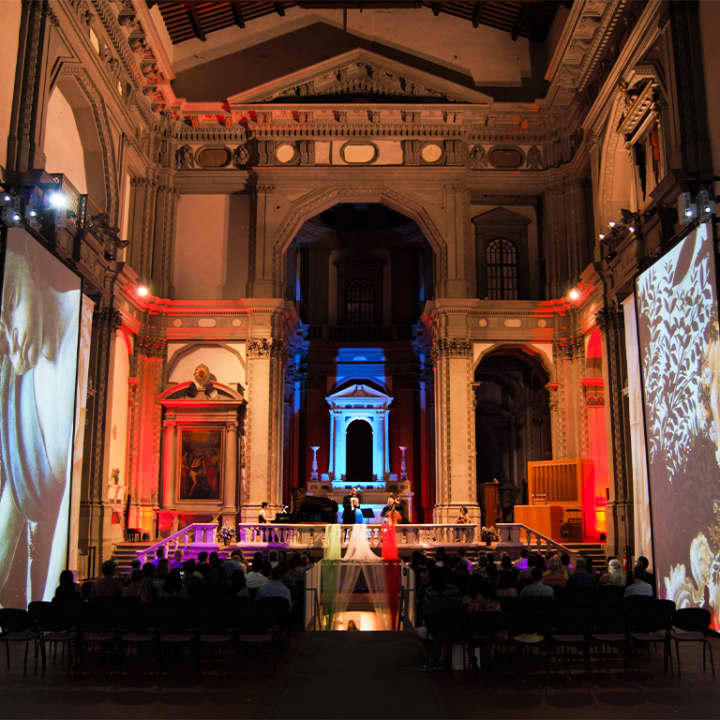
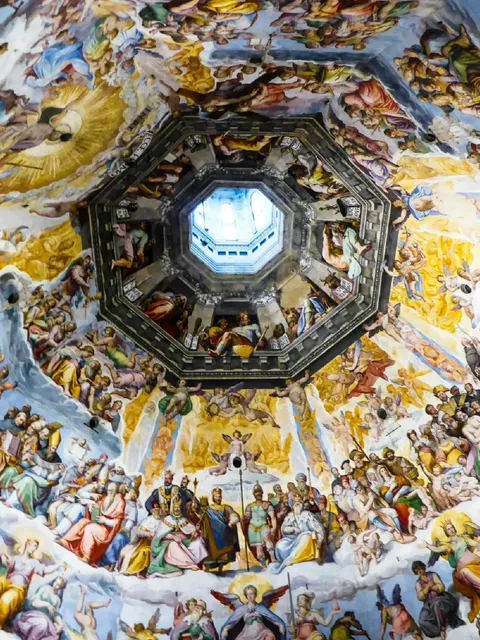
Interior: The interior of the cathedral is more austere in comparison to the exterior, with notable features like the clock by Paolo Uccello, and the frescoes in the dome by Giorgio Vasari and Federico Zuccari, depicting the Last Judgment.
Giotto's Campanile (Bell Tower)
Location: Adjacent to the Cathedral of Santa Maria del Fiore.
Architect: Designed by Giotto di Bondone, a renowned painter and architect, the construction started in 1334. After Giotto’s death, the construction was completed by Andrea Pisano and Francesco Talenti.
Architectural Style: Gothic.
Height: 84.7 meters (277.9 feet).
Floors: Five levels.
Key Features:
Decoration: The campanile is richly decorated with white, green, and red marble to match the cathedral. It is adorned with intricate sculptures and reliefs, some designed by Giotto himself, along with works by Pisano and Luca della Robbia.
Panels: The lower part of the bell tower is decorated with hexagonal panels, representing the Creation of Man, the Arts, and the Planets.
Sculptures: The second level is adorned with niches containing statues of prophets, saints, and kings. These sculptures are now displayed in the Museo dell'Opera del Duomo, and replicas are placed in their original spots.
Viewpoint: Visitors can climb the bell tower’s 414 steps to the top, where they are rewarded with a stunning panoramic view of Florence, including the cathedral’s dome.
Brunelleschi’s Dome
Though not part of the bell tower, the cathedral’s dome is worth mentioning as a related structure:
Designer: Filippo Brunelleschi.
Construction Period: Built between 1420 and 1436.
Diameter: 45.5 meters (149 feet).
Engineering Feat: The dome was an engineering marvel, constructed without traditional wooden supports, using a double-shell design to reduce weight.
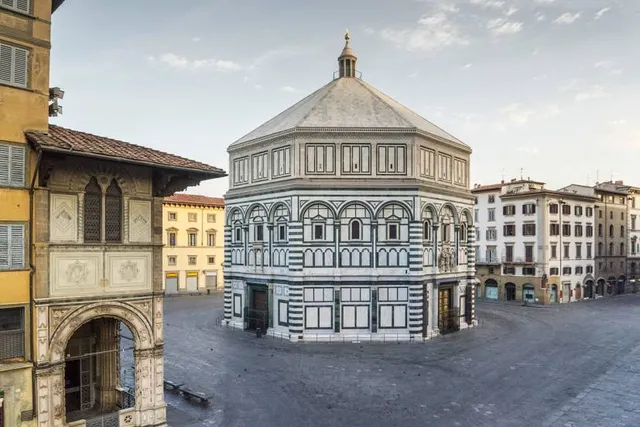
Baptistery of St. John
Located opposite the cathedral, the Baptistery of St. John is another significant part of the complex. Known for its Gates of Paradise doors, designed by Lorenzo Ghiberti, it is one of the oldest buildings in Florence.
Significance:
The Florence Cathedral and its bell tower, together with the Baptistery, form a UNESCO World Heritage Site and are considered masterpieces of Renaissance and Gothic architecture. These structures symbolize the artistic and architectural achievements of Florence during its cultural peak in the 14th and...
Read moreEntrance to church portion (the bottom level) is free. If you are ok to climb over 400 stairs to get to the top of the Brunelleschi Dome for an unobstructed iconic view of the Florence and see the Last Judgment frescoes closer — book tickets in advance, it’s totally worth it. When we were booking the reservations they were sold out on the official website and we bought one from Accord Audioguides that ended up great — priority enter, a shorter line. The audio tour is offered in different languages and hearing about history and challenges made us appreciate it more. During sunset we went to Giotto Bell Tower and the view is obstructed with a lattice all around, unfortunately. So if you have enough of time I’d suggest to go to Brunelleschi Dome and schedule your reservation closer to sunset time!
If you have limited time exploring Florence’s historic center on foot in one day is a delightful way to immerse yourself in its art, history, and culture. Here’s a walking guide, complete with must-see landmarks and vegan-friendly dining options:
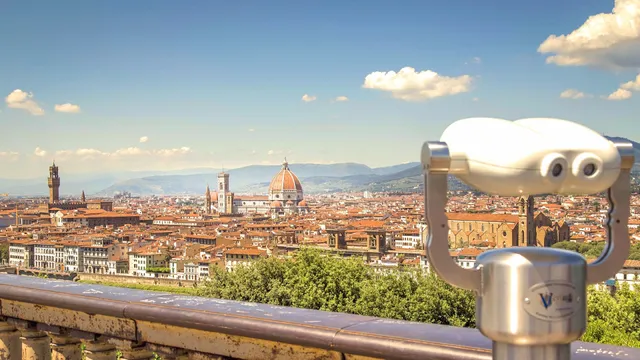
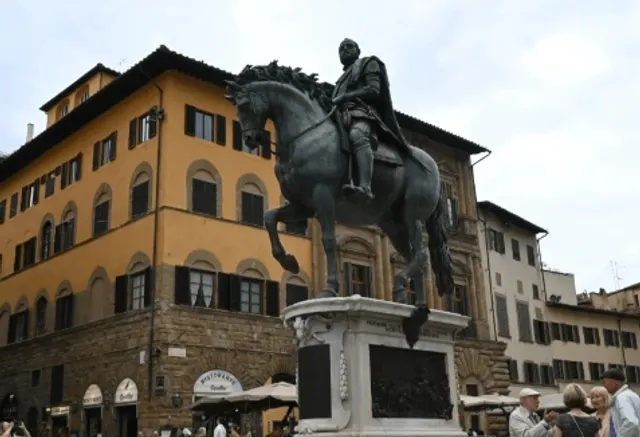
Morning: Start with the Heart of Florence Piazza del Duomo • Visit the Florence Cathedral (Santa Maria del Fiore) and admire its iconic dome by Brunelleschi. • Stop by the Baptistery of St. John and see the intricate bronze doors (the “Gates of Paradise”). • Climb the bell tower (Giotto’s Campanile) for panoramic views. Piazza della Signoria • Walk 10 minutes to this square, Florence’s political center. Admire the Palazzo Vecchio, the Loggia dei Lanzi, and the replica of Michelangelo’s David.
If you’re hungry the famous All’ Antico Vinaya also have 3 vegetarian and 1 vegan sandwich — fresh and delicious and a good size (could be split between two people to snack and get full but also be ready for delicious lunch). Despite the line being long it moves incredibly fast, also they have multiple locations some of which are less famous and less busy.
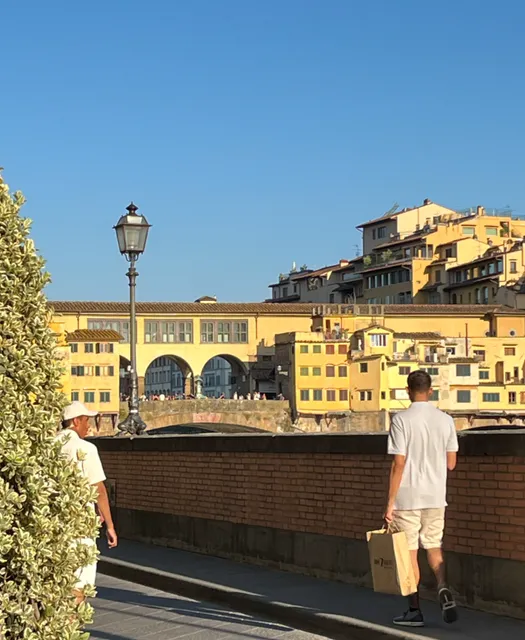
Midday: Cross the Arno River Ponte Vecchio • Stroll across Florence’s famous medieval bridge lined with shops. Enjoy the views of the Arno River. Oltrarno District • Head to the Pitti Palace and Boboli Gardens for a quick exploration of Renaissance opulence and tranquil greenery. Lunch Break: • Brac Libreria (Via dei Vagellai, 18) – A cozy bookstore café serving delicious vegan and vegetarian dishes like pasta, soups, and salads. • Shake Café (Via del Corso, 28) – Great for vegan wraps, smoothies, and light bites and desserts.
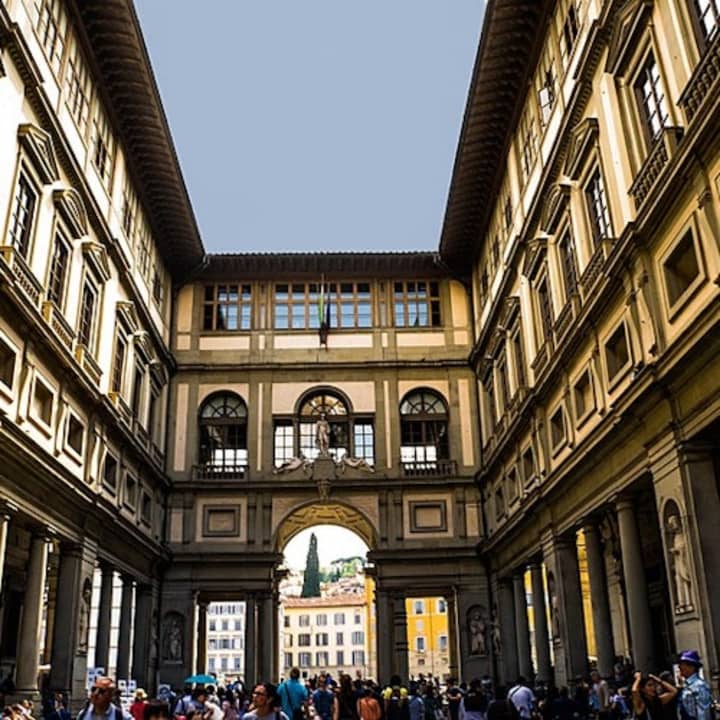
Afternoon: Dive into Art and History Uffizi Gallery (Optional, 2 hours) • If you love art, book tickets in advance to see masterpieces by Botticelli (The Birth of Venus), Michelangelo, and Leonardo da Vinci. Santa Croce Basilica • Visit the burial place of Michelangelo, Galileo, and Machiavelli. Marvel at the stunning frescoes by Giotto.
Evening: Sunset and Dinner Piazzale Michelangelo • Walk or take a short taxi ride uphill to this viewpoint for breathtaking views of Florence at sunset. Dinner: • Il Vegano (Via San Gallo, 92R) – A casual spot with vegan Italian dishes like lasagna, pizza, and desserts. • Veg & Veg — A vegetarian spot for various burgers including “protein style with no bread”, poke bowls, salads, juices etc.
Tips for Your Day: • Brunelleschi Dome: • Start early to avoid crowds at major attractions. • Wear comfortable shoes; Florence’s cobblestone streets can be tricky. • Pack light and bring a reusable water bottle (refill at fountains).
And remember, if you’re tight on time—just skip on long museum visits Florence itself is an...
Read more