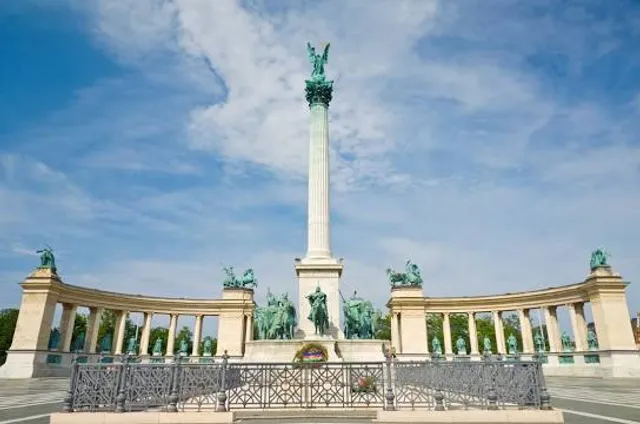
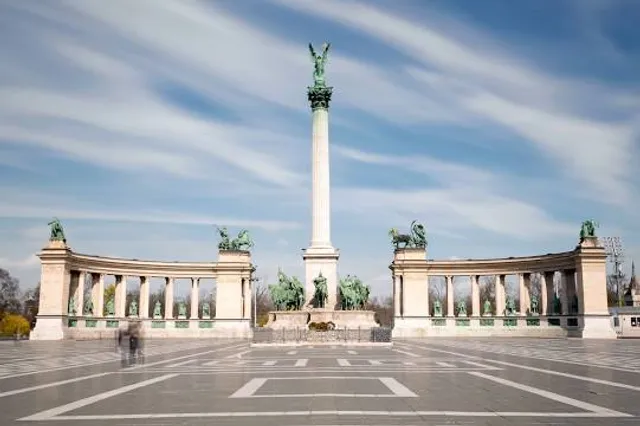
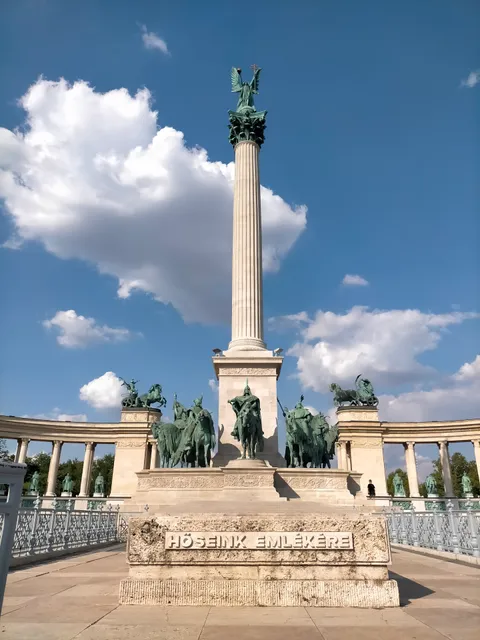
Heroes’ Square (Hősök tere) in Budapest, Hungary, is one of the city’s most iconic landmarks—a grand, ceremonial plaza that commemorates Hungary’s most significant historical figures and symbolizes national identity, pride, and sacrifice.
⸻ Highlights:
• Topping the outer left edge of the left colonnade is a statue of a man with a scythe and a woman sowing seed, representing Labour and Wealth—a pastoral vision of the Hungarian people’s industriousness. • At the inner (right) end of the left colonnade, a male figure drives a chariot, using a serpent as a whip—a striking, visceral representation of War. The snake, a symbol of cunning and deadly force, suggests the unpredictable and consuming nature of conflict.
At the inner left of the right colande a woman holding a palm frond representing peace • On the right colonnade, the outermost statue represents Knowledge and Glory, two figures that elevate the ideals of learning and national greatness. This is the only place in the square where gold detailing is present, adding a subtle yet radiant emphasis to the value of wisdom and legacy.
It may be symbolic that knowledge is on the same side as peace…
3 . Cenotaph • In front of the column lies a memorial stone (not a literal tomb), honoring Hungarians who died for the nation’s independence throughout history.
⸻
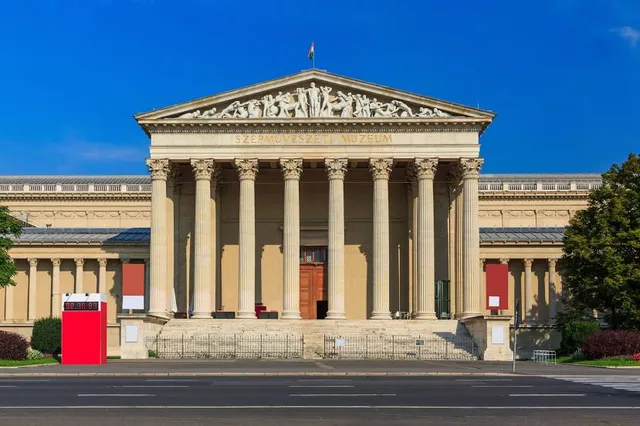
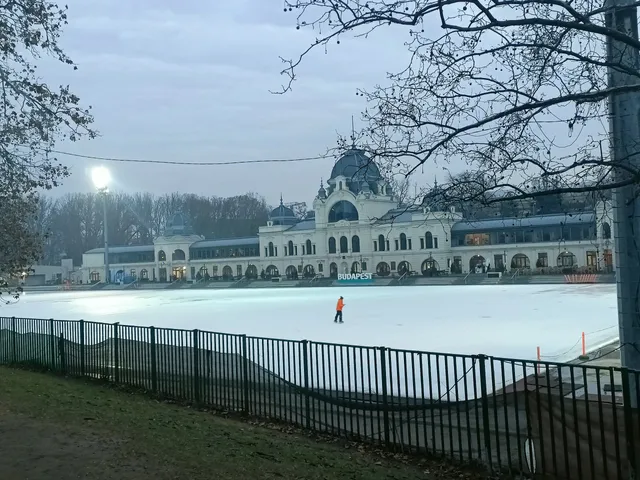
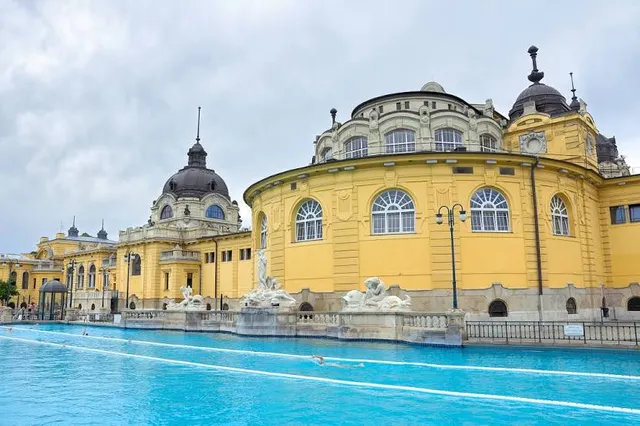
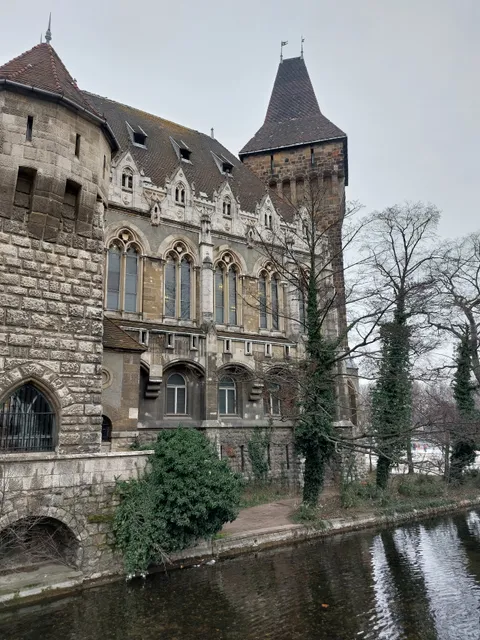
🏛 Nearby Landmarks • Museum of Fine Arts (left) • Hall of Art / Kunsthalle (right) • City Park (behind), featuring Vajdahunyad Castle, Széchenyi Thermal Baths, and the Budapest Zoo
⸻
🟥 Under Communism
Following World War II, Hungary became a Soviet satellite state, and Heroes’ Square underwent ideological transformation: • Statues of Habsburg emperors—including Franz Joseph and Karl IV—were removed from the colonnades to align the monument with Communist interpretations of history. • In their place, figures deemed to represent resistance, revolution, or the working class were added or emphasized. • The allegories of War, Labour, and Wealth were co-opted to support the state’s Marxist narratives—particularly the charioteer with the snake whip, now reinterpreted as both a revolutionary symbol and a warning of counter-revolution. • The square hosted May Day parades, military shows, and Communist Party events. Even sacred elements like Gabriel’s crown or the Tomb of the Unknown Soldier were repurposed for ideological messaging.
⸻
🕊 Post-Communist Restoration
After 1989, Hungary restored Heroes’ Square to reflect a more accurate and holistic view of its millennium-long history: • Original statues and reliefs were restored or replaced. • The gold details on Knowledge and Glory were polished—subtly asserting the value of intellectual heritage. • Religious, royal, and revolutionary figures were displayed side by side, signaling a more inclusive national memory. • When Pope John Paul II celebrated Mass here in 1991, it marked a profound spiritual and cultural renewal of the space.
⸻
🇭🇺 Symbolic Importance
Heroes’ Square has witnessed: • State ceremonies and public holidays • Revolution commemorations (1848, 1956, 1989) • Papal visits • Public demonstrations, from both left and right
Its sculptures—of horsemen and saints, chariots and angels, snake-whips and crests—mirror the soul of Hungary itself: torn by war, grounded in labor, guided by faith, and uplifted by...
Read moreHősök tere (Heroes' Square) is the largest square in Budapest. It is part of the World Heritage Site along with Andrássy Avenue and the City Park. The square features the Millennium Monument, which commemorates the 1000th anniversary of the Hungarian state and the arrival of the Magyar tribes in 896. The monument consists of a 36-meter-high column topped by Archangel Gabriel, who holds the Holy Crown and the apostolic cross. This statue won the grand prize at the 1900 Paris World’s Fair. At the base of the column, there are statues of the seven chieftains of the Magyars, who are considered the founders of Hungary. Behind the column, there are two colonnades with statues of other important Hungarian historical figures. The list of the statues (sculptors) from the left to the right: Saint Stephen (Károly Senyei), Saint Ladislaus (Ede Telcs), Coloman the Learned (Richárd Füredi), Andrew II (Károly Senyei), Béla IV (Miklós Köllő), Charles I (György Kiss), and Louis I (György Zala). John Hunyadi (Ede Margó), King Matthias (György Zala), István Bocskai (Barbabás Holló), Gábor Bethlen (György Vastagh Jr.), Imre Thököly (Jenő Grantner), Ferenc Rákóczi II (Zsigmond Kisfaludi Strobl), and Lajos Kossuth (Zsigmond Kisfaludi Strobl). Heroes' Square was fully constructed but not officially opened during World War I. The right-side colonnade originally had statues of five Habsburg rulers: Ferdinand I, Charles III, Maria Theresia, Leopold II, and Franz Joseph I. In the 133-day period of the Hungarian Soviet Republic in 1919, the statues of the Habsburg emperors were removed and destroyed, while the Millennium Column and the statue of Gabriel were covered with a red veil. A statue of K. Marx was also placed on the square. After the fall of the short living Soviet era, the statues of the Habsburg emperors were reconstructed and put back on their colonnade. The square was completed and inaugurated in 1929 and in 1932 it received the name “Heroes’ Square”. After World War II the statues of Ferdinand I, Charles III and Franz Joseph I were taken down again by the communists. While the statues of Maria Theresia and Leopold II were destroyed during the war Franz Joseph I’s statue was broken to pieces after the war. By 1958 all the statues were installed and since then the square has not changed much. In 1995-96 the column and the surrounding statues were renewed. In front of the monument, there is a cenotaph called the Memorial Stone of Heroes, which honors those who gave their lives for the freedom of Hungary (no one is buried in this place). The square is also flanked by two museums: the Museum of Fine Arts and the Palace of Art. The square has witnessed many momentous events in Hungarian history, such as the reburial of Imre Nagy in 1989, who was executed for leading the 1956 revolution against Soviet oppression. It should be noted that Imre Nagy his coworkers and his family were kidnapped by the Soviet Russian forces from the Yugoslavian (now Serbian) Embassy on the east side of the square. The square is a symbol of national pride and identity for Hungarians. Notice that in China you can find copies of this square....
Read moreDuring the summer vacation of 2023, I had the pleasure of visiting the iconic site of Heroes' Square in Budapest. This majestic area is one of the city's most impressive attractions and lived up to its reputation as an incredibly beautiful place that I look forward to revisiting.
Heroes' Square, known as "Hősök tere" in Hungarian, is a spectacular plaza located in front of the famous Széchenyi thermal bath. This magnificent square is adorned with statues honoring Hungary's great historical figures and warriors. The proud sculptures towering towards the sky impart a sense of honor and grandeur to the place, and it was a memorable experience to wander among them, learning about Hungary's history and culture.
A highlight of Heroes' Square is the "Millennium Monument," an impressive obelisk monument standing at the center of the plaza. The monument is surrounded by semicircular colonnades featuring statues of renowned Hungarian leaders and heroes from different eras. Representing Hungary's millennium celebration, it was erected to commemorate the country's foundation in the year 896.
In addition to its historical and architectural beauty, Heroes' Square also serves as a popular recreational area for both tourists and locals alike. With its vast open space, it offers room for picnics, frisbee throwing, or simply enjoying a relaxing time while admiring the surroundings. The area is also an ideal venue for cultural events, concerts, and festivals, ensuring there's always something exciting happening here.
The visit to Heroes' Square was undoubtedly an unforgettable experience, and I am grateful for the opportunity to explore this incredible place in Budapest. I will undoubtedly return to experience more of its charm, history, and...
Read more