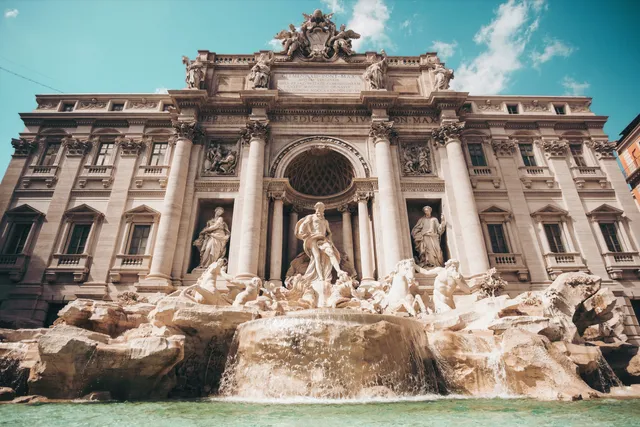
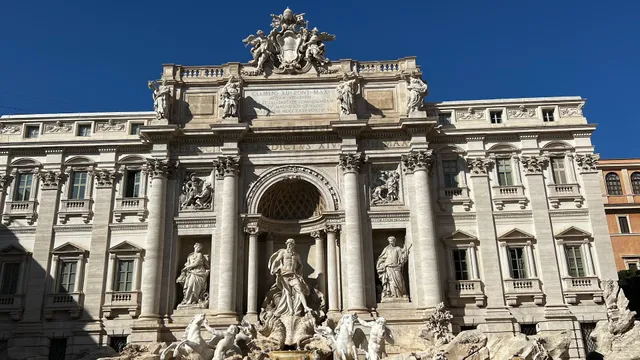
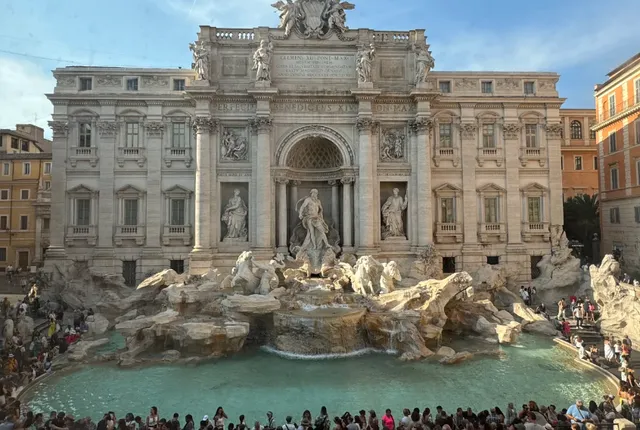
For some reason it is my favorite spot in Rome.The terminal part of the Vergine aqueduct, the only one of the ancient aqueducts continuously in use to this day, the Trevi Fountain it is the best known of the Roman fountains.Its name derives from a toponym in use in the area since the mid-20th century, Regio Trivii, referring to the confluence of three streets in the square, or from the triple outlet of the water of the original fountain.The construction of the current Trevi fountain is due to Pope Clement XII who, in 1732, launched a competition in which the major artists of the time participated. Among the various projects presented, that of the architect Nicola Salvi was chosen.Leaning against Palazzo Poli, the fountain is divided into a wide basin with a large cliff enlivened by the sculptural representation of numerous plants and the spectacular flow of water. In the center dominates the statue of god Ocean driving the shell-shaped chariot, pulled by the angry horse and the placid horse, both held back by two tritons.In the façade, articulated like a triumphal arch, there are two reliefs that allude to the legend of the source and the history of the aqueduct: on the right, the virgin indicating the source to the Roman soldiers and, on the left, Agrippa who orders the start construction of the aqueduct. The decorative apparatus is completed by two allegorical figures that enhance the beneficial effects of water, Healthiness, and Abundance, placed in the side niches.The construction was completed by Giuseppe Pannini who partially modified the cliff by regularizing the central basins. After a restoration operation in the years 1989-1991, the last major restoration took place in 2014, thanks to the financial contribution of the Maison Fendi.Before leaving, do not forget to throw a coin into the fountain, you will definitely return to Rome, as the custom says. If, on the other hand, you are looking for a bit of romance, perhaps even an Italian love, you will have to toss a second and a third coin to make sure that the wedding bells will ring soon.The Trevi Fountain was the splendid setting for the most famous scene of the film La Dolce Vita by director Federico Fellini; a provocative Anita Ekberg wrapped in a long black evening dress calls Marcello Mastroianni: “Marcello, come here!”, while sinuously plunges into the sparkling waters of the fountain. But not everyone knows that there’s a small rectangular basin to the right, away from the fountain, with two small spouts: this is the fountain of lovers.Young lovers who drink at the fountain will stay in love forever and will remain forever faithful the one to the other. It was a simple ceremony that took place when the young man had to leave the city, above all when he would be absent for a long time, as in the case of military service.On the evening before the young man’s departure, the couple would go to the fountain. The girl would fill a glass which had never been used before and hand it to her lover. The glass was broken and the girl could be sure she would not lose the one she loved.There is an explanation for this rite. Tradition has it that all who drank the water of the fountain, while recalling Rome, would always also remember those who loved them and who remained here, in Rome.e...
Read moreThe Trevi Fountain is, without a doubt, one of Rome’s most iconic and breathtaking landmarks, and experiencing it firsthand is a moment that lingers in your memory long after you leave. The sheer grandeur of the fountain, with its elaborate sculptures and cascading waters, is truly a masterpiece of Baroque art. The legend of tossing a coin to ensure your return to Rome adds a layer of romance and tradition to the visit. However, as magnificent as the fountain is, the experience is undeniably impacted by the overwhelming crowds that seem to gather at all hours. The sense of wonder can sometimes be overshadowed by the throngs of tourists vying for the perfect selfie, making it challenging to fully appreciate the beauty and craftsmanship of this historic site.
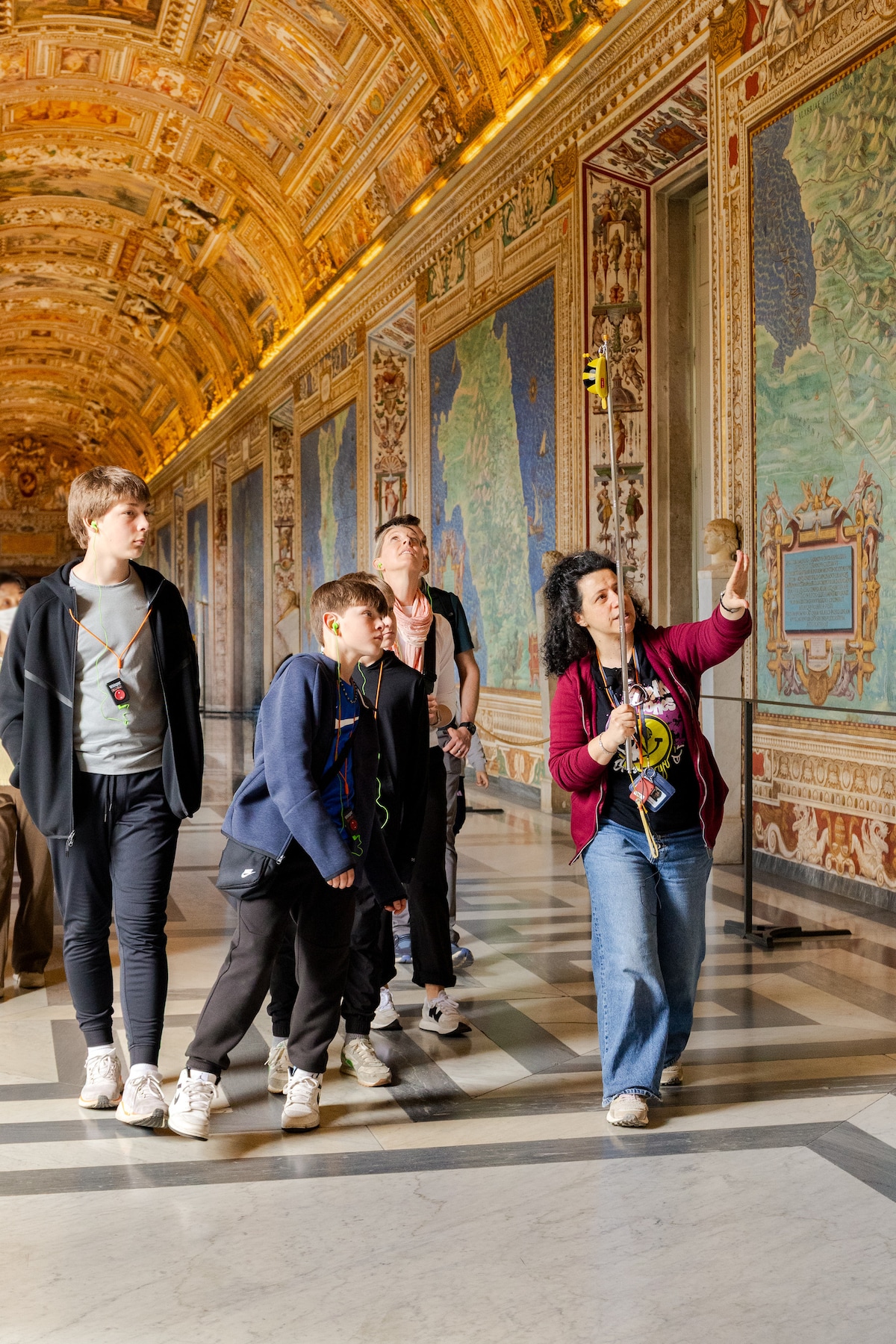
The underground tour of the Trevi Fountain offers a fascinating and somewhat quieter escape from the bustling crowds above. This tour takes you beneath the surface, revealing the ancient aqueducts and structures that lie hidden from the casual observer. Here, you can truly appreciate the engineering marvels that have sustained Rome for centuries. The contrast between the chaotic scene above and the serene, almost forgotten world below is striking. It’s a reminder of the layers of history that Rome is built upon, with each era leaving its mark beneath the city’s modern facade.
While the Trevi Fountain is undoubtedly a must-see, the experience is undeniably marred by the sheer volume of visitors. Over-tourism has taken its toll, turning what should be a reflective and awe-inspiring moment into a struggle for space and tranquility. The atmosphere can feel more like a theme park than a historic site, with crowds often detracting from the opportunity to fully absorb the fountain’s beauty and significance. It’s a poignant example of how the popularity of such sites can sometimes undermine the very experience people come to enjoy.
The underground tour, however, provides a refreshing counterbalance. It’s a chance to connect with Rome’s rich history in a more intimate and meaningful way, away from the hustle and bustle. Exploring the ancient water systems and learning about the history that flows beneath the city adds depth to your understanding of Rome’s enduring legacy. It’s a reminder that while the city’s surface is often crowded, there are still hidden gems where you can find peace and reflection.
In conclusion, the Trevi Fountain remains a breathtaking symbol of Rome’s artistic and cultural heritage, but the impact of over-tourism cannot be ignored. The underground tour offers a unique and quieter perspective, allowing you to appreciate the site’s true significance. Together, they provide a well-rounded experience that captures both the beauty and complexity of Rome—a city where history and modernity collide in ways that are both inspiring and, at times,...
Read moreFirst of all, the narrow streets leading to the fountain were packed with people, making it very difficult to navigate and appreciate the artistic splendor of anything in that area.
I was hoping that visiting the Trevi Fountain would have been an iconic experience according to popular culture, because honestly if it wasn't for "Three Coins in the Fountain" & " La Dolce Vita" this fountain would not be famous at all. Rome is full of magestic fountains but this one in particular is famous with tourists for those movies.
In reality its history is very interesting, the Trevi Fountain was completed in 1762 and stands as a masterpiece of Baroque sculpture. Designed by architect Nicola Salvi, the fountain depicts Neptune, the Roman god of the sea, surrounded by tritons and sea horses, symbolizing the power and majesty of the ocean. Its cascading waters and intricate details make it a mesmerizing sight to behold but the truth is most people there have no idea of its history. Many people seem more interested in taking photos for social media.
Amidst the beautiful history of the fountain, I couldn't help but feel overwhelmed by the hoards of tourists that surrounded it. If they're not taking photos, they're just standing there doing nothing for a long time, chit chatting like there is no other place you can talk. The preferable thing to do is stand, admire, take a photo or two (I would say for no more than 10 minutes) and walk away. I would advise against lingering too long, as the sheer volume of visitors can detract from the serenity and majesty of the fountain.
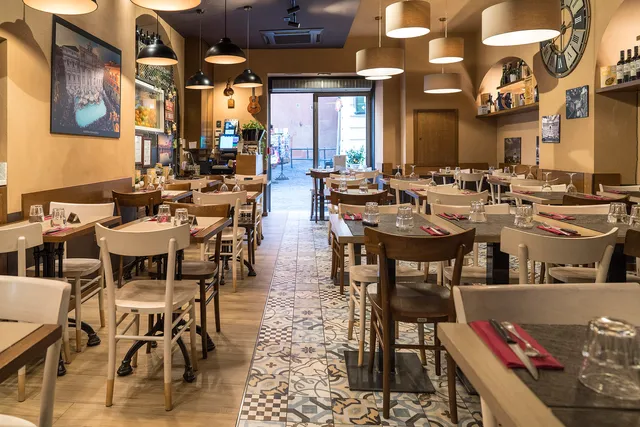
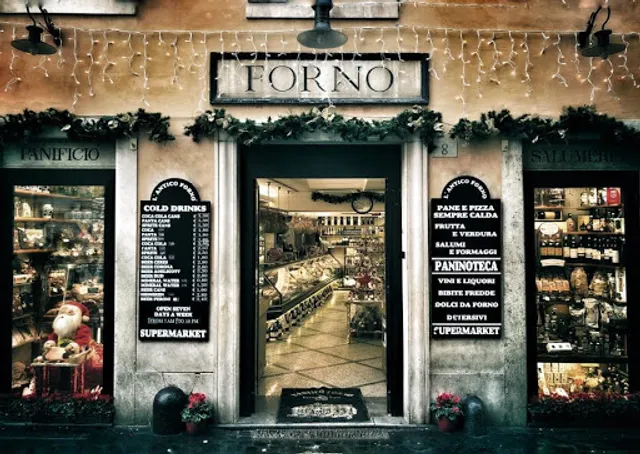
In terms of dining and shopping around the fountain, I found the offerings to be largely geared towards tourists, with inflated prices and mediocre quality. For a more authentic taste of Roman cuisine and culture, I recommend exploring other neighborhoods and eateries away from the tourist traps.
In conclusion, while the Trevi Fountain is famous in pop culture, I suggest you look for other beautiful fountains around Rome, the crowds and tourist-oriented atmosphere in this area detracts from the overall experience. Actually, I couldn't wait to leave that area!
Approach your visit with patience and mindfulness, wear very comfortable shoes and be very very careful with your surroundings, this area is crazy full of tourists and pickpockets. Take time to appreciate the artistry and history of many iconic monuments all around Rome, the more quieter and more authentic corners have the most...
Read more