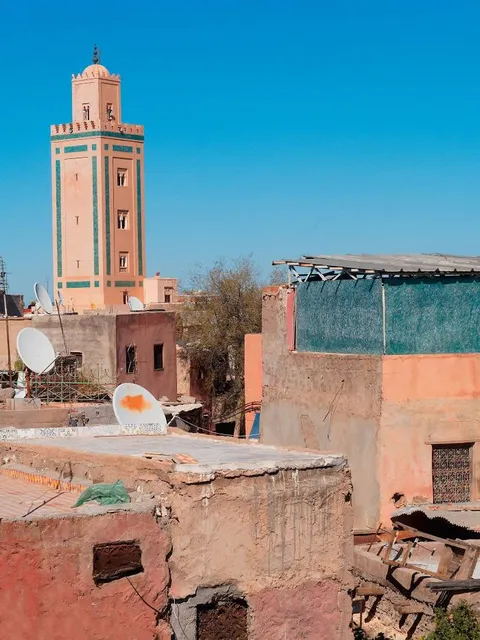
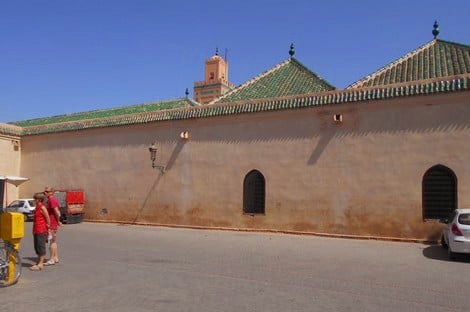
The first mosque in Marrakesh was erected by the Almoravid emir Yusuf ibn Tashfin in the 1070s, to serve as the central congregational mosque of the fledgling city. It was one of the first brick buildings in the city, and Ibn Tashfin is said to have been personally engaged in mixing the mortar and laying of the bricks.1 His son and successor Ali ibn Yusuf ("Ben Youssef", from the French transliteration) built a grand new central mosque, named the Masjid al-Siqaya ("mosque of the fountain") on account of the large fountain with a marble basin in its courtyard. It cost nearly 60,000 gold dinars, and was completed sometime between 1120 and 1132. The minaret, which was probably one of the last elements constructed, was begun in 1129 and finished in 1132.2 It was the largest mosque built in the Almoravid empire, with a rectangular base of 120 by 80 meters, and a minaret on its western side estimated to be 30 or 40 meters high.45] The rising city's layout was organized around it, and together with the neighboring souqs, it formed the center of early Marrakesh's city life. The nearby Qubba Ba'adiyyin was one of the monumental ablution fountains connected to it.
When the Almohads defeated the Almoravids and captured Marrakesh in April 1147, the Almohad caliph Abd al-Mu'min claimed that the Almoravid mosque had an orientation error and it was either demolished or abandoned.[62] The Almohads instead built a new grand mosque, the Kutubiyya Mosque, in the southwestern parts of the city, far from the Ben Youssef Mosque, as well as another grand mosque, the Kasbah Mosque, to serve their new palaces in the south.[8 The new Kutubiyya Mosque, however, was not entirely successful in displacing the center of urban activity away from the original city center.10]
During the Saadian dynasty period (16th century) the city underwent significant urban changes, with new neighbourhoods and new mosques being created in the western areas of the city (on the site of an older Jewish neighbourhood), such as the Mouassine Mosque.[811] The Saadians appear to have also given their patronage to the neighbourhood around the Ben Youssef Mosque. The Ben Youssef Mosque was reportedly rebuilt or refurbished by sultan Abdallah al-Ghalib, who ruled between 1557 and 1574 (though no remains of this Saadian mosque have been found).[1213] Next to it, Abdallah al-Ghalib also erected in 1563–64 a new madrasa (theological college), the Ben Youssef Madrasa, just east of the mosque, thereby giving it a new life as the mosque of scholars.[14 The ornate street fountain known as Shrob ou Shouf was also built nearby during the reign of Ahmad al-Mansur (ruled 1578–1603).13]
Having fallen into ruin in the course of the seventeenth and eighteenth centuries, it was completely rebuilt in the early 19th century by the 'Alawi sultan Suleiman (ruled 1792–1822), with a different alignment and hardly any trace left of its original Amoravid or Almohad design.[15 Construction finished in 1819–20 when the minaret was completed.[16] Despite this later patronage, the present mosque has retained the original name "Ben Youssef".[17]
It continues to serve today as one of the most important mosques in Marrakesh. Traditionally, the qadi (religious judge) of the Ben Youssef Mosque has jurisdiction over all of Marrakesh, and even over outlying areas.[18] It is not accessible to...
Read moreBen Youssef Mosque is a mosque in the ancient city neighborhood of Marrakesh, Morocco, built by Prince Ali bin Youssef bin Tashfin, the fifth ruler of the Almoravid State in Morocco and Andalusia, so the mosque was named after him. Arguably the oldest and most important mosque in Marrakesh
Prince Al-Murabit Yusuf bin Tashfin built the first mosque in Marrakesh in the 1870s, to serve as the city's central collective mosque. It was one of the first brick buildings in the city, and Ibn Tashfin is said to have personally engaged in mixing mortar and laying bricks. 1 His son and successor Ali bin Yusuf built a new and large central mosque, called the Sakia Mosque (“The Fountain Mosque”) due to the large fountain with a marble basin in its courtyard. It cost approximately 60,000 gold dinars, and was completed sometime between 1121 and 1132. It was the largest mosque built in the Almoravid Empire, with a rectangular base 120 by 80 meters, and a minaret estimated to be thirty meters high. 3] The planning of the new city was organized around it, and along with its neighboring markets, formed the center of life in Marrakesh. The nearby Almoravid dome was one of the huge ablution fountains associated with it.
When the Almohads defeated the Almoravids and captured Marrakesh in April 1147, Abd al-Mu'min ibn Ali, the founding caliph of the Almohad state, considered the original mosque to have a guiding error (its mihrab was pointing about six steps south of Mecca) and was immediately demolished. [4 The Almohads built a new central mosque that was reoriented. However, the Almohads were unable to remove its popular designation, and it continued to be known as the "Ali ibn Yusuf Mosque".
The Ibn Yusuf Mosque was renovated in 1563, on the orders of the Saadi Sultan of Morocco, Abdullah al-Ghalib. 2] Around the same time, the city's layout began to change, with new residential areas and markets located to the west, next to the Koutoubia Mosque and the New Mawasin Mosque and Mosque, shifting the center of gravity away from the old Bin Yusuf Mosque. [5] In the Fariba area, the Saadiites established a large new theological college (the madrasa), the Madrasa of Ibn Yusuf in 1563-64, just east of the mosque, giving it a new life as a mosque for scholars. (6)
After the fall of the mosque and ruin during the seventeenth and eighteenth centuries, it was almost completely rebuilt in the early nineteenth century by the Alawite Sultan Suleiman bin Muhammad, as hardly any traces of the Almoravids or Almohads remain from his original design. [7
Today it is still one of the most important mosques in Marrakesh. Traditionally, the qadi (religious mosque) in the Ben Youssef Mosque has jurisdiction over all of Marrakesh, and even over the hinterland. [8] It cannot be accessed by...
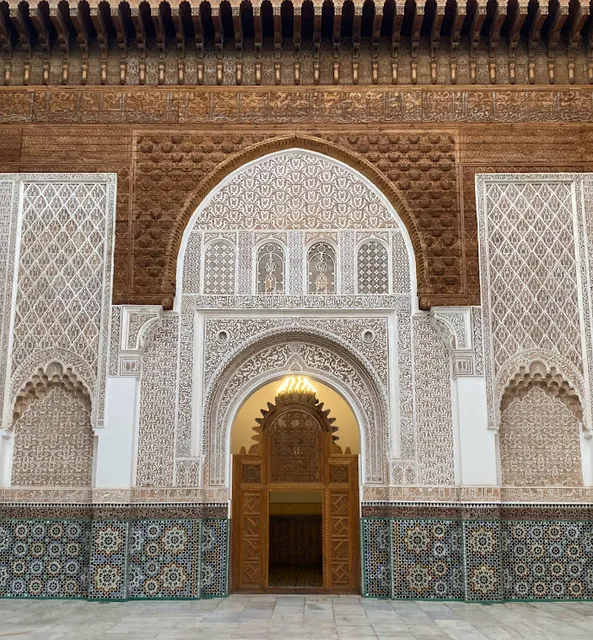
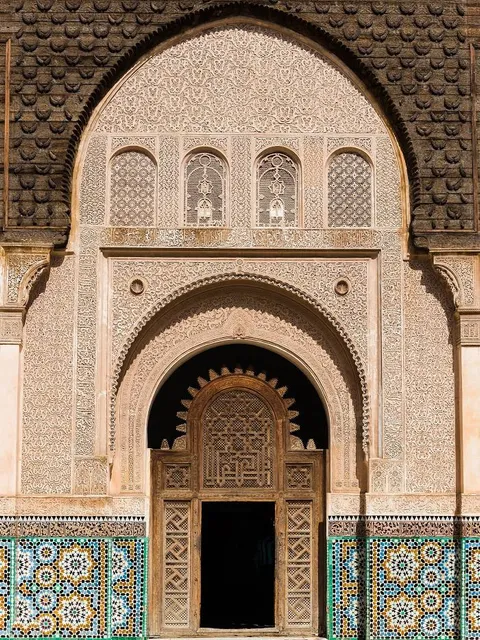
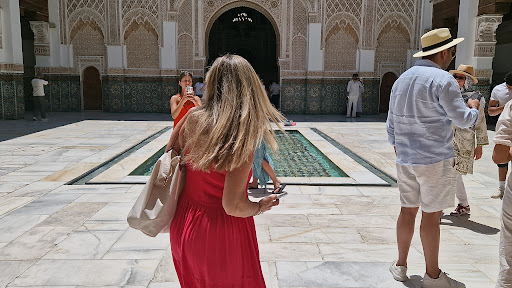
Read moreIt is a very nice structure from the outside, a rather typical Moroccan mosque but considered one of the oldest and supposedly prettiest. It is located in Medina but you can instinctively feel from the atmosphere you are not welcome if not Muslim. So - make note of it from the appropriate distance. When you enter the Ali Ben Youssef mosque you are transported into a world of historic and astounding beauty, the Zellig (mosaics) , Gibbs (carved plasterwork) and woodwork around the Mihrab are truly astounding feats of craftsmanship, the Wudu forecourt is a place of serene peace and tranquility. Finally if you are present at the Friday prayers and hear the multitude say Ameen you will be present at an event that goes back 886 years, probably the most historical event to happen in Marrakech and an event which has occurred 46072 times since the original construction of this fine example of Islamic design and...
Read more