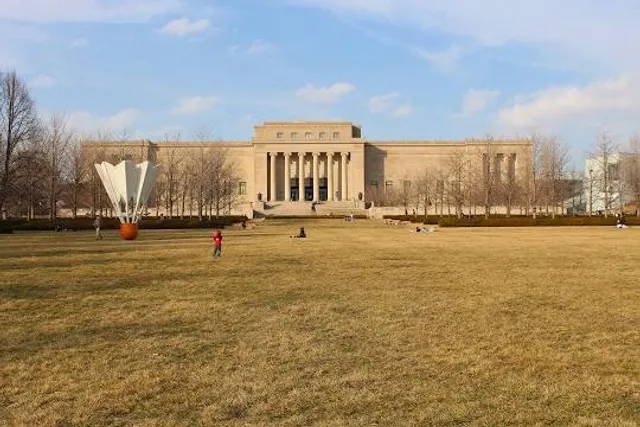
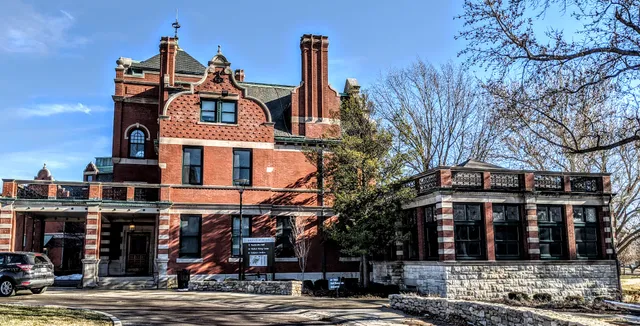
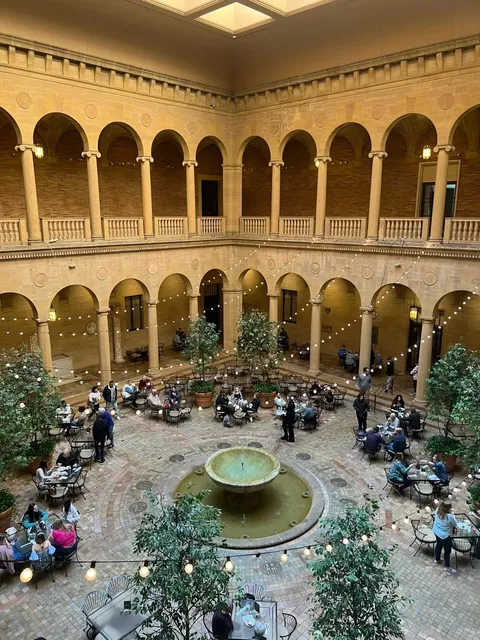
The museum was built on the grounds of Oak Hall, the home of Kansas City Star publisher William Rockhill Nelson (1841-1915).3] When he died in 1915, his will provided that upon the deaths of his wife and daughter, the proceeds of his entire estate would go to purchasing artwork for public enjoyment. This bequest was augmented by additional funds from the estates of Nelson's daughter, son-in-law and attorney.[4]
In 1911, former schoolteacher Mary McAfee Atkins (1836–1911), widow of real estate speculator James Burris Atkins, bequeathed $300,000 to establish an art museum. Through sound management of the estate and a booming economy, this amount grew to $700,000 by 1927. Original plans called for two art museums based on the separate bequests[5. However, trustees of the two estates decided to combine the two bequests along with smaller bequests from others to make a single major art institution.
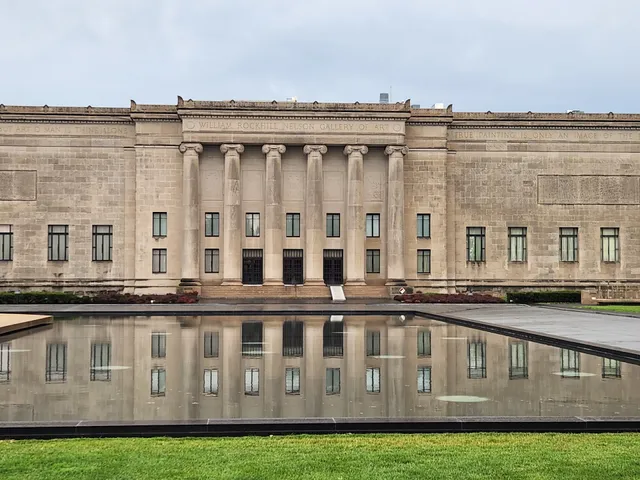
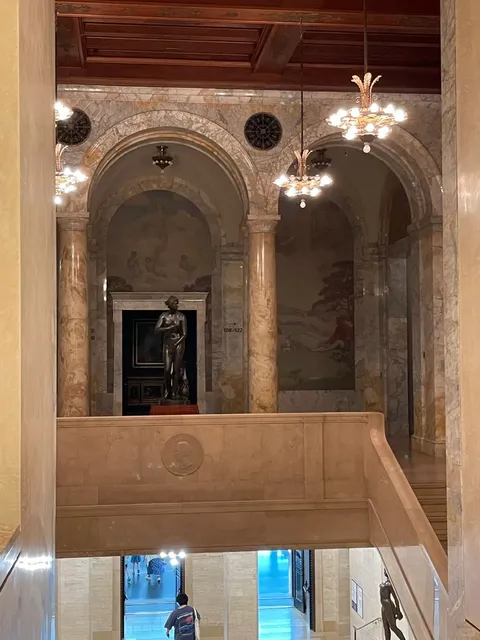
The building was designed by prominent Kansas City architects Wight and Wight, who also designed the approaches to the Liberty Memorial and the Kansas governor's mansion, Cedar Crest. Ground was broken in July 1930, and the museum opened December 11, 1933. The building's classical Beaux-Arts architecture style was modeled on the Cleveland Museum of Art4] Thomas Wight, the brother who did most of the design work for the building said:
We are building the museum on classic principles because they have been proved by the centuries. A distinctly American principle appropriate for such a building may be developed, but, so far, everything of that kind is experimental. One doesn't experiment with two-and-a-half million dollars.[6]
When the original building opened, its final cost was $2.75 million (about $54 million in 2018).[4] The dimensions of the six-story structure were 390 feet (120 m) long by 175 feet (53 m) wide, making it larger than the Cleveland Museum of Art.
The museum, which was locally referred to as the Nelson Art Gallery or simply the Nelson Gallery, was actually two museums until 1983 when it was formally named the Nelson-Atkins Museum of Art. Previously the east wing was called the Atkins Museum of Fine Arts, while the west wing and lobby was called the William Rockhill Nelson Gallery of Art.[7]
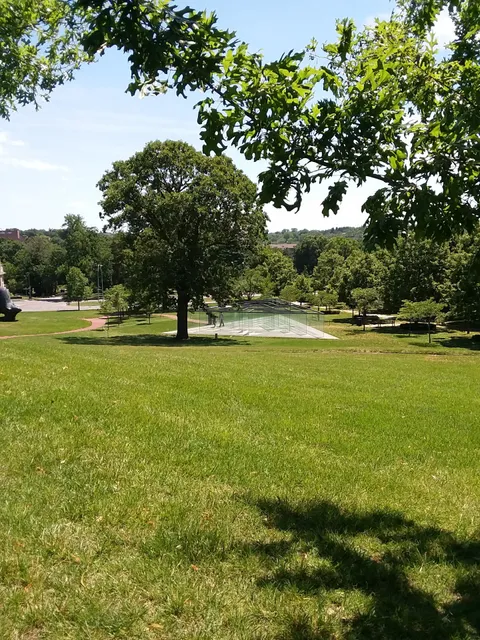
On the exterior of the building Charles Keck created 23 limestone panels depicting the march of civilization from east to west including wagon trains heading west from Westport Landing. Grillwork in the doors depict oak leaf motifs in memory of Oak Hall. The south facade of the museum is an iconic structure in Kansas City that looms over a series of terraces onto Brush Creek.
About the same time as the construction of the museum, Howard Vanderslice donated 8 acres (32,000 m2) to the west of the museum, across Oak Street, for the Kansas City Art Institute, which moved from the Deardorf Building at 11th and Main streets in downtown Kansas City.
As William Nelson, the major contributor, donated money rather than a personal art collection, the curators were able to assemble a collection from scratch. At the height of the Great Depression, the worldwide art market was flooded with pieces for sale, but there were very few buyers. As such, the museum's buyers found a vast market open to them. The acquisitions grew quickly and within a short time, the Nelson-Atkins had one of the largest art collections in the country.[8]
One of the original components of the building was a re-creation of Nelson's oak paneled room from Oak Hall (and namesake of the estate). The room contained Nelson's red plush easy chair and bookcases. The room was dismantled in 1988 to make way for a photography studio.[4
One-third of the building on the first and second floors of the west wing were left unfinished when the building opened to allow for future expansion. Part was completed in 1941 to house Chinese painting and the remainder of the building was completed after World War II.[4] In 1993 Michael Churchman wrote a history of The Nelson-Atkins Museum of Art, High...
Read morenew update 4/15/25
Visited the museum for Night Shift - an interactive exhibit exploring natural ways to preserve our habitat! This was my first time at the museum for this type of event. It was interesting and a journey.
We had a map that we had to get stamps on from specific, diff locations, noted on the map. Getting three stamps got you a free shuttlecock iron on. Forgot what the other stamps earned you 😳
There was live music, craft tables to add to the art already in the process of being made, surveys to take to determine certain aspects of an upcoming exhibit, and more!
It was a unique experience that I’m glad we got to be a part of. Enjoyed seeing some art in the museum that hadn’t been there previously as well. Enjoy!!
If you are a true lover if art and haven’t been here, what are you waiting for?? No invite needed!!
The Nelson is always having something big going on inside or outside. The Sunday we went, we decided to escape the real world and go to the 1930s to see the Art Deco Exhibit, Mini Art golf and the Nelson Lawn Event going on as well.
Outside music filled the air, as did oversized bugs and food, food trucks as well as ice cream trucks, African dances, and the mini golf art. Inside was the special event of the art deco series now through January as well as the regular art to see all the time.
The deco exhibit had some amazing 1930s cars, gowns, videos, electronics, and so much more! They had an old-time vacuum that could be purchased for $60 or so. Wouldn’t that be a nice break these days? There was art by one of our local black artists from decades ago who is extremely famous. Perhaps you can use that for a trivia quiz question during your tour!
Some of the paintings shown are always displayed in the museum. So many cool things and not enough time!. The museum is always free but you do have to pay for a special exhibit or things that go on outside such as the mini golf. The lawn event was free however of course you pay for food drink and drank, 😉etc.
The first 30 minutes of parking is free and aany time after that it is $12 per hour. You better move along quickly! The museum is neat and clean. The bathrooms were a little overflowing with trash however the most important place you need to plant your behind was clean. Ladies if you are wearing a backpack, you will be asked to wear it on your shoulder or to the front of you. 🤔
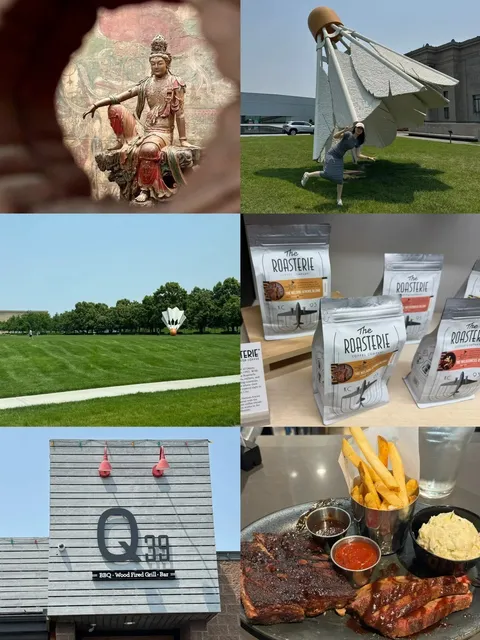
Don’t leave without checking out the phenomenal gift shop full of pieces made by local artists, jewelry, cards, posters/art, games/puzzles, & a plethora of much more.
Get the history behind the bottle cap lids piece of art just a short distance from the gift shop. The pic shown below with a man holding two flattened lines of bottle caps, is to show you up close how they created this! It took years and a TON of bottle caps. Bet they had fun making that….with a few drinks along the way! 😬
When looking for something free, educational in a fun way, head down to the museum! Def catch photos of the statues inside and out, the oversized birdies, the silver tree, & more…all things I’m telling u to take a photo of yet I didn’t this time...
Read moreThis place is absolutely full of magnificent works of art of every kind. Its a beautiful building and campus that I have visited numerous times. Unfortunately I won't be back for the time being, solely based on the treatment I received from a volunteer (or possibly an employee, it was hard to tell but they were not dressed appropriately for an employee so I assumed volunteer). For privacy reasons, we will call her Betty. Before my entry into a gallery, Betty informed me that I could not wear my backpack on my back (a small, purse style backpack), so I carried it in my hand or to the side, no issue. However, for the ENTIRETY of my visit, Betty appeared at every turn. At first this seemed normal enough, because she works there, but after seeing Betty out of the corner of my eye in every gallery and on every floor, staring at me and making awkward eye contact several times, I started to feel followed. This constant surveillance was kept up my entire visit, and I was there for well over two hours, it felt quite strange. I ended my visit at the cafe, and as I stood to leave, I slung my backpack over my shoulder (kept to the side as per the request) and headed for the exit. Less than 10 seconds later, here comes Betty, quite literally, comes running after me, practically tripping over herself, desperately demanding I take my backpack off to protect the art work. I politely inform her that I am not wearing it on my back as she specified, and that I am leaving. Well now she states that I need to wear it on my front and since I have to walk between galleries to the exit, I MUST put it on my front immediately. Betty was so petrified that I would disobey her command that she stalked me the entire visit, waiting for the opportunity to reprimand me. She never specified I needed to wear it on my front, and not a single other employee said a word to me, so I don't know where this demand was coming from. I really didnt mind honoring this rule, I wore my backpack as requested the whole visit, and for the record, the backpack is tiny, there are people whose entire bodies are bigger than me and this backpack put together. The policing behavior from Betty was inappropriate and unprofessional. It was absolutely bananas and unless this policy (or Betty) is changed I don't think I will return. I'm sure the museum will not notice my absence, but I felt this absurd interaction could at least be shared, in case anyone else had the pleasure of being under the surveillance of...
Read more