Originally on the site of the park was the so-called Konstantinovskaya Square, which surpassed other squares in the city in size. This square was not paved, and therefore dusty in dry weather and dirty in rain.
The design of the square was based on the idea of intersection in its center of two large avenues - Kaufmansky and Moskovsky, which divided the territory of the square into four parts and passed through it. At the same time, a road passed around the park, into which all the others poured. All four parts were covered with a grid of pedestrian shady alleys, very rational and taking into account the movement of pedestrians crossing the square in different directions.
It should be noted that these two streets, at the intersection of which the park was and was laid, repeated the ancient trade routes that developed in the vicinity of the city many hundreds of years ago. Moskovsky Prospekt was a section of the caravan route to Kashgar and further to China - the Great Silk Road, which ran from the ancient city of Chach (now the Minguryuk settlement, located only one and a half kilometers from the current park on the continuation of the former Moskovsky Prospekt towards the Salar River), and Kaufmanovsky Prospect was a section of the road leading from the city citadel of old Tashkent through Kuylyuk and through the fords of the Chirchik river towards Kokand, and also a section of the old caravan route. Thus, it can be assumed that the vicinity of this crossroads from ancient times was a kind of cult place.
The park was surrounded by buildings of men's and women's gymnasiums, the building of a state bank, a teacher's seminary, remarkable for their architectural features. Moreover, the buildings of the male and female gymnasiums and the bank in almost unchanged form (in the thirties of the XX century, both gymnasium buildings were built on and became three-story) have survived to our time.
This park originally housed the grave of the Governor-General of the Turkestan Territory - Konstantin Kaufman, who died in May 1882 in Tashkent.
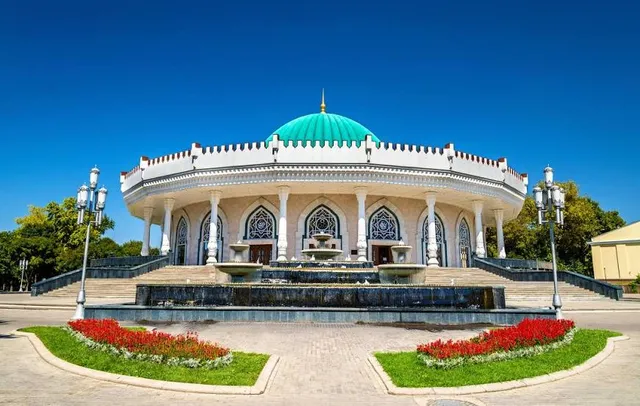
In 1901, the Turkestan Exhibition in Tashkent was held, which was also held in the Konstantinovsky Square. For the exhibition, several pavilions in the oriental style were built, one such pavilion "in the Moorish style", built by the architect A. L. Benois, which withstood even a strong earthquake in 1966, was converted into a pavilion for the sale of flowers and remained in the center of the square until the last time.
On November 17, 1910, in the center of the crossing of Kaufmansky and Moskovsky avenues, the site was consecrated and a monument to Konstantin Kaufman was laid, in the presence of all the higher authorities, troops, students and many other residents of the city.
The money for the monument was collected by subscription, more than 80 thousand rubles were collected. The Academy of Arts announced a competition for the project of the monument “Gen. Kaufman and the troops who conquered Central Asia. "
On May 4, 1913, in the center of the park, where Moskovsky and Kaufmansky avenues intersected, a multi-figured monument to the first Turkestan governor-general, Konstantin Kaufman, was erected according to the project of I.G. Shleifer. The pedestal was decorated with the figure of an eagle with two heads looking in different directions on two necks and bronze plaques, the inscription on the main one of which read: "To Konstantin Petrovich von Kaufman and the troops that conquered Central Asia." The square was named...
Read moreBorn into the Barlas confederation in Transoxiana (in modern-day Uzbekistan) on 9 April 1336, Timur gained control of the western Chagatai Khanate by 1370. From that base, he led military campaigns across Western, South, and Central Asia, the Caucasus, and Southern Russia, defeating in the process the Khans of the Golden Horde, the Mamluks of Egypt and Syria, the emerging Ottoman Empire, and the late Delhi Sultanate of India and emerging as the most powerful ruler in the Muslim world.10] From these conquests, he founded the Timurid Empire, which fragmented shortly after his death.
Timur was the last of the great nomadic conquerors of the Eurasian Steppe, and his empire set the stage for the rise of the more structured and lasting Islamic gunpowder empires in the 16th and 17th centuries.[1113] Timur was of both Turkic and Mongol descent, and, while probably not a direct descendant on either side, he shared a common ancestor with Genghis Khan on his father's side,[1416] though some authors have suggested his mother may have been a descendant of the Khan.[17 He clearly sought to invoke the legacy of Genghis Khan's conquests during his lifetime.19] Timur envisioned the restoration of the Mongol Empire and according to Gérard Chaliand, saw himself as Genghis Khan's heir.[20]
According to Beatrice Forbes Manz, "in his formal correspondence Temur continued throughout his life to portray himself as the restorer of Chinggisid rights. He justified his Iranian, Mamluk, and Ottoman campaigns as a re-imposition of legitimate Mongol control over lands taken by usurpers."[21] To legitimize his conquests, Timur relied on Islamic symbols and language, referring to himself as the "Sword of Islam". He was a patron of educational and religious institutions. He converted nearly all the Borjigin leaders to Islam during his lifetime. Timur decisively defeated the Christian Knights Hospitaller at the Siege of Smyrna, styling himself a ghazi.[7]: 91 By the end of his reign, Timur had gained complete control over all the remnants of the Chagatai Khanate, the Ilkhanate, and the Golden Horde, and had even attempted to restore the Yuan dynasty in China.
Timur's armies were inclusively multi-ethnic and were feared throughout Asia, Africa, and Europe,[7] sizable parts of which his campaigns laid waste.[22] Scholars estimate that his military campaigns caused the deaths of 17 million people, amounting to about 5% of the world population at the time.[23 Of all the areas he conquered, Khwarazm suffered the most from his expeditions, as it rose several times against him.[25] Timur's campaigns have been characterized as genocidal.[26]
Timur was the grandfather of the Timurid sultan, astronomer and mathematician Ulugh Beg, who ruled Central Asia from 1411 to 1449, and the great-great-great-grandfather of Babur (1483–1530), founder of the Mughal Empire, which then ruled almost all of the...
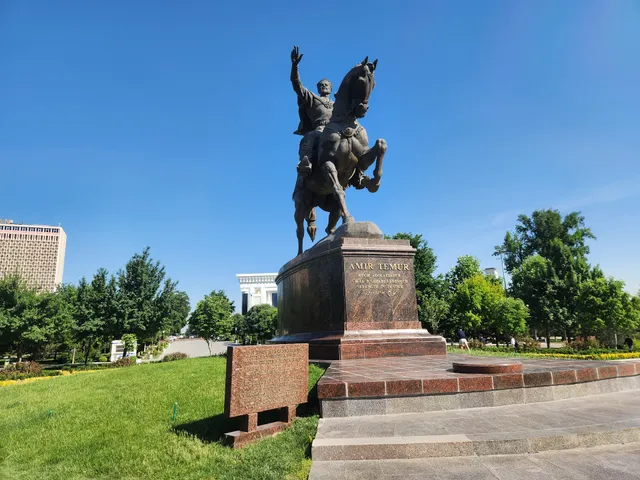
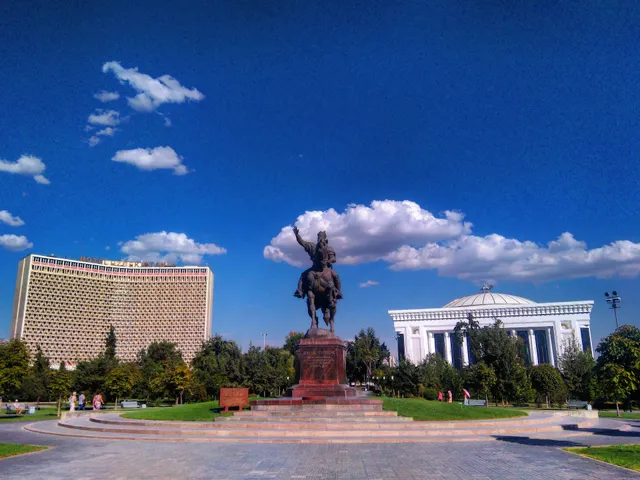
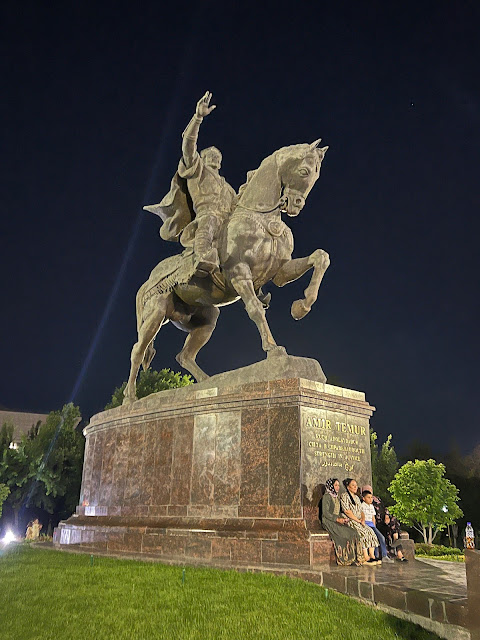
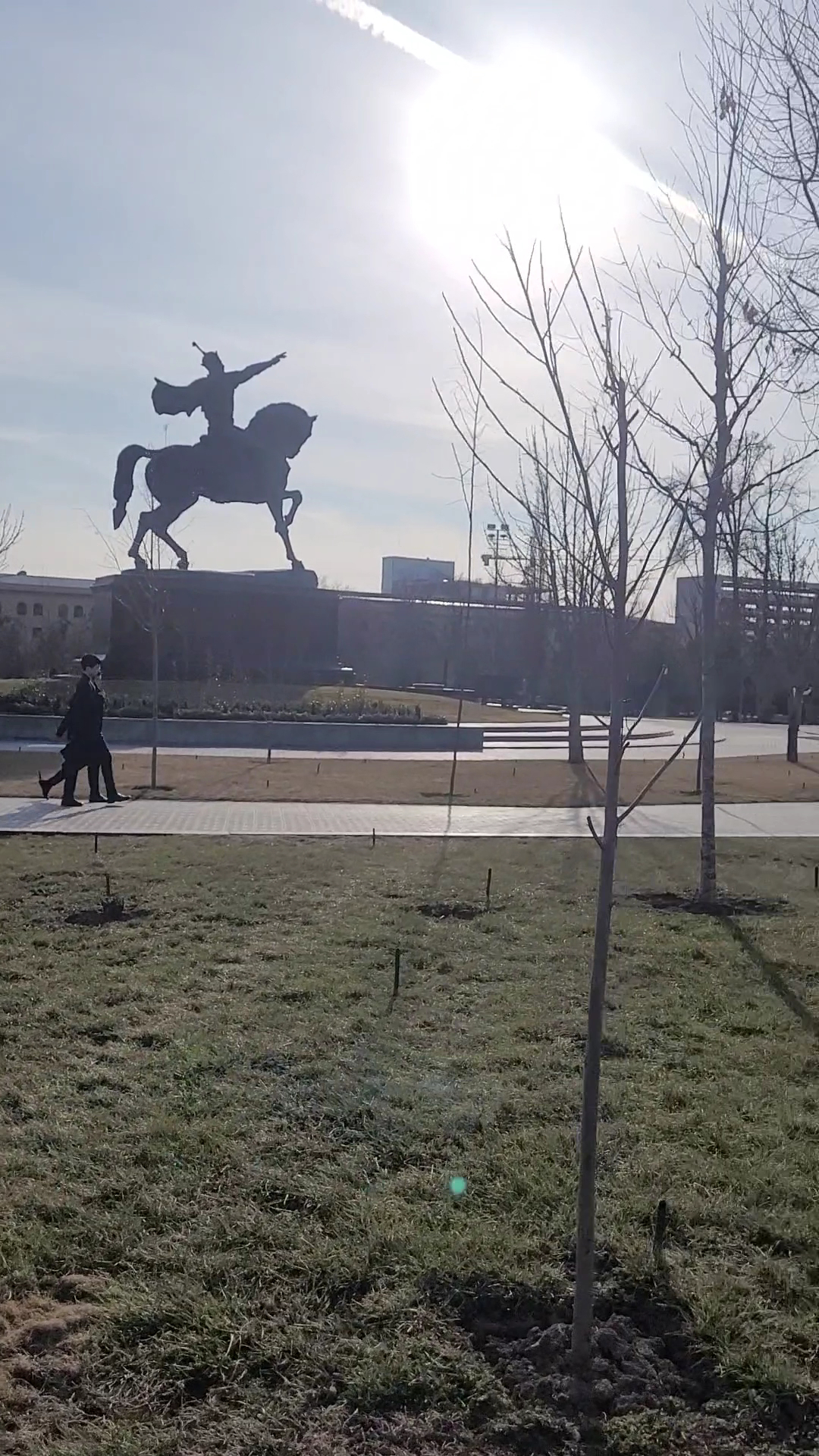
Read moreAmir Temur Square is a significant and visually impressive spot right in the heart of Tashkent. The centerpiece, a grand statue of Amir Temur (Tamerlane), stands proudly surrounded by well-kept gardens and fountains. It’s clear that this square holds an important place in Uzbekistan’s history and national pride.
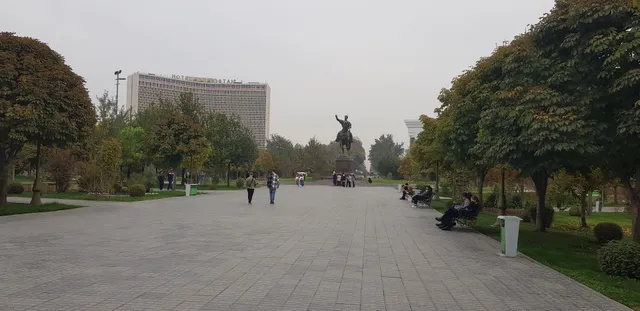
The area around the square is spacious and pleasant for a walk or a short rest, with benches and greenery that invite locals and visitors alike to pause and enjoy the surroundings. The landscaping is neat, and the fountains add a refreshing touch, especially on warm days. It’s a nice place to soak up the local atmosphere and watch the city life unfold.
What I appreciated most was how the square blends historical significance with everyday urban life. It’s not just a tourist spot — you see families, couples, and friends gathering here, which gives it a welcoming, lived-in feel. The statue itself is beautifully detailed, and the nearby buildings complement the space nicely.
On the other hand, for visitors looking for more activities or a vibrant entertainment scene, the square can feel a bit quiet and reserved. There aren’t many cafes or shops immediately adjacent, so it works best as a peaceful place for reflection or a brief stop during a city tour.
Overall, Amir Temur Square is a worthy visit for anyone interested in Uzbek history and culture. It provides a calm and respectful setting to appreciate the legacy of one of Central Asia’s greatest figures. I would recommend stopping by for a leisurely stroll or to take photos, especially if you’re exploring the center...
Read more