Liberté, égalité, fraternité - French for "liberty, equality, fraternity." “We are a continent of refugees, and if you say we can’t integrate refugees, that’s not consistent with our values, even if borders cannot be wide open,” says the new French president Mr Macron in 2017.
"While the French people have been in advance of all other nations in the conquest of their rights, or rather of their political guarantees, they have nonetheless remained the most governed, regimented, administered, imposed upon, shackled, and exploited of all..." says Frédéric Bastiat (1801-1850) a leading French economist and politician. Written more than a 100 years ago, liittle has changed in that regard with the French economy.
France is a statist-run socialist economy that is massively overtaxed and overregulated. France's public government sector, for instance, accounts for more than 50 percent of GDP. With public expenditures at 56.5% of GDP in 2016, France has remained the country with the highest levels of government expenditures between 2007 and 2016. Higher than any other European nation. The.French socialist-statist political system has been in power for decades and the state has substantial centralized control.
The American economist Milton Friedman summed it up best. He declared that the French economy was a mystery to him: “The French government gets everything wrong, and still the country is working.”
The French economist Frédéric Bastiat would be the equivalent of the British economist Adam Smith, whom Britain reveres and which capitalism is founded one. While the French revere Voltaire as the French thinker of Enlightenment, they have totally ignored Bastiat's views on the economy.
Joseph Schumpeter described Bastiat nearly a century after his death as “the most brilliant economic journalist who ever lived.” The economist Joseph Schumpeter was perhaps the most powerful thinker ever on innovation, entrepreneurship, and capitalism and coined the term "creative destruction."
As an example of "creative destruction", one of the main items that has constantly changed over time is the American S&P500 index. About 50 percent of the S&P 500 index will be replaced over the next 10 years. It is an index of the 500 largest American companies with market capitalizations of at least $6 billion. It is seen as a leading indicator of U.S. equities and a reflection of the performance of the economy. Contrast America with France. The CAC 40 (Cotation Assistée en Continu) Index is a French stock market index that tracks the 40 largest French stocks. The CAC 40 is also market-capitalization weighted. It is an economic barometer of the French economy.
Mergers aside, the youngest firm in the CAC 40, was founded in 1967.
Bastiat wrote a series of articles for Journal des economistes, attacking the fallacies of protectionism. Bastiat viewed everything from the standpoint of consumers. One thing is for certain -- with rare exceptions, government involvement with an industry will not be positive for the companies that are impacted. Bastiat said that protectionism hurts consumers and retards the very enterprise the government...
Read moreStanding tall and proud in New York Harbor, the Statue of Liberty has become an enduring symbol of liberty, freedom, and opportunity. A gift from the people of France to the United States, this majestic statue has come to represent the American ideals of democracy and hope. As I beheld the magnificent Statue of Liberty up close, I was awestruck by its grandeur and the powerful message it conveys to all who gaze upon it.
Review: The Statue of Liberty is a true testament to human creativity and the enduring spirit of freedom. As I approached Liberty Island, the statue's commanding presence drew me in. The colossal figure, standing at an impressive height, exudes strength and determination. The copper patina, which has weathered over time, adds a touch of timeless beauty to the statue, further enhancing its allure.
Ascending the pedestal and reaching the observation deck was an exhilarating experience. From that vantage point, I was rewarded with breathtaking views of the New York City skyline and the vast expanse of the harbor. The panoramic vista served as a reminder of the limitless possibilities that await those who strive for a better future.
The Statue of Liberty is not just a visual spectacle; it carries a profound historical and cultural significance. Exploring the museum located within the pedestal provided me with a deeper understanding of the statue's origin and the shared values it represents. Learning about the collaboration between France and the United States in bringing this iconic monument to life further deepened my appreciation for the international spirit of camaraderie and freedom.
One cannot help but feel a surge of emotion when standing before the Statue of Liberty. Its torch held high, symbolizing enlightenment, and its crown adorned with seven rays, representing the seven continents, evoke a sense of unity and hope. It serves as a beacon, guiding those in search of a better life and reminding us of the universal human desire for freedom and equality.
The Statue of Liberty's significance extends beyond its physical presence. It has served as a backdrop for countless historic events and has become an integral part of popular culture, appearing in movies, books, and artwork. Its image has become synonymous with the American Dream, inspiring generations to pursue their aspirations and embrace the ideals of liberty and justice.
the Statue of Liberty stands as an enduring testament to the indomitable spirit of freedom and hope. It is a symbol that transcends borders, representing the universal yearning for liberty and the pursuit of a brighter future. A visit to this iconic monument is not only an opportunity to marvel at its architectural splendor but also a chance to connect with the ideals that lie at the core of human aspirations. The Statue of Liberty serves as a reminder that, despite our differences, we are united by our shared desire for a world where freedom and...
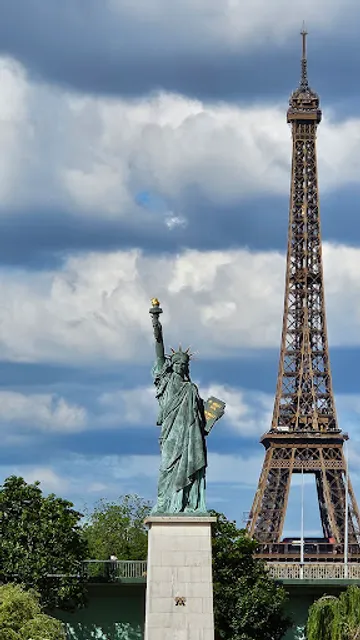
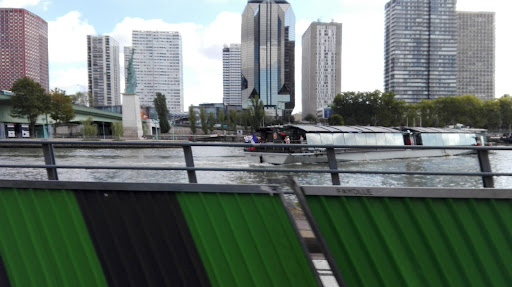
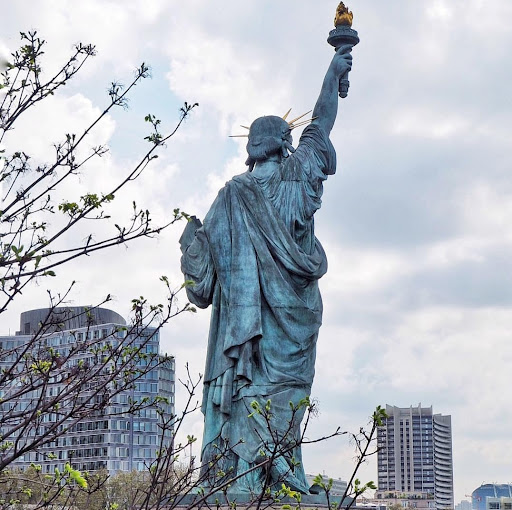
Read moreFrance gave the U.S. the Statue of Liberty in 1886; Americans gave Paris a smaller version of the same statue in 1889. There are many magnificent sites one can expect to see from the top of the Eiffel Tower: the Arc de Triomphe; Notre-Dame Cathedral; the Louvre. Something one might not expect to see is a replica of the Statue of Liberty. And yet, just to the south, smack dab in the middle of the river Seine, by golly there it is.
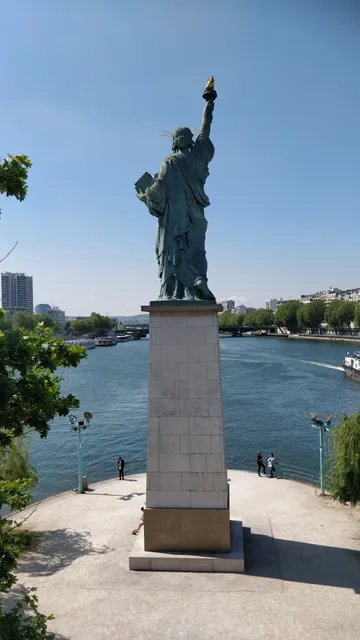
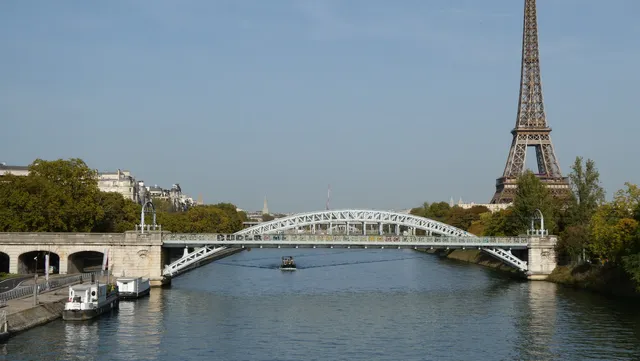
The quarter-scale replica sits on the southern end of Île aux Cygnes, an artificial island built in the Seine in 1827 to separate river traffic from the busy port of Grenelle. Over time, a tree-lined walkway was built that runs the full 850-meter length of the island, and three bridges were built across the island to connect the 15th and 16th arrondissements. Île aux Cygnes is the third-largest island in Paris. The statue itself was given to the city of Paris in 1889 by the American community in Paris to commemorate the centennial of the French Revolution. In characteristic American fashion, the statue was officially inaugurated on the Fourth of July (a date not at all associated with the French Revolution) rather than Bastille Day (a mere ten days later, and often described to the uninitiated as the “French Fourth of July”). To be fair, the inauguration was presided over by French President Marie François Sadi Carnot, who probably had other things to do on Bastille Day (also, the statue’s tablet bears the date July 14, 1789, as well as July 4, 1776). The gift was given to highlight the historically close bond between France and the United States, and reaffirm the dedication of the two nations to the republican ideal on which they were founded. This Pont de Grenelle Statue of Liberty was installed some three years after the New York Statue of Liberty, and in fact was originally one of the working models made whilst preparing to construct the “real thing.” The statue can be accessed via either the Pont de Grenelle or the Pont de Bir-Hakeim, both of which cross the Île aux Cygnes. While this is not the only Statue of Liberty replica in Paris—both the Musée d’Orsay and the Musée des Arts et Métiers house their own—this is the only Statue of Liberty replica in Paris that was featured in National Treasure: Book of Secrets. That alone is worth the cost...
Read more