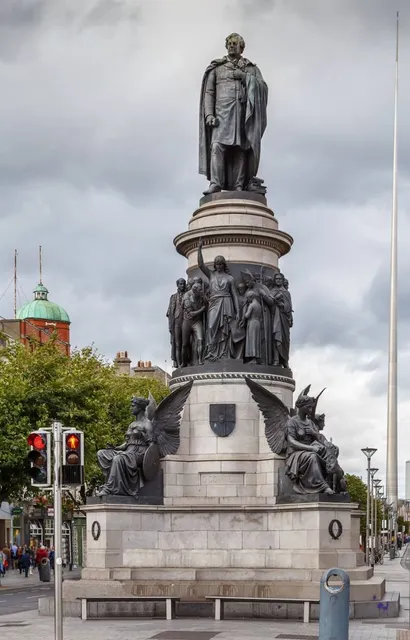
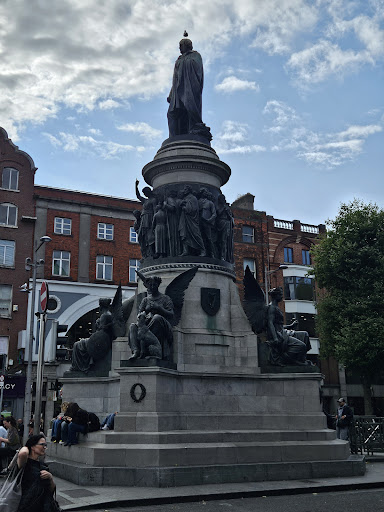
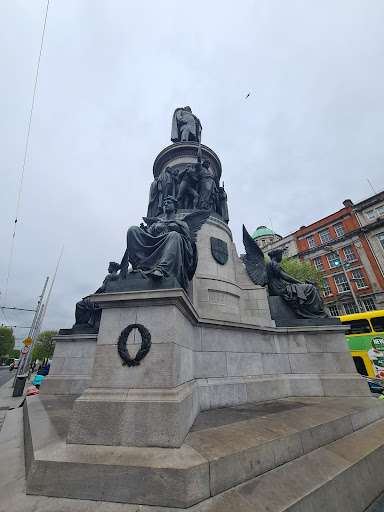
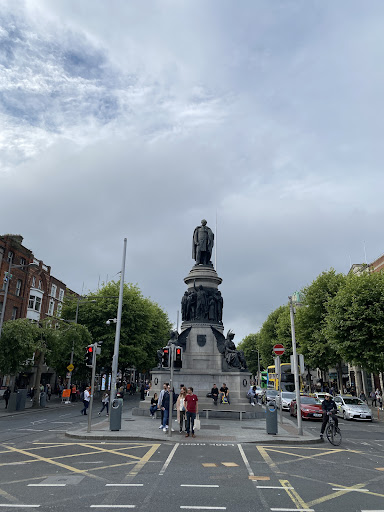
The O'Connell Monument is one of the most prominent landmark in Dublin City. Almost everyone who visits Dublin will definitely see this monument since it is located at the very heart of the city. Located in Dublin's O'Connell Street, it stands as a powerful tribute to Daniel O'Connell, often hailed as "The Liberator." Its history is deeply intertwined with Ireland's struggle for Catholic Emancipation and national identity. The idea for a national monument to O'Connell emerged shortly after his death in 1847, with a public subscription fund initiated in 1862. The O'Connell Monument Committee was formed, and in 1864, the foundation stone was laid in what was then Sackville Street. The design competition was won by the renowned Irish sculptor John Henry Foley, who also created the Albert Memorial in London. Foley dedicated a significant portion of his life to the monument, but sadly, he passed away in 1874 before its completion. His pupil, Thomas Brock, took over the monumental task, bringing Foley's vision to fruition. The monument was finally unveiled on August 15, 1882, coinciding with the centenary of the Volunteer Movement and a major exhibition in Dublin. This occasion also saw Carlisle Bridge officially renamed O'Connell Bridge, solidifying the monument's central role in the city's main thoroughfare. The monument itself is a complex and symbolic work of art. At its apex stands a towering bronze statue of Daniel O'Connell, dramatically draped in his cloak and pointing towards the former Parliament buildings, a gesture symbolizing his challenge to the Act of Union. Below him, a female figure representing "Erin" (Ireland) holds the Act of Catholic Emancipation, with broken shackles at her feet, signifying the freedom O'Connell achieved for Catholics. Surrounding the plinth is a frieze of figures depicting various segments of Irish society, including the Catholic Church, professions, arts, trades, and ordinary people, all united in their support for O'Connell. At the base, four winged Victories, completed by Brock, embody the virtues for which O'Connell was celebrated: Patriotism, Fidelity, Eloquence, and Courage. Notably, the "Courage" figure bears bullet holes, a poignant reminder of the 1916 Easter Rising, during which O'Connell Street was a focal point of conflict. In 1969, this same figure was damaged by an explosion but was later successfully restored and reinstalled. Over the years, the monument's base has been reduced twice to accommodate traffic and pedestrian flow, reflecting the evolving urban landscape of Dublin. Despite these alterations and the scars of history, the O'Connell Monument remains a powerful symbol of Irish nationalism, a testament to Daniel O'Connell's enduring legacy, and a focal point for both historical reflection and modern civic...
Read moreThe O'Connell Monument, a towering tribute to Daniel O'Connell, is not just a statue; it's a powerful symbol of Ireland's struggle for independence and the enduring legacy of one of its most influential leaders. Daniel O'Connell, known as "The Liberator," was a driving force behind the movement for Catholic emancipation and the repeal of discriminatory laws against Catholics in Ireland.
Designed by the esteemed sculptor John Henry Foley, the monument stands as a majestic landmark at the southern end of O'Connell Street, Dublin's principal thoroughfare. It was unveiled in 1882, years after O'Connell's death in 1847, as a fitting tribute to his tireless efforts to advance the cause of Irish freedom and equality.
The monument itself is a masterpiece of Victorian-era sculpture and architecture. At its pinnacle stands a commanding statue of Daniel O'Connell, depicted in a dignified pose, his outstretched hand gesturing toward the future. Surrounding him are four allegorical figures representing the virtues that defined his life and legacy: Patriotism, Fidelity, Courage, and Eloquence. These figures, crafted in bronze, serve as eternal guardians of O'Connell's vision and ideals.
The monument's Corinthian column, rising over 50 feet into the Dublin skyline, is adorned with intricate carvings and ornamental details, a testament to Foley's artistic skill and craftsmanship. At its base, four bronze winged victories hold laurel wreaths, symbolizing the triumph of justice and the enduring spirit of the Irish people.
Over the years, the O'Connell Monument has become more than just a statue; it's a place of pilgrimage, remembrance, and reflection for countless visitors from around the world. It stands as a reminder of the sacrifices made by those who fought for Irish independence and a beacon of hope for future generations.
As Dublin's most iconic landmark, the O'Connell Monument continues to inspire and unite the people of Ireland, reminding them of their shared history and the enduring values of freedom, justice, and equality for all. It remains a testament to Daniel O'Connell's indomitable spirit and his unwavering commitment to the cause of...
Read morePride of place on O'Connell Street where the O'Connell Bridge crosses the Liffey, this statue honors Daniel O’Connell (1775-1847).
Daniel O'Connell, born on August 6, 1775, near Cahirciveen, County Kerry, Ireland, was a prominent Irish nationalist leader and lawyer. Known as "The Liberator," O'Connell played a crucial role in the fight for Catholic emancipation in the early 19th century. After studying law in London, he was called to the Irish bar in 1798. O'Connell's legal acumen and oratory skills made him a formidable advocate for Irish rights. He founded the Catholic Association in 1823, which mobilized mass support for the cause of Catholic emancipation. His efforts culminated in the passage of the Catholic Emancipation Act in 1829, allowing Catholics to sit in the British Parliament¹².
O'Connell's political career continued as he served as a Member of Parliament for various constituencies, including County Clare and Dublin City. He was also elected Lord Mayor of Dublin in 1841. Despite his successes, O'Connell faced challenges, including criticism for his political compromises and the growing agrarian crisis in Ireland. His later years were marked by the Great Famine, which further strained his health and political influence. Daniel O'Connell passed away on May 15, 1847, in Genoa, Kingdom of Sardinia (now Italy), leaving behind a legacy as a champion of Irish rights and a pioneer of non-violent political activism.
This 40 foot tall bronze and granite monument is topped by a statue of O'Connell at 2.5 times size, looking southwards. It was unveiled in 1882. After the creation of the Irish Free State in 1922, Sackville Street, Dublin's principal thoroughfare, was renamed in his honor in 1924. The statue is one of the first in Dublin that did not commemorate the Castle administration or the...
Read more